Over at Quiet Riot Girl's blog, a bunch of girls (by which I do not mean to indicate that we're secretly all gay men) have been discussing the persona of the female intellectual. Is the Butch Dyke/Macho Hag the only persona such women can assume?
One of the most fascinating documents I came across early in my YouTube use was this screen test for The Blue Angel. Aesthetic feminist that I am (or feminist aesthete, with the aestheticism leading the feminism), I immediately sent it off in triumph (in a link in an e-mail) to my friend George Toles, the film professor/critic. It was a big fat "take that" moment in which I offered it as proof that Sternberg did not "create" Dietrich, as the S/D Svengali myth goes. On the contrary, it shows what Dietrich had to offer to interest Sternberg. (George was not persuaded, but that's his loss. I suppose he's used to "feminist triumphalist" moments in Mulvey-dominated film theory and has to find a way to fight back.)
In any case, what I adore about this clip is the way that Dietrich employs instant schizoid shifts between satirical saccharine sweetness (crooning the dumb ditty "You're the cream in my coffee" in English while fluttering her eyelashes crazily), castrating harridan (when the piano player can't perform to her satisfaction), and the gentle, embarrassed woman briefly glimpsed at the end, who seems to be apologizing to the pianist for going as far as she did in the performance (including a bit of physical abuse). Which is the "real" Dietrich? Bisexual, real-life cross-dressing Dietrich (with Hepburn, she blazed the way for American women to wear trousers, or so the myth goes anyway), pal of Hemingway, was a swaggering Macho Dyke who never lost her sexual glamour. Certainly, however, it was the "power" she displays in this performance that must have set her apart from other actresses for (famous cinematic masochist) Sternberg (besides the cheekbones): her willingness to access such fierceness that no one but a masochist could find it a turn-on.
Speaking of schizoid, once as a teenager I had to give a spectacular performance for my drama class because I'd skipped almost all the classes and ignored the assignments and needed to get all of my marks at once. So I came up with a long performance where I played three women, one piece seguing into the next. (Had to memorize it in, I think, two days.)
One was Bette Davis launching ferociously into Leslie Howard in Of Human Bondage (her speech when she finds out he doesn't desire her anymore). I did what I hoped was a pitch-perfect imitation of her hysterical screech at the end, which had made such an impression on me: "Because you're such a mugamugaMUG!"
One was (Vivien Leigh's) Blanche DuBois in Streetcar, describing falling in love at sixteen, and the disastrous consequences. (She finds out the Antinous she rather homoerotically loved is gay, and her disgusted reaction drives him to suicide.)
One was Zuleika Dobson. As a twist, I chose the speech where Zuleika subjugates herself to her fantasized image of the only Oxford undergraduate who is not madly in love with her. Narcissus kneeling!
My idea, you see, was to capture all of the inflections of female power and female abjection. With abjection being the more interesting risk.
Wednesday, July 13, 2011

Sunday, July 10, 2011
Towards (Against?) a Lesbiography
Recently, while browsing the literary essays and criticism section of a bookstore, I was thrown for a loop by the subtitle of a new book, This is Not the End of the Book, which consists of a conversation between Umberto Eco and Jean-Claude Carriere on digital and book culture. I'm not sure that it actually is the subtitle, rather than just a graphic embellishment on the cover that the publisher thought would enhance its prestige-marketing, but in any case, it reads: “Two Great Men Discuss Our Digital Future.”
I mean, seriously? In 2011, we're casually throwing around the term “great men,” like everybody knows what that means (and wants a piece of it)? Who better to discuss a matter of such serious cultural weight than Great Men? Who else is going to tell us anything worth listening to on the subject, in “this twittering world,” as another indubitable Great Man, T. S. Eliot, presciently put it in the 1940s?
I blame Harold Bloom. Back in 1999, the popularity of Shakespeare: The Invention of the Human proved that, despite the combined efforts of academic feminists and deconstructionists, there was a huge cultural hunger, at the populist level, for the concept of the Great Man, as some kind of figure of millennial reassurance. That book was a lot of fun, I'm not going to lie, but Bloom's Wildean hyperbole also felt finally oppressive (as Wildean tongue-in-cheek exaggeration-for-provocation never is, but no one ever accused Bloom of having a light touch), and nearly made me nauseated with the Bard (I had to remind myself I was only nauseated with Bloom). He might as well have called the book Saint Shakespeare... except that the titular suggestion that Shakespeare is, well, GOD (or better than God, who only invented human vessels, while Shakespeare invented our subjectivity: he's not God, he's SHAKESPEARE) left mere canonization in the dust. It didn't even seem to help that I knew where Bloom was coming from, and what he was trying to achieve: that he was using Shakespeare as a synecdoche for the power of literature itself, in reaction against attacks on that power, and on the concept of subjectivity, from “literary theory.” Well, except that Bloom himself often seemed to lose sight of this aim and take his own Bardolatry literally. And certainly, the average reader who bought the book to be educated about Shakespeare was taking it literally.
Quiet Riot Girl, with whom I've been forming a relationship on Twitter and here on my blog that inspires me to nominate us, in our quiet moments (except that there haven't been any quiet moments), as the Doherty and Barat of Internet Discourse (can't get away from those Great Men of History...), recently directed me to David Halperin's Saint Foucault: Towards a Gay Hagiography, in explanation of her concept of “Fagiography” and its critique in her recently free-download-published debut novel, Foucault's Daughter. (Or I assume FD is critiquing it; but you`ll have to wait for the review, when I've finished reading.) I haven't read Saint Foucault, but I gather that it marks the moment when, after Judy Garland's death kicked off the gay rights movement by inspiring Stonewall, gay male culture lost its historical allegiance to Mom (celebrated in the form of opera divas, Golden Age Hollywood actresses, and other female performers of gargantuan personality and presence) and started chasing after the ghost of Dad instead. In doing so, however, rather than pioneering it may have simply joined in the chorus celebrating/mourning those Great Men of History, which has, after all, been a homoerotic theme since Milton's “Lycidas.” In an effort to prove that gay men were exactly like straight men, flamboyance and fabulousness had to be shoved in the closet (or, worse, relegated to reality TV shows); machismo was the order of the day. Even if this machismo was limply, hilariously, intellectual. (Or is that the worst kind?)
In the Room the Women Come and Go...
And where does this leave women? In 2011, when most of the feminist battles have been won, where are our Great Women, and what are they talking about, in ways that, apparently, cannot reassure us? And where is our Lesbiography? I never wrote or published my Saint Foucault (or Saint Morrissey), but I did spend the summer I was seventeen continually writing a 50-or-so-page fan letter to Camille Paglia that, luckily for her and me, I could never complete to my satisfaction, because, well, it was my autobiography: Sexual Personae caused me to rethink the entire history of my personal development (through the prism – or prison – of gender identity and sexuality). (I've often thought that if I had completed and sent that letter I might have ended up as Paglia's partner – instead of the mostly-straight, usually single woman I am now – and she would have eventually ditched me and our baby to join the entourage of a Brazilian pop star, as dotty as Dietrich shedding her heels to trek through the desert after Gary Cooper's legionnaire at the end of Morocco).
Speaking of women and deserts, I return to my theme of the strange lack of comment in the generally ecstatic reviews of Bolano's The Savage Detectives on its feminism, which you'd think would be a theme to inspire the liberal intelligentsia. TSD is a boy's-club novel to end all boy's-club novels, focused on the homosocial, Doherty-and-Barat relationship between the two founders of an obscure, outsider, failed poetry movement, based on Bolano and his best friend. And yet these overgrown boys go chasing after an even more obscure, self-erasing female poet who's disappeared into the desert, in what to all intents and purposes is a sort of pilgrimage. Why? What's up with this? Is it a comment on the historical erasure of women, women's art, women's contributions to culture, women's voices? Why does the erased woman stand for poetry, or the possibility (or the impossibility) of poetry? She's not the Muse: she's the Master. Not a saint, though: a prophet, of the fantastic misogyny exhaustively recorded (and participated in?) in 2666. Of all the crimes Bolano could choose to represent the decadence of the West in the early 21st century, and the negative legacy of the 20th century, he chooses misogyny.
I Just Stand Around and Shoot Into the Blue
Female intellectuals talking to, or about, female intellectuals, remains a rare thing. If women (even Great Women) get together and talk, we expect they're going to talk about women. Or men. Certainly not make pronouncements on topics of general cultural interest and importance. And certainly not deify each other. (Paglia never wrote that book on Madonna, either. Although I think we can all be grateful for that. I just hope she never writes the one on Saint Palin.) So that in the annuls of female intellectuals (not feminists) writing about women (pre-Paglia, whose chapter on Emily Dickinson remains extraordinary), Elizabeth Hardwick's essay on Hedda Gabler (the character) stands out for me, even though, as a female intellectual, Hardwick takes offence at Hedda's (at Hedda's; she treats her like a real person, a historical Great Woman, not Ibsen's creation) narrow pettiness (rather than, as I did in my Hedda essay, taking glee in it as the most outrageously, unapologetically, unsentimentally amoral female character in the annuls of literature). (“I'm burning your child, Ejlert Lovborg. Yours and Thea Elvsted's child.” How I've longed to say those lines in performance; right up there with “I have more offences at my beck than I have thoughts to put them in / Imagination to give them shape / Or time to act them in.”)
(I had a real epiphany about that play when I learned, in some book on Ibsen, that in early drafts Hedda, rather than being a creature of motiveless malignity, was given the sympathetic motivation of genuinely trying to help her husband by destroying Lovborg. By the time of the final draft – and this is the originality of Hedda Gabler, Hedda Gabler, and Ibsen – the very concept of that is a joke that sends Hedda into fits of mordant hilarity. Ibsen was the most murderous feminist of them all.)
(Incidentally, I find this excellent, brief review of Antony and Cleopatra by a female blogger very Hardwickian. The Hardwicks of today, they're blogging, aren't they?)
Oh, there's been plenty of feminist hagiography, don't get me wrong. With a few chosen saints, of which Sylvia Plath (forever fixed in the cultural consciousness crushed under the boot of her deified/demonized Nazi Daddy) is so prominent that I found myself grateful for the sacrilege of James Maker's line “A sonnet from a sociopath / I annihilated Sylvia Plath” from “Born That Way.” (Or maybe I just got the mordant giggle-fits at the idea of rhyming “sociopath” with “Sylvia Plath.”)
The thing is, if I did write that book on Paglia, it would hardly be appropriately titled Saint Paglia. If there is to be a Lesbiography, I would want it to take a perspective that's not idolatrous, but iconoclastic. We don't need to celebrate any more Great Men, or sentimentalize our feminist martyrs. We need not new heroes (or heroines), but a new perspective.
If I call myself “gynocentric” (at which Quiet Riot Girl recently – rightly – took umbrage) it's in relation to a cultural context where it's still expected that the intellectual-oriented woman will also be male-oriented. And don't get me wrong, I like the intelligent conversation of men and always have. I don't exclude anyone from intellectual discourse based on gender. But I'm no more likely to want to talk ideas with a man than with a woman (or vice versa). Despite this, I have not escaped the sense of being "honoured" by having male intellectuals bestow their interest upon me, as though my credibility in my own eyes somehow depended upon it, or was enhanced by it.
Remembering that high school English teacher (rumoured to be gay, although I hardly knew what that was despite Reading All About it in Orton's published diaries) with whom I had antagonistic chemistry because he would not take me seriously (to be fair, I was demanding acknowledgement that I was a genius; then I proved that I might be, but he still wanted me to prove that I could impress him in the context of a high school English assignment, which I did once), who gave me Shaw's Pygmalion to read, which I fancifully half- interpreted as a comment on our relationship, and I thought, "No, you will not be my Henry Higgins. Even though, or because, that is exactly what I want." I was not falling into that paradigm. I would go it alone, lonely, without the male mentor. I would go it alone, lonely, without the artist boyfriend, seeking a Muse.
I certainly went it alone.
That incident made its way, in a way, into Live With It. (The Pygmalion fantasy, accepted, and turned into nightmare.)
This in preface to a post on a few of my favourite, mysterious female artists.
Friday, July 8, 2011
The Gaze in the New Metrosexual Order, and Some Aggressive Notes on "Passivity"
As anyone with a cursory knowledge of Film Studies, knows, the theories of Laura Mulvey have been pervasive in that field since her essay “Visual Pleasure and Narrative Cinema” appeared in 1975. There is almost nowhere you can go, if you want to read academic film criticism, without encountering Mulvey's gaze. Mulvey's “gaze theory” can be (and usually is) summarized by saying that classical Hollywood cinema placed the spectator in the subject position of the male protagonist, while female characters were (this is what Wikipedia says; it's been a while since I read Mulvey's essay) “coded with 'to-be-looked-at-ness.'” (Um, you really couldn't think of a better way to say that? Okay, moving on.)
Now, off the top of my head, I can think of about a thousand exceptions to this. Actually I can think of a whole genre it ignores: the woman's film. Screwball comedy, too, can hardly be said to require viewer identification with the male lead, and, in the case of some screwball comedies, such as Preston Sturges's The Lady Eve, said identification would be rather painful, and certainly would not place the identifier in the “powerful” role. In his essay challenging Mulvey's gaze, “Mother Calls the Shots: Hitchcock's Female Gaze” (you can find it in the House Made of Light collection), George Toles makes a similar point about Norman Bates in Psycho, who may, like the camera, spend a lot of time gazing at Marion in states of undress, but with whom identification is hardly comfortable for the male viewer, and who is ultimately himself subject to the monitoring, censoring gaze of Mother.
Is this man, shown here blurring into his dead mother, really the poster boy for the “powerful” “male gaze”?

But Mulvey's influence on feminism and media analysis has extended beyond her original theory, and in popular use now generally alludes to the inescapable fact that visual media, from movies to ads, are overwhelmingly created by men and assume a male viewer: they are designed by and for “the male gaze.” As she often does, Camille Paglia largely accepted this tenet of feminist theory but gave it a neutral spin. For Paglia, men have created more art because they are in possession of this harsh, demanding “male gaze,” which is also the aestheticizing (or “Apollonian”) gaze, which Paglia finds in its purest form in gay male culture. But this line of thinking is also where she departs from standard feminist theory: because she notes that the peak of Western visual art, the Italian Renaissance, homoerotically worshipped the male form. This it took from its classical Greek influence, but after the Renaissance, the male nude is suppressed in Western art. While accepting the idea that women usually are the subjects (can I say that, or does it always have to be “objects”?) of the male gaze in art, pornography, and advertising, Paglia challenged the idea that to be the object of the gaze is to be “passive,” by using the example of gay male pornography: do we really believe that the subjects of gay porn are “passive” “victims of the gaze”? Instead, she took the desire to look at women as a tribute to female sexual glamour, and argued that women like looking at women, too, for instance in their consumption of fashion magazines (meaning straight women, although her lesbian perspective probably pointed her to that insight), which, in her view, was not simply a sign of their enslavement to male ideals of beauty. (Anyway – again – in the fashion industry those have traditionally largely been gay male ideals of female beauty.)
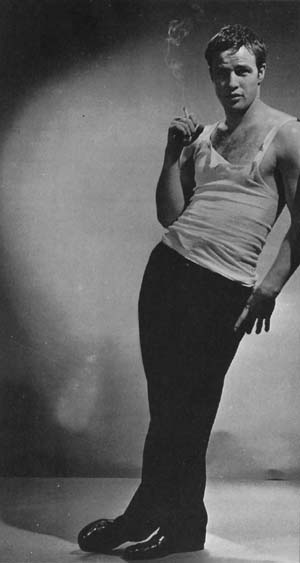
Why hello Marlon Brando, the original metrosexual! I once showed this photo to Mark Simpson and commented that you can't tell whether he's just committed rape or been raped. He seems to have enjoyed it, in any case. You want to tell me if this sex object is “passive” or “active”? Gore Vidal, in his essay on his friendship with Williams, suggests that Brando's Kowalski was the first time that women were put in the cultural position of being allowed to exhibit their lust for men as sex objects – which, of course, they were permitted to do thanks to Williams's expression of his gay male lust. And so the gay male gaze paved the way for the female gaze.
Objectification and Identification in Narrative Art
It's not gaze theory that I want to directly challenge here, though, but rather the notion of “objectification.” As a female writer who has written male characters as often as she's written female characters, it's occurred to me to wonder: can you actually separate objectification from identification in the process of writing? In that same essay Vidal recounts Williams's claim that he couldn't write a short story (I'm sure it applied to plays as well) unless he was sexually attracted to at least one of the characters. I know what he meant, and though I've written plays where this was not, or less, the case, it was a lot tougher to get motivated. For some writers, at least (maybe those in the decadent mode, as per Paglia's theory of decadence), the line between fantasy and art is fine indeed. And maybe that's never more true of the female writer than at the acute point of (uninitiated) adolescent libido. Anyway, I've often thought that the psychology behind my award-winning play Live With It, about 60s gay playwright Joe Orton, was comparable to the Bronte sisters' in their Byron fanfic. In fact I was so aware of it that I had to make a conscious effort to “make” that play art by forcing myself to be less attracted to my male protagonist (who, in an additional psychological twist, was just a narcissistic fantasy of my insufferably female teenage self as a gay male “bad boy” anyway).
But if for some male and some female writers, sex plays an important role in literary composition (and one can obviously include filmmakers too), the question is whether this results in something called “objectification.” Because my identification with Orton was murderously (so to speak) intense; though no more intense (and actually perhaps less) than my identification with the Halliwell character, to whom I was not attracted.
But the greater portion of my evidence comes from my experience as a reader and viewer, that is, as a critical theorist (since I cannot perform these roles without analysis, whether simultaneous or retrospective). In Love and Death in the America Novel, Leslie Fiedler argued that the puritan strain in British culture led to an obsessive focus on rape in the British novel, most spectacularly in the first great “realist” novel, Samuel Richardson's Clarissa. One result of this puritan tendency to take imperilled virtue as its subject was the temporary phenomenon of male writers creating female protagonists, which culminated in the psychologically sex-crossing Henry James, and has never become popular again. Well, at least until Steig Larrson performed his immensely popular modern spin, with virtue and rape still as much at stake as ever (and still as much of a mask for prurience), as Tim Parks's New York Review of Books article, “The Moralist,” makes clear. The male author in this strain both identifies with and objectifies his heroine, views her as subject and object. The “rape line” reemerges in cinema with Hitchcock and continues with Polanski and Lynch. There's a grim culmination in Rosemary's Baby, in which a director has rarely more closely identified with a heroine (or forced an audience into closer identification), and yet still subjects her to his rape fantasy. (I wonder if I've already mentioned on this blog the irony that Roman Polanski may understand women better than any other film director. And I'm not the only woman I know who thinks this.)
I suppose what I am trying to say is that a heterosexual (or whatever Henry James was) artist's relationship to his or her opposite-sex main character is, or can be, immensely complex, comprising both identification and attraction, and, in result, sadism and masochism; not to mention the psychological implications of sex-crossing identification. And in the reader's response, too, identification and objectification also often co-exist.
I'll give the unlikely example of a couple of songs by the punk band Mindless Self Indulgence, “Shut Me Up” and “Faggot.” In them, the male singer assumes the persona of an apparent masochist, begging for someone of indeterminate gender – it would be equally perverse whether it was a woman or a man – to, well, shut him up, or call him (make him?) a faggot. The assumption of masochism by a hardcore performer gives these songs a real frisson for me, but I couldn't tell you whether it's sadistic or masochistic in nature: if I'm enjoying the abjection of the male persona or identifying with it. (The male listener's choices are even more limited: he can identify and be queer, or enjoy and be queer. The hardcore phenomenon of MSI and its relationship to queerness is something far beyond my understanding! The only “hardcore” I understand is the Pulp album.)
(Actually, come to think of it, the assumption of masochism and invocation of a shadowy abstract figure to perform sadistic acts on one just reminded me of John Donne's Holy Sonnet XIV. Backing away fast.)
From this (very) brief discussion of narrative art, it should be clear that “objectification” is not simply a visual, but a mental act: not just a way of looking at someone, but a way of seeing them.
Objectification in Visual Art and the Metrosexual Subversion
The question becomes different when we move from narrative or narrative-visual to visual art. The feminist concern, as I understand it (in its most reasonable form, that is), is that cinema and mass media, including advertising, inherited the tradition of the female nude in fine art (a permanently discredited meme within fine art since Picasso's Demoisells d'Avignon) and pervaded the culture with sexualized images of women to such a degree that young men were being insidiously “educated” to believe that all women were “objects” with no human agency or subjectivity. In its less reasonable form, this feminist concern becomes the concept of “rape culture,” in which this objectification of women (including pornography as well) creates an environment in which rape is more likely to occur. (Never mind that rape is as old as, well, sex. Or crime. Or may most often happen to minors, in situations having nothing to do with media portrayal of women. Or in situations of social and political upheaval, such as war, along with other terrible crimes against men, women, and children; again, with zero relation to the media.)
Obviously, I'm not too interested in the “rape culture” argument, but I am interested in what gives it whatever emotional credence it has. For many men and women have now become so pervaded with the feminist meme, without even studying feminist theory (and without any necessary feminist interest or allegiance), that it's often now taken for granted that a) to be photographed in a sexualized manner is to be “objectified” and b) that this inevitably makes one passive.
Certainly, this sort of thinking is behind the subversiveness of Mark Simpson's theory of “metrosexuality” and the yummy Sporno evidence he's produced in support of it. I can't remember if Mark has ever said in so many words that men are now more often the objects of the gaze in advertising than women are, but I do believe that that's Quiet Riot Girl's interpretation of metrosexuality. (If I'm wrong she can correct me for the record in the comments!) Yet this consequence of metrosexuality has been met with disbelief, scorn, and defensiveness by the media because, for one reason, of the implications that feminist gaze theory has bequeathed us: with disbelief based on the idea that men can't be objectified because masculinity is inherently “active” (and Mark's concentration on sports is crucial here); with defensiveness based on the idea that being the object of the gaze is to be made passive (and why would men want that?).
In her post on Mark Simpson's analysis of Rafael Nadal's Armani ad, "Why Can't A Woman Be More Like A Man?," Quiet Riot Girl quotes from Mark's dwelling on the flirtiness and tartiness of the delectable image, and wonders why it has more of a “charge” for her than a similar ad run simultaneously by the company, featuring a female model. Well, I would suggest that it's because the image of Nadal subverts our expectations of masculinity by deliberately exhibiting passivity and flirty invitation, which is all the more piquant because he possesses a traditionally masculine, hunky physique, as well as his athletic rep. In much the way Paglia has described the perversity of some of Michelangelo's sculpture that erotically renders hunky males passive, languid, or masochistic. (Sorry, I gave away my most recent copy of Sexual Personae when I was drunk, otherwise I'd give the exact quote here, because it's good. And by good I mean hot.)
The other reason metrosexuality has caused a scandal is that to make yourself the object of the gaze means potentially (or really, at least in the public imagination, inevitably) making yourself the object of the male gaze. For men to be comfortable being the object of the gaze means getting over their homosexual panic, not only "abstractly," by choosing to be "passive," but directly, by desiring the desire of men. Which is what “metrosexuality” is all about. What Mark, if I recall correctly, hasn't emphasized as much is that it also means that other kind of homosexual panic, being comfortable as the (“passive”) object of the female gaze.
...Men Sick of Looking at Naked Women?
Unfortunately for feminist theory (and those of us who've unconsciously imbibed it, for our own female or male self-interested purposes), the active/passive binary just doesn't hold up. Of course women aren't uniformly “passive” or men uniformly “active” (whatever that could possibly mean), and of course every sexy photograph does not make the subject of the photograph “passive” (whatever that could possibly mean). However, these ideas of “activeness” and “passivity,” attached to ideas of “masculinity” and “femininity,” are there to be played with in the sophisticated sexual theatre of image-creation.
I've had the opportunity to occasionally peruse softcore gay male magazine porn (academic/aesthetic interest only, you perverts; it's not what I “use”), and, in my opinion anyway, it's exponentially more effective as a turn-on for my female purposes than any comparable porn I've seen created by straight women for straight women. And if I analyze it, it's because the models in those magazines, despite having rather blandly handsome faces and chiseled bodies that aren't my usual type, are engaged in flagrant displays of “feminine” passivity (sensual offerings of the body, especially buttocks) that are far beyond what I'm used to seeing from my academic perusal of straight male softcore magazine porn. In other words, these men are working hard at being passive. Which I find interesting, because you'd think with the reputation of gay men for being horny, all they'd need – as straight men claim to – is a naked body, no seduction or semiotic foreplay required.
Metrosexuality isn't the whole story of the Noughties. Even if metrosexuality was on the rise in advertising, the “objectification” of women in the media didn't go away, as feminists and conservatives (the same unlikely bedfellows as ever) clamoured about the “pornification” of culture. Since I always like a bit of Great Woman history, I'm going to go ahead and follow Simpson in putting the blame for this squarely on Madonna. In the early 90s, Paglia claimed that her favourite pop star crush had single-handedly “corrected” second-wave feminism by showing that female sexual glamour meant power, not passivity or victimization. With the Paglian insights (of the essay collections Sex, Art, and American Culture and Vamps and Tramps) intertwining with other aspects of media feminism, the result was a generation or so of young women, including young women pop stars, who seemed to think that the road to “empowerment” (that awful catch-all empty Feminism Lite meme) was paved with self-exploitation. If sex was power, and women could dress however they wanted to on feminist principle, ergo, women ought to flaunt whatever they've got (or acquired through surgery); and as long as they were doing it on their own prerogative, or at least for self-interested purposes (like getting fame and money, the bottom-line capitalist justification), they stayed firmly on top even if they were crawling on their knees and licking the dirty floor.
If you think I'm going to draw some awkwardly backtracking feminist-lite sentimental conclusion from this, like how maybe the concept of modesty had its merits, you've obviously never read me or spoken to me before. I prefer Mark's conclusion, in his Out take on the Paglia v. Gaga showdown (Two Great Women determine The Future of Sex!), that pornification via the post-feminist self-objectified female body has simply led to a cultural dead end: “[Gaga]'s post-the now boringly compulsorily 'sexy' world that Madonna helped usher in, bullwhip in hand, which is now as burned-out as that 'Bad Romance' skeleton.” Or in a word (his word), she's “postsexual,” as are we all now.
In confirmation, I recently saw a YouTube video (one of my favourite sources of sociological hard evidence) of Janelle Monae's Letterman performance of “Tightrope” in which a presumably male commenter celebrated the novelty of a female pop singer with “clothes and talent.” (Here's the vid, but I can't find the comment now. If you want proof, or proof that I'm on crack, you can look through them all if you want!) And it's true that it seems like the choices for the female in pop, thanks, ultimately, to Madonna, are now between Gaga's postsexual exposed labia and Monae's buttoned-up androgyny.
Morrissey's on board with my Great Woman History here too (and with great minds like Paglia, Simpson, Morrissey, and me on the case, how can one go astray?). I recall reading an interview in which he commented at the time that Madonna had erased the already historically academic line between pop music and prostitution. Of course, he was one to talk.
The Western tradition of homoerotic iconography reaches new heights of subtle suggestiveness in pop music's most sustained coy tease.


Who's Calling the Shots? (Fun with Guns)
As I suggested above, passivity and activity in relation to masculinity and femininity are not fixed, essential qualities, but roles to be played, and played with (whether you want to come at that from a Butlerian or Paglian perspective). Nor is the “sex object” of a photographic image fixedly passive, or, in Paglia's reversal of the binary, active or “powerful” either. Any image that aspires to be iconic, at least, is a collision site of both previous iconic images and our inherited cultural understanding of what and how images mean. And this is true whether the primary auteur of the image is the photographer or the photographic subject, in a given case (or it may be a collaboration).
In order to talk about objectification and passivity in sexual imagery meaningfully, we have to carefully, and without an agenda, examine individual images. Academic feminism is tops at careful examination but tends to fall down on the “lack of agenda” front.
It might also help to know the background of how the image was created. So I'll tell a little story. When I was an 18-year-old playwriting prodigy facing the opportunity of my first front page Arts section newspaper photograph, I wanted to make an impact. (And it's a good thing I made the most of it, because it would also be my last such photograph.) This is because I held in my mind a gallery of iconic writer photographs that had determined what it meant to be “a writer” for me, from Oscar Wilde's scandalous long-haired dandy series, to Colette's sensational Claudine “schoolgirl” series, to Capote's seductive pixie-boy dust-jacket photo for his debut novel, to Orton's Christine Keeler take-off. In other words, I thought it was my pleasurable duty to make people upset, with sex the easiest way to accomplish this. But as pop tarts from Britney to Ke$ha have demonstrated with their bland “compulsory” sexiness, it's not quite as easy as it looks. It does require a bit of thought.


When the adult male photographer and assistant showed up for the shoot on the set of the small indie theatre where Live With It was first performed, my greeting to them was, “You can do whatever you want with me.” (Passivity? Not always so passive.) In fact, however, I was the one who suggested that we use a pair of handcuffs, a prop from the play (not S&M at all, perverts; those were mofo existential handcuffs), which I put on and posed curled up on a bed, another prop (the scene of Orton's gory murder). I can't remember who suggested the bed, but I would have been game due to the reclining Capote precedent.
See, I wanted a sexy image of myself because, who doesn't, but I also wanted a sensational image, and since this was the early 90s, and we'd already been through Madonna, there already wasn't much left to do with a sexy image of a woman that would be sensational. I had read Paglia by the time of this photo, and I took her point that Madonna had demonstrated that for a woman to be sexy was to be powerful. So what was the only taboo left surrounding representations of women in the still-p.c. early 90s feminist environment? (You cannot imagine now the media flack that Paglia got. Maybe Quiet Riot Girl can. And yet fellow liberals still tell me that the conservative perspective is dominant in the media.) Obviously: female masochism.
Honestly, I came up with all this in 3.5 seconds; that image was the coalescence of all of my thoughts about women, feminism, sex, and the role of the writer (which like many of my generation, I had started to confuse with the role of the pop star: the writer and pop star as “poor man's” versions of each other) up to that point. Female masochism – to make the cheeky suggestion that women were not so powerful after all – was the most confrontational, aggressive, active thing I could do in what would otherwise be a blandly passive sexual representation of myself.
...although I may have fallen a little short of my iconic/iconoclastic intentions, considering the only response I ever got to that photo was that it made me look fat. (Trufacts.)
I don't have the original of that photo (I do of another, earlier Free Press photo, in which I presented myself as an underage smoker in a purple suede miniskirt... the cigarette did inspire reader complaints), or a scanner to reproduce it, or the faded and tattered newspaper reproduction, if I still have an intact copy of it anywhere. But, since I take the least photographic opportunity (I only wish I had more) to perform a minute twist on the “active” and “passive,” here's a Halloween snap from about ten years later (I'm supposed to be Emma Peel):

It would be just too obvious for me to assume that “powerful” dominatrix female role (notoriously a male fetish, anyway) by pointing the gun at you. (Yeah, that's a toy gun at my jaw there. It's not a professional image, sue me.) I thought that the flippant suicidal suggestion was much more subversive, and much more aggressive. (A line of thought that would culminate in a ten-minute one-woman performance I gave at the National Theatre School about three years later, in which I took inspiration from Jarvis Cocker's – on record! – troubled pornography “obsession” at the time of This is Hardcore. ) I mean, if a woman's death-wish is a turn-on for you (and you are otherwise normal), that is not going to be a comfortable feeling. (And so Charlotte Corbeil-Coleman and I discussed when coming up with our improv-based performance, Where Are You Going?, which we privately subtitled “A Clown Piece About Rape.” We agreed that we wanted to be sexy – who doesn't – but in the most uncomfortable way for the audience possible.)
On the other hand – as a man – James Maker makes the dominatrix iconography (phallic symbol fetish gun and heels) of the photo below really work for him. I can't know Mr. Maker's intentions here, if he recalls them himself – and I prefer not to ask, because I'd rather imagine that, like me in my Free Press photos, his primary motivation was simply to rile up anyone who cares to get riled. But there's definitely something more psychologically complicated going on in this photo than the typical metrosexual melting submission or good-natured gaze-courting. To me it reads as a literalization of the look/don't look nature of the female relationship (with the aggressive component underlined) to the male gaze (or male sexuality generally) of which men have been heard to complain. Or maybe I'm just thinking of the back cover photo on the original Blizzard edition of Live With It, in which (still 18) I tried my hardest to look like Garbo (in tribute to Bowie's Hunky Dory cover) and posed with cigarette in languid hand... with a stop sign propped up behind me (the legend "STOP" clearly legible). (It made my publisher giggle. Once again, I aimed at the sublime and achieved the ridiculous.)
Regardless, you want to get shot through the heart by this pretty face, don't you?

I also feel like there's some channeling of Diana Rigg's aforementioned 60s pop feminist twist on the dominatrix, Mrs. Peel:

Put her in trad-dominatrix costume in order to make her a typical sex object, however, and her cool disdain at this farcical charade (I believe it was my friend Donna who told me to look at the way she's looking at that snake) is evident.
Woman v. snake!!! The primal conflict. Now that's a look.

Temporary Conclusions: Another Look
To summarize in the terms of some of the questions raised in Quiet Riot Girl's fascinating series of posts on metrosexuality and the gaze:
Are women the primary objects of the gaze anymore? No.
Are “metrosexual” men enjoying the gaze that the puritan strain of feminism told women was tantamount to rape? It would appear to be so.
Is there a female gaze? If you mean are women looking at men as sex objects, yes, obviously. If you believe Vidal, Williams and Brando started it all in the 50s; the male rock star continued it (as Paglia has pointed out); and in the 90s and Noughties, most women (certainly the ordinary, mainstream pop-listening, masculine men-dating young women I knew) were looking not at Armani ads, but at shirtless six-pack-flaunting rappers – who, for some reason, no one has ever claimed for metrosexuality. (Is this because black men have always been – whether in fact or in white perception – more comfortable with displays of their sexuality than the pre-metro buttoned-up white male? Or because no white critic dared to question the machismo of what Kevin Barnes called, in song, "a black male domination spasm"?) (It's a little more complicated than that, since Barnes is talking about, or in the person of, his alter ego, a Tiresian MTFTM, if I've got that right, black transsexual. But you know what they mean.)
But the most interesting question to me, as the foregoing should have made clear, is whether to be what we call a “sex object” inevitably involves passivity. What I attempted to demonstrate above is that although the concept of passivity plays an important role in the theatre of sex and sexuality, passivity itself isn't always passive. Take a good look at what you're looking at. There may be much more going on than you think. Oh, and remember to enjoy it while you're at it, too.
If you can. The boyfriend who took this picture told me it freaked the hell out of him.

Of course, you don't have to date me.
Sunday, June 19, 2011
A Defense of the Hipster
I nearly aborted Part 2 of my hipster post, but after chatting with loyal reader Elly, I'm thinking that I need to give a bit of explanation of why I'm sympathetic to the hipster
It seems to me that hipsters are mainly hated for the following reasons (not including their own self-hatred, which is uninteresting university-indoctrinated white liberal guilt and familiar bourgeois self-loathing):
- Their elitism (they're better than you, smarter than you, have better taste than you, and are “above” consumerism); this also ties in with the perception that the hipster is white (middle-class and privileged – with or without a trust fund)
- Their combination of loose affiliation with multiple subcultures and, in apparent contradiction, rampant consumerism (i.e. they have no strong counter-culture position or beliefs, but they're wearing the fashions of previous movements, and in some cases spending a lot of money on them)
The first reason I'm sympathetic to the hipster is that I have never had any problem with superficiality. Allow me to explain. When I was in high school, lo many years ago (the late 80s/early 90s), I first attempted to find my identity by joining the “alternative” scene (which, incidentally, you weren't supposed to call that, since they didn't like “labels,” which even at the time I thought was hilariously self-important). Its comforts were many. First, these people seemed cool, and I wanted to learn how to be cool. Second, they had a uniform (all black), making the agonizing decision of what to wear (since anything you wore had a social meaning and consequences) easy. Third, there was security in numbers. It meant I'd be accepted by a group.
Pretty soon, I realized the essential hypocrisy of “rebel” subcultures: we were supposed to be “different,” but there were strict rules about what you could and couldn't wear, listen to, like, and think. Notably, you couldn't wear colours and couldn't have any fun because then you wouldn't seem angsty and depressed. I was probably clinically depressed at the time, but I thought that never joking and laughing was probably the worst way you could react to it: presumably, the point was to stop being depressed, not to stay depressed.
So, I broke free of that group of friends and went on a new identity construction quest. Having been introduced by them to thrift-store shopping, I went on a giddy spree of buying whatever looked interesting to me, including things they wouldn't like and that would also serve to protest preppie blandness. This largely involved colourful floral old ladies' blouses and clashing peasant skirts. I retained a couple of alternative signifiers, so my basic allegiance would still be clear: black tights (all-year-round), black skinny jeans (because I could never go back to blue denim and retain my self-respect, although sometimes I'd wear my dad's bell-bottom blue jeans from the 70s, with giant holes in the knees, over ripped black tights), and the pale face/red lipstick/black eyeliner combo. Otherwise, though, my colourful thrift-store fashion aesthetic ended up looking a lot like the rummage-sale aesthetic of early Morrissey (not an influence, since pre-internet, in Canada, my only “visuals” for The Smiths were occasional nostalgia photos in the NME). (Of which we got one copy per month in the downtown mall Coles.) I interspersed it with early 70s discoveries from my parents' storage closet: psychedelic minidresses, pinstripe suits (to play Thin White Duke), square metal-framed Lennon sunglasses.
This, I'm pretty sure, was one of the beginnings of hipsterism: “arty” high school students coming out of the alternative scene and rejecting the fashion and music that was marketed to them, but also the “rules” of specific subcultures, in favour of a fun thrift-store aesthetic that naturally emphasized retro fashion. Soon I became friends with a large group of similarly-inclined kids, most of us lower-middle-class in an upper-middle-class school, who represented many of the various strains of subculture influence that would later get lumped together as “hipster” taste, such as hippie-beatnik and hippie-environmentalist/multiculturalist. Most of us liked to express ourselves creatively through our fashion choices (and tended to use either thrift stores or, if we had a bit more money, such as by getting jobs, independent boutiques) and almost all the members of the core group were involved in the arts (poets, playwrights, actors, singers, dancers). There was some crossover in music tastes (and anyone who liked things that were uncool, like metal, had to be either tutored or keep it to themselves), but more discrepancy of the “my bands are better than yours” kind. (Another important point in common: most of us read books. On purpose.) But differences in taste were well-tolerated. As long as you didn't have mainstream tastes, you were obviously a bit “off” (you might, for example, be severely medicated, or insufficiently medicated), and you were unconcerned about the high school Holy Grail of “popularity,” you were accepted. Later I learned that in many cases these kids were extremely insecure and, before finding this loose alliance, had in fact been worried about popularity and been victims of cruelty. I didn't know it at the time, because I really wasn't insecure in the least. Not, anyway, about my high school social status. You had two choices, basically: you could either continue to suffer it out on the fringes of the “popular crowd,” or you could kiss them goodbye and join a group where the worst you'd get was some mild teasing for having redneck music tastes.
Within our group (from my own perspective there were about half a dozen core “members,” including my two closest friends, plus about half a dozen others), I'm pretty sure I was the one most concerned about what was “cool.” In fact I distinctly remember the day I saw the Spin “Cool Issue” (back when Spin was still an alternative music magazine) and had the epiphany: “Yes! That's what I want to be! Not popular – cool!” I didn't take their advice on what was cool, except when I already agreed with it (e.g., The Ramones). I did take their advice on not taking their advice but rather figuring out this mysterious, elusive thing, so closely associated with rock for so long, on my own. Cool, of course, meant original above all. You couldn't copy it, and there was no sure way to achieve it. That meant if you hit it right, you were some kind of genius; in a way that may be evident only to you, since no one else might be cool enough to appreciate your cool. Which made it even better, because you didn't have to rely on others for affirmation (except in your own mind, where their congenital inability to appreciate you made you feel smugger).
And I did value originality. So that when Nirvana hit in '91 and suddenly friends who'd previously exhibited the “creative” retro thrift-store aesthetic were dressing in drab plaid and slouching around literally overnight, I was disappointed to discover that they were just trendy after all. Of course to the external eye the thrift-store aesthetic of “not looking like anyone else” probably looked like just as much of a uniform, and that's certainly what it became: the hipster look. I saw it happen, as trendy boutiques in the arts areas of our city bought up the “coolest” retro items from the general thrift stores in order to sell them at jacked-up prices, presumably to solvent young urban professionals. I refused to shop in those places (with the occasional exception, naturally) not only because I couldn't afford them but also because buying thrift-store clothes at expensive prices ruined the principle. So did having the choice of what was cool made for you, rather than determining it yourself.
As the pickings got slimmer (now I'm picturing this as an indie movie, with a recurring scene of the girl on a thrift-store hunt, at first tentatively, guided by cooler friends; then enthusiastically, on her own; and then forlornly, the treasures gone), and the choice retro items were snatched up, I had to get more creative. One day all I could find that was unusual was a lace shirt, yellowed with age. I thought, “But dare I? I'd be violating every last punk principle.” And then I had another of those epiphanies. I took it home, cut off the sleeves, and wore it as a punk statement on femininity that was also a punk subversion of punk. A few months later, I saw Courtney Love on a magazine cover for the first time, in her baby doll gear. Around this time I started to get obsessed with the idea that simply by following my instincts, I could predict fashion, and believed, probably delusionally, that I was seeing the “trends” I “started” everywhere in the media. Mark Greif's snark in his NYMag attack on the hipster, “The hipster is a savant at picking up the tiny changes of rapidly cycling consumer distinction,” would have been taken as a compliment by me, although it may give the hipster too much credit: what's really characteristic of the hipster is not that she's able to predict trends, but that she's obsessed with being able to do so.
But I had excellent historical and philosophical justifications for this obsession, so read on.
Hipsters and the Gay Male Subculture
One of the reasons I was the member of my group most overtly concerned with fashion and “coolness” was that I had done my research into gay male culture. It started, as it does for many hipsters, with an obsession with David Bowie when I discovered The Rise and Fall of Ziggy Stardust and the Spiders from Mars by complete accident. (I was 13; my grandparents bought a new second-hand car and gave the abandoned 8-track collection to me; I had also inherited a record player with 8-track; these contingencies converged to provide the soundtrack that literally enabled me to survive puberty.) Even before that, though, I'd discovered Oscar Wilde, also by complete accident (I saw a photograph of the early dandy Wilde in an unreadable New York Review of Books article on Richard Ellmann's biography of Wilde, which I did read). (Wilde wore a hat and a cape. How cool was that?) I read a bio of Bowie and researched his influences, particularly Andy Warhol. When Camille Paglia's Sexual Personae appeared, I got over the media portrayal of her as an anti-feminist when I looked in the index and saw that it included both Wilde and Bowie – and at the time, it was radical for a work of scholarship to incorporate pop culture references, which is exactly what I was looking for: someone to bring together the traditional arts and pop culture, my two branches of interest, which I'd never seen as separate. All of this took place for me between the ages of 13, when I discovered Wilde, and 17, when I read SP.
While I was parading around my high school in sloppy, clown-coloured retro thrift-store clothes, listening to indie music (mostly The Smiths), reading teenage hipster literature (Kafka, Naked Lunch, On the Road), and writing plays (one of which would be produced when I was 18 and win a national award), I thought of myself all the while as a Wildean aesthete. I appreciated fashion, knew its history (Cecil Beaton was among my idols), thought that the “authenticity” prized by other counterculture elements was a preposterous pose, and enjoyed tweaking these elements by emphasizing my superficiality. And, in line with another frequent accusation against hipsters – that they're more interested in cultivating the artist persona than in making art – I definitely thought that this was the way an artist should be. Artists should be colourful, eccentric, playful provocateurs. And, if possible, sexy. As a teenager, the main way in which I got interested in writers was through their photographs: Wilde, Colette, Truman Capote, Jane Bowles, Joe Orton – they all knew how to pose (which made an obvious point of connection between the writer and the pop star in my mind). The artist, I believed, should be a poseur. And they should never assume the drab pose of self-important seriousness: that was bland and middle class. The artist was trickster and imp. Obviously, I did take my writing seriously (although, significantly, my subject was still the artist), and I was surprised when in my first major interview with a local newspaper I was described as having “the pose of the writer.” The same arts critic, anyway, decided that I delivered the goods when he reviewed my play, but I didn't understand how my appearance (let alone my vocabulary) was setting me up with something extra to prove in the first place. Of course I had the pose of the writer – that's one of the things, besides good writing, that I believed a writer had to deliver!
The playwriting career, obviously, didn't take. And by my early twenties I had learned to admire writing and writers for reasons other than their subversiveness or sexiness. By my mid-20s I'd stopped wearing thrift-store clothes, even though my clothing budget wasn't any bigger, because I thought it was undignified, although I couldn't bear to adopt the standard university student costume of hoodie, blue jeans, and ponytail. My elitism was unwavering, though mild, and if in high school I'd consciously defined myself against Gap and other brand-name preppies, in university I more casually defined myself against the prevalent Canadian prairies aesthetic. Without a clothing budget, I bought clothes as little as possible, but now and then I did need a new pair of pants, and wasn't surprised when the only other girls I saw in the same ones were Asians (easily the most fashion-conscious university students in my city to this day, when they've far outstripped me at my advanced age).
What does surprise me is that in all of the media coverage of the hipster, no one seems to have noticed how much this sociological group has borrowed from what used to be the gay male subculture. That subculture seems to have lost a lot of its coherence and influence, whether it's because of the LGBT bid for mainstream respectability or because, as my friend Mark Simpson suggested in a piece of writing he let me read, the older generation of gay bohemia that survived into the 80s was decimated by AIDS. Paglia talked it up a lot as one of her main influences: the 20th century subculture that adopted the dandy persona from Wilde; that developed taste into a fine art; whose impassioned interest in art and beauty was reflected in career choices such as fashion design, stage and costume design, interior decorating, and, at the lower end of the economic spectrum, window decorating (like pre-fame Warhol) and hairdressing; and which was famous for predicting trends with their taste (e.g. Japanese art and interior design). It was this trend-predicting “savant” ability of the gay bohemian that made him so useful to pop stars who acted as conduits between the avant-garde and popular culture, like Bowie in the 70s and Madonna in the 80s.
Greif calls the hipster “that person, overlapping with the intentional dropout or the unintentionally declassed individual – the neo-bohemian, the vegan or bicyclist or skatepunk, the would-be blue-collar or postracial twentysomething, the starving artist or graduate student – who in fact aligns himself both with rebel subculture and with the dominant class, and thus opens up a poisonous conduit between the two” (which is just bewildering, since Greif has a Yale Ph.D., and therefore was at one point a graduate student: is he really delusional enough to believe that his academic Marxism protects him from “alignment with the dominant class,” or is it like the literary theory loophole where all text is subject to ultimate indeterminacy except the text you're reading now that's telling you this?). But only recently, the gay man was that person, and liberals (well, anyway, Sontag and Paglia) considered his role of conduit as being of vital cultural importance – despite the fact that this 20th century subculture produced aesthetes and commercial artists rather than, for the most part, major fine artists (the only exceptions I can think of are Warhol, Bacon, and maybe Mapplethorpe). Which is exactly how Greif dismisses the hipster: because they're not producers, they must be consumers (there's no other role you can serve in life, and that magic word, “consumer,” obliterates all credibility with no possibility of appeal); and to the extent that they do produce, it's not “major art,” but rather artisan art (tattoos and T-shirts).
Hipsterism and the Post-Feminist Male
But even as gay bohemia, although perhaps still existing in some pockets, had lost its vital influence, its traits were spreading throughout a much larger minority of heterosexual youth – right down to their humour, snark, which (especially in its highly-developed online form) is gay male bitchery and liberal-baiting* as practised by gender-bending, bi-curious heterosexuals, many of whom had their lives changed at some point by reading Judith Butler in a Gender Studies course and/or picking up a copy of Sexual Personae. This post-gender, post-sexuality hipster is, most importantly, post-feminist: one of the main sources of the twee movement in hipster art that Greif identifies is Smiths-era Morrissey (whom Greif doesn't mention), who surprised me in early interviews (which I read late, on the internet) by mentioning 70s feminist theorists, to which I believe he was introduced by his performance artist friend Linder, as an influence on his rejection of rock machismo. If the hipsters didn't have Morrissey, they had an undergrad women's studies, gender studies, or queer studies course, or a girlfriend (or boyfriend) who took one or several of these. (And yes, there are gay hipsters – lots of lesbian ones, or maybe those are just the ones I know – since “hipster” in the broad sense just means a certain kind of youth culture, including youth from the LGBT community.)
Because “hipster,” at least in one of its meanings, refers to a large, loose affiliation of youth subcultures whose subculture affiliations are also loose (or they couldn't be part of the “hipster” melting pot), there's a tension within it, which I detected even within my small high school group of arty kids, between fashion-conscious superficiality (the trait held in common with the gay male bohemian) and punk/hippie authenticity. And if you want to deconstruct the hipster – which apparently everyone does – you can declare this an “aporia” (another magic word, but only English students care) that renders the entire project incoherent. The hipster is not only (arguably) the first youth culture figure to have her counterculture tastes marketed back to her instantly, in order to transform the rebel into an obedient consumer; she's also the first youth culture figure to be subjected to Cultural Studies-style pseudo-sociological analysis, which is apparently the exact same thing as Reefer Madness-style pseudo-sociological conservative analysis, except practiced by leftists... with Yale Ph.Ds. Or by hipsters themselves, graduate school dropouts who funneled their Cultural Studies-style education into more lucrative careers as satire bloggers. (What was SWPL but the nailing of a trend... the hipster trend?)
In the early 90s, Paglia called for several things from de-ethnicized middle-class youth, and the university student in particular: to reclaim their aestheticism from p.c. academe, recognizing that taste is elitist, something that can be cultivated but not taught**; and to learn something about life outside the university by getting menial jobs and having some experience of being poor. Well, hipsters did that. And the process got kicked into high gear after the recession made it obvious that a humanities degree was not, for most, a ticket to the middle class, but rather a one-way ticket to a career in retail, where, incidentally, full-time jobs were also scarce. Hence the two great contradictory meanings of the hipster: on the one hand, he's despised for his symbolic privilege (white, male, middle class, highly educated); on the other hand, he's despised for symbolizing the defeat of that privilege (he lacks any socio-economic power: he's not middle class, he's not working class, he's not anything, he's just ridiculous).
And make no mistake, it's the male hipster who's the symbolic point of contention: turn-of-the-millennium, cerebral, deliberately eschewing masculinity (metrosexuality arrived right on schedule to give the twee persona more of an urban, cosmopolitan touch for those who wanted it), he looks to everyone, himself most of all, a helluva lot like Wells's Eloi, and there's not a thing he can do about it.
As for the stigma on people in their 20s or 30s continuing to get financial assistance from their parents, that one's just plain baffling: since there is no such thing in 21st century Western culture as the extended family (at least not for white people) or the middle-class private income, what exactly are young people supposed to do if they are not interested in immediately starting a lucrative career and focusing their energy on advancement? Is that really what we want all youth to do? And I know plenty of young “hipster” workaholics, but they have careers as things like hairdressers, chefs, or retail managers, all of which I assume Greif would scorn. Some of them work several jobs and live with their parents. I can't tell you why: maybe so they can be better consumers, or maybe because many people in their early 20s aren't emotionally ready to leave their families. Which makes another damned-if-you-do-or-don't: hipsters can't both be mega-consumers (one criticism) and slackers (another criticism), unless all of their parents are paying for everything... and they're not.
If we all agreed to define the hipster as “that young person, student, or ex-student who professes vaguely counterculture tastes and sentiments while doing nothing but mega-consuming corporate-marketed trends on their parents' dime,” I would readily agree to jump on the condemnation bandwagon, although I still wouldn't get excited about it. (Why? Because some of these people at least look cool and have good taste, and the world needs more of that. The ones that look like idiots I could do without, but they at least provide entertainment.) But that is not every young person, student, or ex-student who professes vaguely counterculture tastes and sentiments. In fact, I don't know anyone who meets this description. But then, I don't live in a major metropolitan centre.
From Camp to Kitsch
What the hipster represents to me, in line with the role they've taken over from the gay bohemian, is one major strain of the turn-of-the-millennium aestheticization of reality. I remember the moment when I realized that youth counterculture had taken over camp: when I saw Ghost World (2001) in my mid-twenties, and recognized that the young people who were extending the retro/thrift aesthetic of my teenage years had developed a particular aesthetic attitude to the world that strongly resembled Sontag's classic definition of “camp” (poisonous, and deadly hip, New York conduit as she was between the gay counterculture and the trendy liberal intelligentsia). The middle-class teenage “counterculture rebels” of Ghost World were attempting to reclaim kitsch – including the politically- charged kitsch of pre-p.c. racial stereotyping – as camp: as something of aesthetic/humourous value. As something cool. I have to admit that I was a little disturbed that the word “camp” never appeared in the film; and disturbed again when a similar issue comes up in the second episode of The Burg, and again, no mention of “camp” appears. (“Retro,” yes; “camp,” no.) Are hipsters really so ignorant of the gay subculture they so closely resemble, and to which they owe so much philosophically? There's a vague allusion to camp in the second Burg episode, when the hipsters' new roommate, the yupster Ryan (he has a job on Wall Street and naive enthusiasm for the “creativity” of hipster culture), seeing a decorating trend of such potential gay iconography as a Russ Meyer poster and an absence of signifiers of traditional masculinity (such as other posters of sexy women), asks one of them if they're gay, to his consternation – even though the less uptight Ryan thinks it would be cool or even “hot.” So maybe the male hipster (in some versions) did have to dissociate himself from homosexuality, considering that to the outside observer, it's hard to tell the difference between his taste and gay taste.
The Middle Class, Now Purely Symbolic
Lest we add the “appropriation” of gay culture to the list of the hipster's sins, however, it's important to note that Wilde appropriated the dandy for gay culture (after Walter Pater's Studies in the History of the Renaissance permanently associated the aesthete with male homosexuality).*** It was Baudelaire who appropriated the dandy as the ideal persona for the avant-garde artist, because of his aristocratic disdain for the bourgeoisie; even though this disdain was now purely symbolic, with no basis in real socio-economic power: the bourgeois was in, the aristocrat was out. Much like the situation of the hipster now, according to its critics: the de-ethnicized bourgeois is out, the ethnicities he has historically oppressed are in. For the symbolic disdain of the dandy, which refused to bend to mass taste (the origins of kitsch), substitute the symbolic knowingness of the hipster. And with Baudelaire's appropriation of the dandy's symbolic elitism for the existential stance of the modern artist came the separation of the practice of art from the cultivation of the artist persona: for the first time, being an artist meant pissing off the bourgeoisie not only with your art but with the way you looked and acted. There had been many artists like this before (and the Romantics really dug it); but now it was a programme. By the time Wilde took it up, he thought the best way to piss off the bourgeoisie was to make that the main duty of the artist, of much greater importance than creating major artworks (which he managed to do almost by accident, and only once or twice). And to this day, it seems like the best way to piss off as many people as possible is to assume the pose of an elitist artist, or “artistic type,” which artists themselves seem reluctant to do, maybe because that persona (and their cultural influence) was taken over by the rock star. Well, nowadays everyone has learned how to be their own rock star, on Facebook or walking down the street. Except now it's not the conservatives getting riled up: it's the liberals and leftists, for whom “consumerism” is the only issue of the day, to the point where the once-trenchant critique is becoming meaningless. Conservatives are too busy worrying about youth developments that have little overlap with hipster culture, like teen pregnancy and single motherhood. Liberals, it seems to me, are a little bit too distracted by fashion on this one.
*Hipster humour is a strange phenomenon. It's unusual for youth culture to be associated with a specific (or any) type of humour; we don't hear about punk humour or hippie humour. Or, if you want to suggest hipsterism as an art movement (which no one does, yet they somehow, like Greif, end up doing it anyway, if only to argue against it), it's not usual to associate those with humour either; Dadaism is the only exception I can think of. Fuelled by white liberal guilt and bourgeois self-loathing, hipster humour has paradoxically converted these things into a self-deprecation that's reminiscent of ethnic humour. That may form another source of frustration for the hipster's critics: if you come to youth with the expectation of punk rage or hippie love, and instead get snark, you are liable to perceive, humourlessly, as dispassion what is in fact a way of looking at the world from a viewpoint not only of aestheticism but of absurdism. (The humourless hipster, on the other hand, is just a fashion victim, like any other.)
**The hipster critic would reply to this that hipster taste is taught, and that's the point: it's taught at university, and its main signifying function is that you've been to university. Cutting class-based argument that this is, it's extremely attractive; unfortunately, it's not borne out by my experience. I picked up my hipster (or indie) taste in high school, and many of the “hipster youth” I know have never been anywhere near a university. If they ever plan to do so, it's not necessarily in the humanities. While it's true that some late-blooming hipsters only learn indie taste in university, it's sure not from their classes (mandatory listening to OK Computer or Funeral or viewing of HBO dramas is not part of the core humanities curriculum, at least not yet); as in high school, it's from their peers. The middle class, ranging from lower to upper, is currently faced with a choice: declass yourself by aligning yourself with elitist taste, or declass yourself by aligning yourself with populist taste. Either way, it's not your class (parental or personal income) that decides your taste, but your taste that decides your (symbolic) class.
***Thus associated, "aesthete," like "hipster" (damningly associated with the white middle class) became uniformly a term of abuse, from which only a few brave souls have tried to rescue it. I'm one. I called myself an "aesthete" and defended aestheticism as often as possible throughout university, which didn't affect my marks (disappointing my pretensions to intellectual martyrdom), but did get me into plenty of arguments with the professors who liked me best. Obviously, "aesthete" is no longer a term of abuse for its association with homosexuality, but for the implication that values exist that are independent of social constructs or materialist reductions.
Saturday, June 4, 2011
Beyond the Pale: The Rising Profile/Declining Relevance of the Hipster
It would appear that the hipster is officially dead. This is how I know:
- In the mid-00s, hipster awareness hits the masses. Or at least, the small portion of the masses with hipsterish tendencies. In 2006 a creative team from Williamsburg, Brooklyn produces the web sitcom The Burg about Williamsburg hipsters, with the tagline, “Who Says Gentrification Isn't Funny?” Although I only found out about that show a few days ago, I'm fairly sure that 2006 is the same year I start using the word, in such sentences as, “Oh my God, I'm SUCH a hipster.” I probably started using it in theatre school in Montreal, but when I returned to Regina, Saskatchewan, in the Canadian prairies, in 2007 – so, hardly a major metropolitan centre – it was in use in hipsterish circles. I have no idea where I first heard it, but I'm pretty sure it wasn't in an article or on TV. It's much like that other amorphous, all-purpose term that was tossed around in the 00s and with which “hipster” has developed much overlap, “metrosexual,” except I know I did discover that term in an article. (From 2002: Mark Simpson's "Meet the Metrosexual." Mark has taken the occasion of the start of new decade to review the metrosexual's influential 00s trajectory in the just-released collection Metrosexy.) Like metrosexual, it was one of those terms where you instantly recognized the phenomenon (probably with a giggle) and understood its application even though you couldn't define it in less than 5000 words. Also rather like that all-important but all-subjective/all-contextual distinction of the online era, nerd vs. geek, which was gaining currency at the same time.
- In October 2007, New Yorker popular music critic Sasha Frere-Jones bashes indie in the article “A Paler Shade of White” for being, you guessed it, too white, apparently unaware of the Unfortunate Implications, whereby you can't stereotype white people (i.e., mainly guys: they have no balls, rhythm, or “vigour”), however fair game they may be, without stereotyping black people (again, mainly guys: figure it out). Indie fans such as myself feel butthurt, but are also pretty quick to accept that they're bland, boring, and, of course, secretly deeply racist. And this despite the fact that Frere-Jones's thesis is reflecting perception more than reality, since during the 00s, there's been more indie/hip-hop collaboration and crossover than ever, what with the efforts of Danger Mouse and the critical and popular success of Damon Albarn's Gorillaz and M.I.A.'s art school hip-hop. Perhaps the British don't count.
- In January 2008, Christian Lander creates his Stuff White People Like blog, a sort of rewrite of Theory of the Leisure Class as satire, but less snarky, and it instantly becomes a phenomenon, with a book deal. People love it, hate it, or love/hate it. It's widely recognized in the blogosphere that Lander is not talking about “white people” per se but rather hipsters. More Unfortunate Implications ensue, and the Great Cultural Divide between elitist hipster culture, middle class and apparently exclusively white, and white trash culture (e.g. reality TV), enjoyed by “the wrong kind of white people,” as Lander puts it, and all of their ethnic working-class friends, becomes apparent. No one knows what black people think about the uncool implication that if they have hipster taste it “makes them white,” which is what this tortuous form of white liberal guilt has resulted in by contorting itself into pretzely shape. Even though white people have been praying that having “black taste” (i.e., appropriating hip-hop culture) will make them black for, like, over a decade. Hipsters appear to be the only white people left who realize that they are hopelessly white, no matter how many ethnic foods they try.
- Catching on to this trend rather late, in July 2008, and making up for it with hysteria, hipster magazine Adbusters declares hipsters the dead end of Western civilization. The article attracts a crapload of comments, most of them telling Adbusters to chill out. Adbusters might have avoided the uproar by specifying that they were describing the wrong kind of hipster – the kind who reads Vice. (First I'd heard of it. Is it like Mad magazine was in the 50s, or something? I mean, it sounds like the Futurists fighting the Dadaists, or some shit.) It becomes apparent that hipster self-loathing is an unprecedented intensification of the self-loathing that Marxist sociologist and art critic Arnold Hauser dryly identified as uniquely and bizarrely characteristic of the bourgeoisie, hence giving rise to the avant-garde (i.e. the ultimate roots of counter-culture and thus hipsterism). Obviously if Arnold were alive now he'd have a satirical faux-sociological blog instead of, like, massive tomes that I still haven't read all the way through.
- Around this time, the hipster debt to indie makes me nostalgic for my youth, so I start wearing skinny jeans for the first time since I was 16. Luckily, as a recent graduate with an MA in English, I'm so poor that I'm thin enough to more-or-less get away with it for the first time since I was 16. At some point I also sport an ironic mullet, but grow afraid that no one in my city, where the wrong kind of white people are barely recovering from the non-ironic mullet, will realize that it's ironic, even though a co-worker at the bookstore drops a Karen O reference. I manage to resist every other hipster fashion movement because, frankly, they're as hideous as the hip-hop clothes. Trucker hats? Ironic vintage tees? (Funny for five minutes.) 80s sweaters – again? Designer nerd glasses? (Okay, if I'm honest, I would get those if I could afford a nice pair.) Neckerchiefs? You do know you look like a complete tool, right? Also, I'm in my mid-30s now, which puts me just outside the upper range of the hipster demographic, so I've got to watch it.
- A little later, I go to browse in an HMV outlet and notice a table of books (since I work in a bookstore, I've always got my eye out for any undercutting by non-bookstores) whose theme appears to be counter-culture and which includes some of the subversive, underground books I read as a young teenager, which one found out about from word of mouth or researching David Bowie – notably Naked Lunch. When I next see my 20-year-old hipster sister, I share with her my shockhorror, declaring, “They've got a marketing table of hipster literature at HMV!!!!” But where was Story of the Eye? I mean, if Naked Lunch is no longer beyond the pale, what is? And what are the kids going to read now to shake up their middle-class sensibilities, now that The Man is selling the horror-porn milestones of counter-culture to them (and not Lou Reed's Man, either)? No wonder hipster youth is commonly characterized as jaded.
- In the summer of 2009, the unthinkable happens: Jay Z attends a Grizzly Bear concert, then blogs that he hopes indie will “push hip-hop.” Indie music critics rejoice, since there's nothing to make something okay for white people like black people acceptance, and also because this seems to be a move in the direction of even more indie/hip-hop integration. Jay Z was apparently dragged to the concert by Solange Knowles, a high-profile black hipster – which, as we know, according to the definition of hipster made explicit by Lander, should be logically impossible. After all, if there's no such thing as an intellectual (assuming: hipster=faux intellectual), since intellectualism is always only class snobbery in disguise (you mean someone went to grad school and got indoctrinated with p.c. theory?), and, according to the guilty white liberal mind, black people can never be guilty of class snobbery, not even if they're middle class and over-educated like their white hipster brethren, ergo, black people can't be hipsters. Unfortunately for Lander et. al., it appears that hipsterism, rather than hip-hop, is the up-and-coming youth movement, and young black hipsters (born circa the mid-80s) are getting in people's faces about it. Another example: comedian Donald Glover, writer for 30 Rock (never seen it: too hip for me), actor on Community (just the right amount of wrong hipness: seen it, like it), member of web college humour sketch troupe Derrick Comedy (seen it on YouTube, funny), and nerdcore rapper under the name Childish Gambino (from his 2010 mixtapes: “Ima make my street cred stack up / I mean I'm rapping over Grizzly Bear, what the fuck?”).
- And then, in spring 2010, indie critics expire with joy when Janelle Monae releases The ArchAndroid (I'm not kidding: the NME review actually made reference to Jay Z's blog remark), an uncategorizable hybrid album that embraces the entire history of 20th century black American music while also overtly laying claim to the European avant-garde conceptual approach for popular music by black musicians. Suddenly, hipster recycling of the past (which has also, simultaneously, characterized underground hip-hop and dance) isn't dead-end, unoriginal pilfering but scintillating eclecticism. Whatever: as a YouTuber put it, at last, a female pop star with clothes and talent. If this is the future of post-rock, I can handle it.
- Which brings us to summer of 2011. First, a few days ago I found myself using the term “hipster” in a positive sense for the first time ever. A hipster that I became friendly with over Doctor Who (note the hipster-geek overlap; also, in North America, the right kind of British pop culture is always hip) while working in the warehouse of my bookstore (note the hipster working class cred) – he works in the affiliated coffee shop, and we met when he'd take the garbage out through the back – told me he had a new job as a chef in a new restaurant. I asked him if it was a hipster joint. He said he thought it was going to be. And I said that in that case, I'd have to come and check it out. Note (because I have to spell it out) that this exchange took place without irony. It might have been the same day I observed in a memo from a publisher that “hipster” is now a literary marketing category, apparently identifying a strain of “literary fiction” that people actually read; not, obviously, because it's good, but because it's hip (mainly by guys: Palahniuk, Chabon, Franzen... is this the first time marketing has told the strict truth?). (No Logo – remember that? – author Naomi Klein was thrown in as the token chick.)
COMING UP: In Part II of this post-mortem, I ask, “Who Was the Hipster?” (Unsurprisingly, NYMag already declared this death in the fall of 2010, but hey, even in the online/global era, trends take a while to reach Regina from New York. Anyway, my definition of “hipster,” and most people's, is probably a bit broader than the one they use in, excuse me, New York.)
(I googled “Who Was the Hipster” to find out whether to capitalize the “was.”)
Subscribe to:
Posts (Atom)