Showing posts with label metrosexuality. Show all posts

Saturday, June 2, 2012

In which I discover Goodreads, Archer, and Brideshead Revisited, basically


For the past few days I've been fooling around with Goodreads, after a friend mentioned it again. I've developed a fidgety past time of cataloguing my reading, so I thought I might as well do it on the internet, like everyone else. My Goodreads account isn't a matter of boasting, though; it's more of a source of shame.

As I suspected, despite the designation “reader” being at the core of my identity, I haven't actually read that much. In the internet era, anyone who might be timidly inclined to congratulate themselves on their knowledge of literature or film has learned that the true bibliophile has read thousands, not hundreds, of books, as the true cinephile has watched thousands, not hundreds, of movies. If you exclude the picture books and children's novels I read as a child, or the popular fiction I read from 10 to 15 (probably around 80 novels), from 12 to nearly 37 I've only read around 300 “books.” I suspect, based on just how slow and picky a reader I am, that in another 25 years I will have only read another 300, at most. In fact, such is my desire to be free of the obligation to read the thousands and tens of thousands of great books out there, that I'm toying with the idea of drawing the line and not reading any more fiction after my 50s, except perhaps new works. Right now, my “to read” tag contains around a hundred books, and I don't particularly want it to grow much more; the only books I want to add to it are those I haven't heard of yet, new ones especially.

Now look at this picture, which I will come back to at the end of this post:


In the meantime, back to dry reflections that are only of interest to myself. 

Of course “books” is a dubious way to quantify one's reading. Though not so dubious that I don't think it gives a fairly accurate representation of my shame. First, individual plays and some long short stories, essays, and poems count as a “book,” but so do collections of them. I'm inclined to choose the anthology I read if I can find it in the database; however, that doesn't allow you to rate the individual works in it.

Other kinds of reading are left out entirely. It's hard to say where to draw the line, of course: do magazine articles on how to apply eyeshadow count as part of your “reading”? Does the newspaper? At the moment I follow the NYRB and LRB, and several online literary sites; in university I had to read all kinds of academic essays and book chapters; as a teenager I read a lot of criticism for pleasure. I could track down some of those books, but it seems pointless; I wasn't reading out of interest in the essay-writer, but in the book under discussion, the same way I might, now, read a blog post without taking note of the author if I find it through a google-search for a topic. Such reading is enormously important in helping me form my opinions, but authorial “anonymity” seems an essential part of it. On the other hand, I've included classics of criticism in my Goodreads catalogue.

Another inaccuracy is that I often can't find the translation I read, or not without searching through many pages, which I don't have the patience to do. The ratings seem to apply to particular works, not editions – meaning not translations either. I can't help feeling odd recommending a translation I didn't read. The difference a translation makes is obvious in the case of two different collections of Robert Walser that I rated, with different translators: one got 5 stars from me, the other 2. In rare cases I couldn't even find the work, in any edition, either on its own or in a collection – for example, I found Colette's Innocent Libertine, but not its sequel, Minne.

Other interesting quantifications that Goodreads allows me to perform on my reading: I have forgotten nearly a quarter of what I've read (mostly books I read before the age of 21); and the books I read as a teenager account for nearly a third of my reading. (Which I suppose makes sense, since that was nearly a decade of my life, and since then there has been another decade and another near-decade.) Books I read for university, on the other hand, account for only a miniscule amount of my reading, which doesn't surprise me, although it was even less than I'd thought.

Reading, Memory, Mortality

Preparing my Goodreads catalogue has made me reflect on what I've only thought about glancingly in the past: what it means to “remember,” or not remember, a book. To begin with, I was surprised and pleased to discover that in about 80 per cent of cases I remembered the covers of the books I read (which is how I knew what editions I'd read) even if I read them 20 years ago or more, no longer own them, or have them in storage and have seldom looked at them since. On the other hand, if the editions I read were clothbound volumes from the library or purchased second-hand, they'd be impossible to identify even if Goodreads included pictures of hardcovers without their dust jackets. In some cases I selected editions that I owned at one point, although I may have first read – or only read – another edition from the library.

Some prolific authors I've read in numerous collections over many years – such as Freud, whom I've read in volumes I've owned and in volumes I've taken out from the library. I know which works I've read, but I can't always remember which collection they're in. If I took the volume out from the library I was only interested in a particular essay and would have left everything else in the volume alone. With Emerson, again, I've read him in a number of editions, both owned (second-hand, new) and taken out from the library; I summarized this in Goodreads by choosing a complete works I've never touched and tagging it with “partial reads.”

Reading is, simply, much less tidy than the idea that one reads authors in the form of particular, discrete volumes assumes. Again, if I read a play in an anthology of drama for university, I'm disinclined to look up the anthology and mark it as even a “partial read,” since I may have read less than a third of it for the course; instead I'll find and review a random edition of the play; however, I will also have no idea who the translator was if it was a foreign play.

But the question of recalling the content of a book is the most fascinating, and depressing, of all. In many cases, I don't remember the book itself, but plot summaries and thematic analyses from the criticism I've read (e.g. Pale Fire). In most cases, even if I can only recall one or two scenes from the book, I do remember my reaction: it may have been violently negative (1 star), or blissful (4 or 5 stars), or indifferent and a little contemptuous (2 stars), or indifferent but respectful (3 stars): there you have my interpretation of the 5-star system for rating books (subjective in all cases, no doubt). There are two cases where I feel I can't give a book a rating even if I do remember it: if I didn't actively dislike it, but the pleasure I got from it did not outweigh the effort, and consequent frequent boredom, of reading it (the case with monsters like Paradise Lost and Middlemarch); and if I read it largely for its reputation of being sexually subversive (the case with many books I read as a teenager, such as Naked Lunch and Story of the Eye).

In almost all cases where a film adaptation (or, even better, audio book) hasn't prompted my memory and I haven't read much criticism of the book, I will not remember most of the events in any novel or play I haven't read several times without looking up a summary online. Because I'm such a slow reader, I seldom re-read; exceptions include the Shakespeare plays I've read (most of them twice or three times, Hamlet around a dozen times), Jane Austen's novels (most of them twice, Pride and Prejudice around half a dozen times), Henry James's Portrait of a Lady and The Wings of the Dove (twice each), Jane Bowles's Two Serious Ladies (twice), and a few other favourite plays (e.g. Importance of Being Earnest, Streetcar Named Desire, Hedda Gabler). “Pure” cases of forgetting a novel include Tess of the D'Urbervilles, which I read as a teenager and remembered enjoying, but didn't recall a single event from it, and The Brothers Karamazov, which I read in my late 20s and enjoyed, but couldn't recall a thing that happened in it almost immediately afterwards. To my mortification, I'm in that position with Roberto Bolano's The Savage Detectives and 2666 now: although I read both recently and loved them more than almost anything else I've read, I recall few of the characters by name and very little of what happened to them. In this case, though, I will certainly re-read.

Then there's the problem of applying ratings to books you haven't read in over a decade. As I said, I can always recall my reaction even if I can't recall anything about the book; that doesn't, however, mean I'd have the same reaction if I read it now – either again or for the first time. Many Goodreads users mention this phenomenon and give the context of their reading in their reviews. The sense of dissonance arises when trying to list one's all-time favourite books; it would be more accurate, perhaps, to list them by decade, keeping to the books read that decade. Or even by year.

Films, oddly, seem to be a different case, at least for me. It's far easier to rewatch a film than to reread a book, and while I may like a film slightly more or slightly less than the first time I saw it in subsequent decades, my tastes in film were more formed by my 20s then my tastes in literature will ever be: there is nothing I liked or loved in my 20s (in contrast to my teens) that I'm likely to repudiate now, although there are things I hated in my 20s that I may appreciate now. My taste in films follows the course that Northrop Frye considered ideal for the literary critic: an increasing catholicism. (Though, I have to admit, incrementally increasing.) I can't think of many books I've loved that I'd repudiate now, either, but I'm not sure that Pride and Prejudice would have had such an impact on me if I hadn't read it at 16, or Portrait of a Lady or Wings of the Dove if I hadn't read them in my early 20s. Often, my favourite novels are those in which I powerfully identify with the protagonist due to perceived psychological or circumstantial similarities. One may consider this a limited response to literature, but the fact is that I expect literature to translate my experience into literary terms, and in the process help me to make sense of it and help to make it more endurable. I do not have that expectation of film; I expect, from a film, to be entertained, perhaps moved, perhaps even gain a little insight into myself, but I don't expect it to explain me to myself. For one thing, movies usually only follow the main character's life for a few weeks or months; novels follow the main character or characters for years, concentrating on a period of formative development and typical experiences – growing up, struggling to acquire money or achieve fame, falling in love, falling out of love, getting married, getting divorced. Movies are a type of drama, and also (as Hitchcock, I think, pointed out) related to the short story: they deal with a particular event or episode in a character's life that changes them forever. (Often, it destroys them.) The novel is... the novel. It encourages the application of one's entire life story to the character's entire life story. In the best cases, it encourages the conscious or unconscious reassessment of one's entire life story, or large portions of it.

There is another kind of book I can't review, and those are the books that changed my life as a teenager. With the exception of Paglia's Sexual Personae, the most important of them, which I gave 5 stars; I am still reasonably confident that it's a masterpiece, though every year that I have to hear more out of Paglia shakes my confidence. I'm also reasonably confident that Ellmann's Oscar Wilde is a masterpiece of the biography genre, although some of its interpretations have since been challenged; however, I can't review it, because the 5 stars wouldn't be for that, but for the impact it had on me when I read it at 13. What one reads as a teenager has an impact that nothing ever will again, because it forms one's identity and view of the world. One is also, of course, unconsciously shaped in many little ways by the things one reads, watches, and listens to as a child and teenager; but I don't believe that any of it is as important as the conscious influences of adolescence: the books (and in rare cases, popular culture) that challenged the assumptions with which one was raised (the assumptions of parents, class, and mainstream culture) and made one aware of additional, or alternative, possibilities.

At one end, there are movies and books; on the other, music and visual art. We are expected to remember the basic plot of narrative fiction to say that we “know” it, even though we will also insist that knowing the plot a work of fiction is not equivalent to reading the work, or we could all read the Sparks notes (and anyone who thought that knowing the plot of a movie was equivalent to watching the movie would be considered crazy). But it's the texture of a novel that makes up the bulk of our experience of it – the prose, the wit, the observations, the descriptions, the dialogue – and that it what is likely to escape our memory, except in the form of a general impression. It's a rare reader who can recite prose from a novel or story; not so with dialogue-based works: most movie and play fans can recite lines from their favourites; monologues, like poems, lend themselves to memorization.

We are not, however, expected to “memorize” music or paintings. There's no shame for the classical music fan in only being able to hum a bar or two of a composition, or in having forgotten how it goes completely. And we don't know what it would mean to memorize a painting; I can vaguely call to mind most of my favourite paintings (particularly the figural ones) as well as others I've seen often, though not in any detail. (I should add that, as a Canadian who hasn't travelled much, almost all of my experience of famous paintings is through books, posters, and the internet; I think I saw one Picasso during a trip to San Francisco, but I can't remember which one.) But this is simply a fact about memory; it's not an accomplishment.

Contemplating the books I've read and haven't read, and making decisions about what I still want to read and what I have determined inessential, is one of the ways in which I come to terms with my mortality; I've started to wonder whether, since I'm not religious, it's the main way. I feel more shame and regret over the number of books I've forgotten than the amount of events in my life I've forgotten (who remembers more than a handful of days, a dozen experiences, from every year, despite the number of minute events that obsess and oppress us daily?), perhaps because reading time is time stolen from life – not time deliberately wasted, however, like watching junky TV or piddling around on the internet, but time that is supposed to be invested; the experience of art is transcendence at one's command, taking time away from one's life but, in return, giving an experience that's worth any number of mundane days spent obsessing about minute things one will not remember and watching junky TV and piddling around on the internet.

Arrested Development: Brideshead Revisited and Archer

What if readers approached books as the music fan approaches music (in the age of recorded music, at least): re-read a favourite book whenever they want to in order to experience the pleasure it gives, without expecting to remember anything about it (except that pleasure) between readings? Consider the difference between books and movies here: most cinephiles think that you must watch a good film many times in order to see all of the things in it, and that, consequently, a critic like Pauline Kael, who refused to watch movies more than once, was irresponsible, or just plain crazy. But although everyone would readily admit that a great 19th century novel like Middlemarch is more complex than even the most complex film, I don't think any literary critic would claim that you have to read them many times in order to “get everything out of them.” A single careful, attentive reading will do.

Are film critics more pretentious than literary critics? Or are they unconsciously motivated by the fact that watching a movie is, for most people, considerably less time-consuming, as well as far easier, than reading a novel? Or is there the idea that meaning is far less contained in films – because of its visual nature – than in novels, so that, as with poetry, the meanings that can be discovered are potentially infinite? In any case, although readers who are at once faster and less ambitious than I am (slowness and ambition: what a terrible combination) are doubtless more inclined to re-read than I am, unless you're Harold Bloom – you knew that he had not only a freak speed-reading ability but a medical condition that makes it unnecessary for him to sleep – you will probably, as an adult, read most books once. Whereas, in contrast, if I like a movie I am extremely likely to watch it more than once, and I can think of dozens of favourites that I've seen anywhere from half a dozen to several dozen times.

Recently I read Evelyn Waugh's Brideshead Revisisted for no reason except the pleasure of reading it: I went to it straight from watching the 1981 mini-series, a roughly 13-hour affair that's such a faithful adaptation that there is practically no difference between watching it and reading the book; somehow, however, it made me want to read the book anyway. The major departure was in the ending: the screenwriters wisely dramatize incidents related in the novel in dialogue. Otherwise, between Waugh's strong reliance on dialogue and the screenwriters' use of great swathes of the first-person narration in voice-over, the mini-series is practically a word-for-word, scene-by-scene adaptation. The only odd note was in the casting: Anthony Andrews as a blonde Sebastian is iconographically correct as a homoerotic beautiful boy, but it underlines how little he resembles Diana Quick as his twin, Julia. (In the novel as in the mini-series Julia is dark-haired; the colour of Sebastian's hair is not given in the novel, that I noticed.)

I gave Brideshead a miss when I read Waugh's satires as a teenager, having read that it was his most “conservative” novel. While that may be true politically, it certainly isn't true sexually: although Catholic theme of the novel is the working of grace in the lives of the main characters, Waugh's attitude (and the attitude of those main characters) towards sexuality is startlingly worldly for a novel published in 1946. Not only is Charles, the narrator, depicted as being reciprocally in love with the beautiful young aristocrat Sebastian, but he later goes to what he specifically refers to as a “pansy bar” with their flaming queen friend from Oxford, whom he specifically refers to his “pansy friend” – both to his mistress, Sebastian's sister Julia. Neither Charles's love for Sebastian nor his friendship with Anthony is ever repudiated, nor does Waugh depict Charles as feeling any shame over them – other than his early ambivalence towards the outrageous Anthony.

One of the most interesting things about the novel is how much Waugh leaves opaque about the characters and their motivations – and I don't mean just the depiction of Charles and Sebastian's relationship, which is at once elliptical and absolutely direct. We never learn precisely what causes Sebastian's disintegration, although we know that in his own mind it is connected with his family, especially his mother. From what I've seen on the internet, readers love projecting their own issues with their mothers onto Lady Marchmain, complete with early 21st century babble about “narcissistic” parents (as if there were any other kind) – just as Anthony and Sebastian himself love to do. It almost makes me wonder if Waugh was influenced by T. S. Eliot's essay on Hamlet, Gertrude, and the objective correlative. Waugh gives no objective correlative for Sebastian's distress; it is simply the case that families do this to one; it is part of what we understand, in 20th century literature, the family to be.

And nothing seems to bring out the pressures and repressions of the nuclear family – whether middle class or aristocratic – like the depiction of addiction: the horror of the addict's misery and uncouthness intruding upon the family's calm, respectable surface, its failure, dysfunctions, and deeply buried disorders personified; the attempts to control the addict without ever directly broaching the problem, at least to him. I found myself frequently thinking about Williams's Cat on a Hot Tin Roof, and was therefore struck when, late in the novel, Charles calls the thwarted, hysterical Julia, “Cat on a roof,” and wondered if Brideshead could have influenced Williams. Waugh's blackly comic depiction of the dying paterfamilias's favouring of Julia and Sebastian, the adulterous but aesthetically pleasing scapegraces, over his pious but aesthetically displeasing eldest son and his vulgar new wife, also brought to mind the battle between Maggie and the “no necks” for Big Daddy's regard. And of course, in both play and novel, the alcoholic is also implicitly homosexual. Is Sebastian's homosexuality the sufficient cause for his depression and self-destruction? Is that what his family is trying to control? Waugh gives us very, very little indication of this, although the defender of this interpretation could argue that Waugh could not emphasize this interpretation without making the homosexual theme completely explicit. The mini-series – made 35 years later, after the legalization of homosexuality – gives a few more hints: in one Heavenly Creatures-esque scene that's not in the novel, after Charles and Sebastian are kept apart from each other in the evenings at Oxford due to their shenanigans, a drunk and sobbing Sebastian shows up outside Charles's rooms to wail pathetically, “I just want to see you!” If Lady Marchmain had allowed Sebastian and Charles to take up residence together as planned, instead of trying to put Sebastian under religious supervision, would they have lived happily ever after, with Charles – as he argues to her – able to keep Sebastian's alcoholism in check? I suspect that Waugh's answer would be the same as the Jesuitical Bridey's when Charles argues that Sebastian would be better off if he'd been raised without religion: “It's quite possible.” (On the other hand, it doesn't turn out too well when Jeremy Irons applies this logic to his homoerotic relationship to his drug-addicted twin in Dead Ringers.)

As it is, however, the novel testifies to the enigmatic nature of human character and relationships; in particular, the mystery of self-destruction, which always has too many causes and never enough. The heterosexual reader who is uncomfortable identifying with a homosexual character can argue that Charles's homosexuality was an adolescent phase (albeit one he never repudiates); the homosexual reader or more open-minded heterosexual reader can argue that Charles is bisexual or that he suppresses his homosexuality due to the social pressures of the time – the outwardly conservative Charles can't live like either Sebastian or Anthony. Whatever sociological or psychological explanation ones gives for Charles's sexuality in the novel, Waugh seems to be pursing the theme of a bisexual ideal, between Anthony's recitation from the Tiresias section of The Waste Land and Charles's transference of his love from a male to female twin (does “Sebastian” refer to Shakespeare's twins as well as the early homosexual icon St. Sebastian?); also a Platonic ideal of progression from the sensual to the spiritual in which his homosexual love for Sebastian is a forerunner of his “mature” love for Julia, which is in turn a forerunner of his fully sublimated love for God.

It doesn't quite work: mysteriously, Julia, although also conceived as a sort of charismatic androgyne, is not as successful a representation as Sebastian. Is it because the section that depicts the idyllic early days of Charles and Sebastian's relationship is drenched in nostalgia for the prelapsarian last days of youth and illusion – into which adult sexuality, to say nothing of responsibility and, worst of all, reality, is always a painful intrusion? The novel is as much in love with this adolescence, in a Gothic, regressive way (as Wuthering Heights is obsessed with the freedom of Cathy and Heathcliff's childhood) as Sebastian is with his childhood; this vision ruins Charles, as Anthony sees: he sees that charm has ruined him, just as it has led many homosexual men to destruction, starting with Wilde, who represented it as a beautiful boy in The Picture of Dorian Gray; but Charles is ruined by the charm of a family – insular and doomed.

Charles's – and Waugh's – fetishization of the upper class is made either better or worse, depending on the reader, by the fact the family, their estate, even or especially their Catholicism all stand in for the aesthetic way of life, as the aristocracy did for Wilde and Proust. Charles's bowels may shrink when his vulgar wife chatters to party guests that he “lives only for beauty,” but she's absolutely correct. There is nothing more to Charles: the modern world is vulgar and ugly; the fading past is beautiful; if the war does not bring about the end of the world, it will most certainly bring about the end of everything good and permanently usher in the modern. After reading over the years that Wilde's trial made things extremely difficult for male homosexuals for decades afterwards, it's astonishing to see, in Brideshead Revisited, 1920s Oxford represented as though it's the 1860s Oxford of Pater and Wilde's 1895 trial had never intervened. Anthony Blanche is more than up to the small amount of bullying from the macho element at Oxford that he receives, and aestheticism, hedonism, and homosexuality as a single education of the senses and cunning method of rebellion against social convention and parental expectation (with conversion to Catholicism as the seal upon one's aestheticism); it is all excitement, even the bit of shame that Blanche's shamelessness makes Charles feel; there is no fear or furtiveness.

Poor old conventional heterosexuality can't live up to this glamour, at least for some readers, though I'm not one of those who thinks there's less emotional conviction in the Julia section of the novel. On the contrary, the storm at sea drenches their affair in an atmosphere of roiling emotion and the overcoming, however briefly, of tremendous sexual repression. I don't think there's any way to get around Charles's psychosexual excitement at discovering his lost male love in the person of his twin sister, which also allows him to make an attempt to recreate that lost love and all it came to represent by entertaining fantasies of becoming the master of Brideshead. That he does not suggests the Oedipal fantasy underlying this ambition (also suggested by the adultery angle). At heart this is a Gothic novel, haunted by the ghosts of the family romance, which give it its emotional energy.

I came to the mini-series by hearing it mentioned in the same breath with Downton Abbey, which even in its first season is a poorly-written soap opera (I was too bored to go on to the second season, which I've read on the internet is supposed to be the bad one). It is also truly unfortunate in its social implications: the servants are either pure good or pure evil; they are good if they are loyal to their masters, evil if they harbour any class resentment; the only servants who are permitted to have social ambition move in the orbit of the cause-y aristocrat sister, presumably to make her look good. Fans of the massively popular series – a phenomenon in the UK, a cult hit in North America – appear to defend it as “escapism,” but I can't escape when the series keeps rubbing the ugliness of social divisions in my face with its retrograde assumptions. The character of Daisy, the simple-minded, childlike, superstitious young servant girl, is a throwback to Prissy of Gone With the Wind, but since she's white, I'm not even sure if fans have realized that this is an offensive characterization of the rural peasantry. Not that I know anything about the rural peasantry of the early 20th century, but I did find myself wondering, as I watched the servants of Downton, “Did anyone, anywhere, ever talk or act like this?” I doubt it: Julian Fellowes is working from melodrama archetypes that haven't changed in hundreds, maybe thousands of years. If Downton was well-written I could forgive it its basis in snobbery; but then, its class condescension and poor writing are inseparable: the problem with the servant characters is that they are written like no human beings anywhere, ever. (The aristocrats don't correspond to any known human types, either, but at least they're allowed to have flaws and virtues without being depicted as strictly good or evil.)

The difference between Downton Abbey and Brideshead Revisited isn't the difference between bad and good writing; it's the difference between TV writing and real writing. Many contemporary novels, both commercial and “literary,” are so dreadful that sometimes I wonder if real writing exists or if it's something I made up; Waugh reminded me that it does exist, and it's not the unique preserve of untouchable masterpieces: the writing in Brideshead isn't flawless, nor does it exhibit Modernist difficulty; it seems to be absolutely lucid, but the characters and their dilemmas are finally opaque and their psychology murky. If Brideshead reminded me of how good even the lesser masterpieces of the early 20th century Anglo-American novel could be, Downton reminded me, with a thud, of how bad TV writing usually is. TV is not especially good at realistic drama; it is very good at fantasy and sci-fi adventure (my own favourites are Buffy the Vampire Slayer and the revamped Battlestar Galactica), and in the best series, sneaks realistic depictions of relationships into these genres.

It is also very good at comedy; the sitcom seamlessly took over stage comedy (unchanged in its essentials since Greek New Comedy, as Frye observed) and combined it with the pleasures of the serial. Besides Brideshead, I also checked out the adult cartoon series Archer last month. It's ostensibly a spoof of the spy genre, with lots of gross-out comedy involving vomit and kinky sex, but its interest, for me anyway, lies in its satire of 21st century masculinity in the figure of the main character, a Don Draper/James Bond type whose “retro” appeal is a cover for his thoroughly modern metrosexuality – and whose adventurous, womanizing ways are undercut by the fact that he works for his actual mother, who runs the spy agency – and who's played by the same actress who played the mother on Arrested Development. The adolescent boy's fantasy of being a misogynous, babe-magnet spy is acknowledged as such; Archer's inability to settle down, respect women, or get a real, grown-up job is attributed to his screwed-up relationship with his domineering, manipulative, cold, and neglectful mother – openly depicted as all the things readers tend to project onto Lady Marchmain. Waugh, by keeping the mother-son relationship enigmatic, sidestepped the Freudian explanation for Sebastian's arrested development; Archer, as a satire on ideas of masculinity, revels in it. Most of the reviews I've read note the quality of the voice acting, and when Archer and Malory are allowed to tear into each other with rapid-fire sitcom insults, it's a testament to the genius of H. Jon Benjamin and Jessica Walter that they manage to generate some kind of emotional truth and stakes; while the timing of the cast and the Bogey-and-Bacall energy they bring to Adam Reed's endless barrage of deliberately infantile sarcasm often produces small miracles of comedic ensemble work.

Early on, before serial plotting takes over and characters become more dramatic and less inclined to be the butt (or boobs) of the satire, much fun is had at the expense of the equivalence of Archer and the show's action girl babe, Lana, as sex objects; both are inclined to prance around in their underwear, wiggling and jiggling, but Archer is more of a narcissist and exhibitionist – or at least he's more out about it than Lana, who must cling to her feminist principles even as she prances around in post-feminist clingy mini-dresses or designer underwear “knock offs,” as Archer camply accuses her. As cartoons they can effortlessly embody the fantasy ideals for male and female bodies – which, as Mark Simpson argued in "Transexy Time!", are so similar, in the end, that it's hard to believe that they belong to opposite – or even different – sexes. I thought of that article as I watched Archer and Lana traipse across the screen in their undies and listened to them compare notes on the sleekness of their depilated genitals: these are not opposite sexes; they are one sex, the product of the pornographic imagination, which isn't interested in gender, but simply in sex – sex that has nothing to do with nature and everything to do with the perverse imagination. 


Sunday, August 7, 2011

“I've Got a Pair of Herberts in Front of My Heebert”: Jerry Lewis's Kinky Imagination, Freud's Phallic Mother, and Metrosexual Gangsters

In The Ladies Man (1961), Jerry Lewis got as close as he'd ever allow the Idiot to get to being a conventional handsome leading man. Even when he later split himself up into abysmal nerd and swinging lady killer in The Nutty Professor (1963), he had to make up for it by giving Buddy Love an ugly personality (resulting, naturally, in Misaimed Fandom). In Lewis's first proper solo vehicle, Rock-A-Bye Baby (1958) (The Delicate Delinquent, which sounds like a Morrissey song title*, had been intended as a Martin and Lewis vehicle, but they split up), director Frank Tashlin put great ingenuity behind making the now over-30 “juvenile” into a viable romantic lead, but the Lewis persona was still gawky-geeky. As the title, with its double meaning, suggests, The Ladies Man wanted to propose Lewis as a rival to his ex-partner's screen persona, even while he took back the audacious suggestion at the same time. It was a double bind: on the one hand, the Martin “half” of the act was even more necessary to Lewis (psychologically, and in terms of his image in the public mind) than Martin himself, so he had to incorporate it into his own, diametrically opposite persona; on the other hand, the incorporation couldn't be too successful, or he'd cease to be “Jerry Lewis.” You can't be the spastic, infantile/adolescent comic and also the handsome straight man. Though Lewis made this impossible attempt more than once, and in more than one way.

To create this new persona, Lewis – who claimed that the films he made as auteur were attempts to recapture the glamour of the studio-era Hollywood films he adored in his youth, which were already a thing of the past in the early 60s – drew not only on Martin but on two of his screen idols: Cary Grant and Gene Kelly. Grant still had a certain association with Martin: in their TV spots, and presumably in their nightclub act, Martin sometimes did a Grant impersonation, underlining their physical resemblance. So to make the glamourous Grant persona more amenable to the nerdy Lewis one, Lewis specifically drew on Grant's performance as a bespectacled absent-minded professor in Bringing Up Baby. (It's important to note that part of the audacity of presenting himself as a sex symbol for Lewis was, doubtless, the problematic idea of the Jewish man as Hollywood sex symbol. Lewis's frienemy Tony Curtis had managed it, but hadn't presented himself as nearly as “ethnic” as Lewis, who had catapulted the Borscht Belt comedic tradition into a post-vaudeville age.)


Gene Kelly, on the other hand, was all Lewis's. As a remnant of the bygone vaudeville age (in Oedipal emulation of his vaudevillian father, whom Lewis hero-worshiped as he did Martin), Lewis knew all the basics of entertainment, including dance; in fact, his pal Sammy Davis Jr. honoured him with the epithet “the great white faker.” But his identification with Gene Kelly went beyond his skills and pretensions as a dancer. In fact, it's when he's not dancing that Lewis is most Kelly-like, the most physical physical comedian of them all, as Kelly was the most physical screen dancer. Despite having greater balletic and avant-garde dance aspirations (or pretensions, as Astaire-favouring critics have it) than his rival for greatest screen dancer, Kelly had a working-class onscreen persona and, unlike the top hat-and-tailed Astaire, favoured form-fitting clothing that revealed his stocky athletic build, necessary for his athletic, earthy performance as a dancer. (Astaire, in Paglia's fanciful comparison of him to Byron's poetry, glides over the surfaces of furniture indoors. In contrast, Kelly's most memorable dance routines – in Cover Girl, An American in Paris, Singin' in the Rain – take place in the streets.) And that admiration he courted for his body as an artist was part and parcel with the narcissism of which he's also been accused, and with which Lewis could also identify – or more precisely, he could identity with the Kelly persona's incongruous combination of narcissism and populism.


The Ladies Man is a dreamlike, surreal homage to studio-era Hollywood glamour and fantasy, set in a lifesize dollhouse of Lewis-the-auteur's devising, in which a vast array of pretty, candy-coloured women, all aspiring performers, hover in hive-like cells. It's the old Don Juan-in-the-harem gag, with the catch that Herbert Heebert isn't the wolf in sheep's clothing... he's the eunuch in eunuch's clothing. Women-as-dolls are this girl-boy's favourite, forbidden playthings; as living, emotional, sexual creatures, they're his worst nightmare. Yet it's a nightmare that Herbert – and Lewis – feels compelled to confront.

The Bringing Up Baby tribute plays out in a recurring gag involving Herbert Heebert's attempts to care for an unseen, ferocious, malleable, Schroedinger's cat named Baby, who's revealed (but not necessarily “finally”) as a lion in the film's punchline. Baby is behind one forbidden door, which Herbert is forced to breach in order to fulfil his duties to his protector, the fleshy, benevolent-but-strict opera diva who owns the place. Behind that door, the hunk of raw meat that Herbert arduously delivers as an obscene offering is reduced to bone in a cartoon instant. The other forbidden door is basically the same as the first, leading to a liminal space of transformation which, like Baby's room, is associated with a deadly, devouring femaleness. This second door belongs to a Miss Cartilage, and Herbert is repeatedly warned not to enter it – which of course he must, out of the same Pandoran/moron curiousity that gets him into trouble throughout. But never quite this much trouble.

What ensues when he does is a sequence justly admired by the handful of cineastes brave enough to admit the obvious – that The Ladies Man isn't a dopey/campy/kitschy entertainment but an infinitely strange art film. In this Forbidden Room or White Room sequence, Lewis reimagines two key moments of classical Hollywood fantasy: the film-within-the-film from Singin' in the Rain, which pairs Kelly with Cyd Charisse; and the exploration of Rebecca's bedroom in Rebecca. The Broadway Melody sequence in Singin' in the Rain is an audaciously long (and, to Kelly's detractors, self-indulgent) interruption of the narrative by what's essentially another film, and one which includes a lengthy fantasy sequence within it. In this story, a nerded-up Kelly (in glasses and hat with the brim dorkily turned up) is a rube arrived in New York from the country, who meets up with tall, leggy femme fatale Charisse, a gangster's moll. She denudes him of his illusions by plucking off his glasses and using her endless, muscular leg as a hatstand for the silly hat while he's on his knees in front of her. The poor boy goes into the raptures of an abstract balletic fantasy involving an unbelievable length of white silk fluttering in a wind machine, but is eventually snapped back to reality, in which the helmet-haired, hard-hearted dame prefers to stay where the money is. But all-American can-do optimist that he is, he's only momentarily crushed before he remembers the true passion she's distracted him from, the only truth that matters: that he's gotta dance (gotta entertain, gotta feel the joy and energy of the rhythm).


In Rebecca, the mousy, anonymous “second Mrs. de Winter” enters a mansion haunted by a feminine presence that makes her feel overwhelmed and inadequate. Like Herbert, the gauche, naive young woman does everything wrong, including breaking a precious object belonging to “the lady of the house.” And like Max de Winter, Herbert has been traumatized by the memory of a woman who sexually betrayed him, which makes him emotionally inaccessible. Unlike the heroine of Rebecca, Herbert is aided by a kindly housekeeper/secretary (in the form of frequent collaborator Kathleen Freeman; when an elderly Lewis said that female comedians weren't funny, he'd apparently forgotten the comedy partner with whom he had the most chemistry post-Martin), whereas the second Mrs. de Winter is undermined by her sadistic housekeeper, Mrs. Danvers, who remains fiercely, quasi-erotically in thrall to her late mistress. The mystery of Manderley collects in the charged atmosphere of Rebecca's bedroom, kept as a shrine by Mrs. Danvers, to which the second Mrs. de W's curiousity finally, masochistically leads her. Hitchcock's rendering of this haunted, erotic space is memorably gorgeous: seemingly endless, full of light and transparent, aerated feminine fabrics that only accentuate the mesmeric stillness.


To these influences Lewis, I think, adds a third: one of his own previous films. The six solo Lewis films directed by Tashlin, beginning with Rock-A-Bye Baby in 1958 and ending with The Disorderly Orderly in 1964, constituted the second great artistic collaboration of Lewis's career. Historians of the Tashlin-Lewis collaboration have suggested both that Lewis learned how to direct from Tashlin and that Lewis's role in the Tashlin films may have been more collaborative than normal for a star. Accordingly, it's not easy to know who came up with the ideas in the Tashlin-Lewis films; what's certain is that Lewis used, transformed, and developed them in his own films, as though those existed in a creative continuum with his work with Tashlin (which, however, has a distinctly different flavour than the auteur Lewis films). The all-white room in The Ladies Man, against which Miss Cartilage appears in contrasting black, seems to be an evolution of a gag at the beginning of Rock-A-Bye Baby in which Lewis causes a cloud of soot to invade and soil the all-white living room of an elderly woman. (There's a more obvious evolution of this gag as a gag in the scene where Lewis approaches the tough-guy gangster he previously reduced to a nervous wreck with his hands covered in oil, perhaps from Buddy Love's hair, while the latter is wearing a white suit.)


Even more, however, the Forbidden Room sequence seems to draw on the most remarkable scene from the first film Lewis made with Tashlin, the 1955 Martin and Lewis vehicle Artists and Models: Shirley MacLaine's staircase serenade of Lewis with “My Innamorata.” Ballet-trained MacLaine handles the physicality of the scene nimbly, and her movements as she tries to entice, lure, hypnotize, block, and tackle Lewis reminded me on first viewing of some kind of stick-insect or spider. The Freudian plot of her romantic trajectory with Lewis involves his reconciling his adolescent erotic fantasy of the comic book dominatrix The Bat Lady, for which, unbeknownst to him, MacLaine served as the artist's model (the artist in question is her female roommate, but that's another blog post) with a flesh-and-blood woman, of which he remains terrified.

Lewis seemed to merge these ideas into the singular creation, Miss Cartilage, part-spider, part-bat, and all dominatrix. She's introduced by lowering herself from the ceiling, hanging upside down, dressed all in black... including the hood over her face, that covers her eyes and almost her nose but reveals the morgue-white skin of the lower half of her face and her blood-red lips. Wait – what's mummification/asphyxiation kink doing in a Jerry Lewis comedy? We won't see anything like this again in a Hollywood family movie until the Tobey Maguire Spiderman (remember that kissing scene?).


But the fact is that The Ladies Man is a spectacularly kinky film, beginning with our hero's name, Herbert Herbert Heebert, which is surely a reference to Humbert Humbert: after causing a scandal in the UK and France, Lolita was published in America in 1958 and became an instant bestseller. Lewis is Humbert-the-pervert, but he's also Lolita, which is what seemed to happen to the (cutesified) Lewis persona when it was put on film, culminating in The Delicate Delinquent, where – I'm not kidding – he plays a directionless young man who's “taken in hand” by a police officer (the role Martin was supposed to play) who stalks him to his apartment and invites him over to dinner. All in the interest of straightening out misguided youth, of course. Lewis, now in his mid-thirties, makes his infantilization so literal in The Ladies Man that he ends up in a highchair being fed by Kathleen Freeman in a scene so bizarre and outrageous that I nearly died laughing the first half-dozen times I saw it. (And that, in case you ever wondered, is the nature of Lewis comedy: it's not always that it's funny.)

Oddly enough, Herbert isn't obliterated by his encounter with the Spider Lady, played by Sylvia Lewis (no relation, Lewis clarifies in the commentary), who powerfully evokes Charisse in Singin' in the Rain although costumed quite differently. On the contrary, facing up to her – even if it mainly involves getting chased around the room – causes Herbert to “man up” for the only time in the film, even if that involves dancing with her to big band music in a snazzy suit. Like a sped-up version of Kelly's transformation from nerd to balletic lover in the Broadway Melody sequence; although, as in Cinderfella, Lewis is both the prince and the fairy tale maiden in this scenario. Somehow or other, these two – Herbert and Miss Cartilage – although opposites, are twins. After removing her mask, she hands it to him like he ought to know what to do with it, or like she's passing the torch, and this sexually charged bit of material is what he's left holding after he leaves the room, to show him that he didn't dream it all. As for Miss C, after their dance she retires to her bed and stretches out felinely behind the transparent curtain. They've hardly touched (and note how Lewis manhandles her head in the image above like it's an alien object), and indeed, one of her myriad fetishes appears to be not-touching (which makes another point of connection with the black hands-and-white suit gag). In other words, the female self-pleasuring of waiting and fantasizing. Suspended in gaffa, as Kate Bush put it. She'll be waiting for him in her all-white lair, when he's ready, if he ever is. (Would you be?)


The Ladies Man is Lewis's self-castrating homage to female power and the feminine (ironic, then, that – like a male version of Bette Davis in Jezebel – he was never handsomer than in this film), and Miss Cartilage is a to-the-letter phallic mother, enshrined in a taboo psychological space: both holy (surrounded by white) and demonic (covered in black). Whatever his offscreen sexual preferences, onscreen Lewis is queer in persona and, in The Ladies Man, in imagination and sensibility. But queer fantasies can tell us a lot about heterosexual male fantasies too, when it comes to women. (Here's a fun list of phallic mothers from popular culture, in which the Freudian concept is explained as “not a woman with a penis, but a woman with the symbolic power of a potent male.”)

The Miss Cartilage sequence is The Ladies Man in miniature: at once a fantasy and a nightmare of being absorbed by femininity. Lewis's relationship to both femininity and masculinity is staggeringly ambivalent; which one can take as either cause or effect of his “queerness,” as you like; at any rate, it's the content of it. The exact nature of the fantasy here, as in many of the Ladies Man sequences, is so obscurely private as to be opaque; but that's exactly what makes The Ladies Man as fascinating as any recognized “art film,” despite Lewis's old school vaudeville/classical Hollywood commitment to entertainment and spectacle. It belongs not only to the history of surrealist comedy, with Tati, Tex Avery, Tashlin, and the Fleischer Brothers, to name a few, but to the history of surrealist/erotic filmmaking, with Deren and Lynch (and at moments, Hitchcock). The most Lynchian moment, for me, is when Herbert encounters a Southern Belle whose accent is so thick as to be incomprehensible: it's a vaudeville joke, but in the context of The Ladies Man it's a comment on the fearful alienness of femininity. It may be one of Lewis's surrealist sound experiments, and reminds me of Lynch's backwards-talking dream dwarf. (What Lynch and Lewis have in common in particular, besides their assumption of a seriously "off" boy-next-door persona, is their perception/assertion of a continuity between the unconscious, fantasy, and the essence of glamourous studio-era Hollywood cinema, product of the Dream Factory.)

Another example of such surrealist filmmaking is Cocteau's Orphee, in which Maria Casares is a superb phallic mother, and dangerous Dark Muse to the poet, as Miss Cartilage perhaps was to Lewis.


Herbert Herbert may have sacrificed his Heebert to gain entrance to the darkly magical all-female space of The Ladies Man (at least he's got two Herberts in case he loses one), but to survive within in it proves he's a bigger man than the Hollywood macho male with whom he's also in ambivalent, opposites-attracting relation: the other person he dances with in The Ladies Man is George Raft, playing himself. Lewis loves psychological redundancy, and Raft's double within the film is the gangster played by Buddy Lester. (Criss cross: Raft, in the film, is a real person who played fictional gangsters; Lester plays a fictional real gangster.) In what's probably the objectively funniest sequence of the film – and Lewis's career – we watch in trepidation for the tough guy to demolish the sissy – instead of which, in torturous slow motion, the opposite happens. Lewis's hysterical nervousness communicates itself to proper males and causes them to unravel, while Lewis, who's used to the chaos, remains “in control.” But if I can be Mark Simpsonist about this: the cause of the scene's hilarity is its deconstruction of masculine male vanity. Lester's gangster (in a concept brilliantly realized by Lester) is paralyzed with horror by Lewis's ministrations because if his tough guy image is a hair – or thread – out of place, he can't function. As in The Nutty Professor – Lewis's other colour, and queer, auteur masterpiece – Lewis anticipates Simpson's concept of metrosexuality, due to his sharp understanding of masculinity – based, in part, on his own “feminine” alienation from it. 


*Oh wait, it is: "Sweet and Tender Hooligan."

Friday, July 8, 2011

The Gaze in the New Metrosexual Order, and Some Aggressive Notes on "Passivity"

As anyone with a cursory knowledge of Film Studies, knows, the theories of Laura Mulvey have been pervasive in that field since her essay “Visual Pleasure and Narrative Cinema” appeared in 1975. There is almost nowhere you can go, if you want to read academic film criticism, without encountering Mulvey's gaze. Mulvey's “gaze theory” can be (and usually is) summarized by saying that classical Hollywood cinema placed the spectator in the subject position of the male protagonist, while female characters were (this is what Wikipedia says; it's been a while since I read Mulvey's essay) “coded with 'to-be-looked-at-ness.'” (Um, you really couldn't think of a better way to say that? Okay, moving on.)

Now, off the top of my head, I can think of about a thousand exceptions to this. Actually I can think of a whole genre it ignores: the woman's film. Screwball comedy, too, can hardly be said to require viewer identification with the male lead, and, in the case of some screwball comedies, such as Preston Sturges's The Lady Eve, said identification would be rather painful, and certainly would not place the identifier in the “powerful” role. In his essay challenging Mulvey's gaze, “Mother Calls the Shots: Hitchcock's Female Gaze” (you can find it in the House Made of Light collection), George Toles makes a similar point about Norman Bates in Psycho, who may, like the camera, spend a lot of time gazing at Marion in states of undress, but with whom identification is hardly comfortable for the male viewer, and who is ultimately himself subject to the monitoring, censoring gaze of Mother.

Is this man, shown here blurring into his dead mother, really the poster boy for the “powerful” “male gaze”?


But Mulvey's influence on feminism and media analysis has extended beyond her original theory, and in popular use now generally alludes to the inescapable fact that visual media, from movies to ads, are overwhelmingly created by men and assume a male viewer: they are designed by and for “the male gaze.” As she often does, Camille Paglia largely accepted this tenet of feminist theory but gave it a neutral spin. For Paglia, men have created more art because they are in possession of this harsh, demanding “male gaze,” which is also the aestheticizing (or “Apollonian”) gaze, which Paglia finds in its purest form in gay male culture. But this line of thinking is also where she departs from standard feminist theory: because she notes that the peak of Western visual art, the Italian Renaissance, homoerotically worshipped the male form. This it took from its classical Greek influence, but after the Renaissance, the male nude is suppressed in Western art. While accepting the idea that women usually are the subjects (can I say that, or does it always have to be “objects”?) of the male gaze in art, pornography, and advertising, Paglia challenged the idea that to be the object of the gaze is to be “passive,” by using the example of gay male pornography: do we really believe that the subjects of gay porn are “passive” “victims of the gaze”? Instead, she took the desire to look at women as a tribute to female sexual glamour, and argued that women like looking at women, too, for instance in their consumption of fashion magazines (meaning straight women, although her lesbian perspective probably pointed her to that insight), which, in her view, was not simply a sign of their enslavement to male ideals of beauty. (Anyway – again – in the fashion industry those have traditionally largely been gay male ideals of female beauty.)


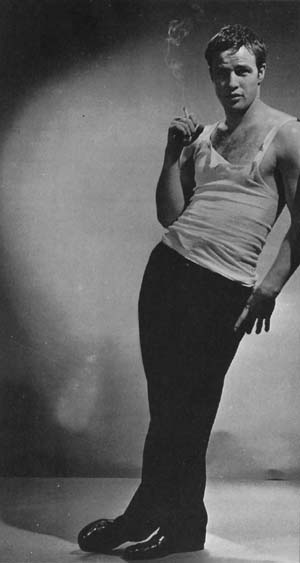
Why hello Marlon Brando, the original metrosexual! I once showed this photo to Mark Simpson and commented that you can't tell whether he's just committed rape or been raped. He seems to have enjoyed it, in any case. You want to tell me if this sex object is “passive” or “active”? Gore Vidal, in his essay on his friendship with Williams, suggests that Brando's Kowalski was the first time that women were put in the cultural position of being allowed to exhibit their lust for men as sex objects – which, of course, they were permitted to do thanks to Williams's expression of his gay male lust. And so the gay male gaze paved the way for the female gaze.

Objectification and Identification in Narrative Art

It's not gaze theory that I want to directly challenge here, though, but rather the notion of “objectification.” As a female writer who has written male characters as often as she's written female characters, it's occurred to me to wonder: can you actually separate objectification from identification in the process of writing? In that same essay Vidal recounts Williams's claim that he couldn't write a short story (I'm sure it applied to plays as well) unless he was sexually attracted to at least one of the characters. I know what he meant, and though I've written plays where this was not, or less, the case, it was a lot tougher to get motivated. For some writers, at least (maybe those in the decadent mode, as per Paglia's theory of decadence), the line between fantasy and art is fine indeed. And maybe that's never more true of the female writer than at the acute point of (uninitiated) adolescent libido. Anyway, I've often thought that the psychology behind my award-winning play Live With It, about 60s gay playwright Joe Orton, was comparable to the Bronte sisters' in their Byron fanfic. In fact I was so aware of it that I had to make a conscious effort to “make” that play art by forcing myself to be less attracted to my male protagonist (who, in an additional psychological twist, was just a narcissistic fantasy of my insufferably female teenage self as a gay male “bad boy” anyway).

But if for some male and some female writers, sex plays an important role in literary composition (and one can obviously include filmmakers too), the question is whether this results in something called “objectification.” Because my identification with Orton was murderously (so to speak) intense; though no more intense (and actually perhaps less) than my identification with the Halliwell character, to whom I was not attracted.

But the greater portion of my evidence comes from my experience as a reader and viewer, that is, as a critical theorist (since I cannot perform these roles without analysis, whether simultaneous or retrospective). In Love and Death in the America Novel, Leslie Fiedler argued that the puritan strain in British culture led to an obsessive focus on rape in the British novel, most spectacularly in the first great “realist” novel, Samuel Richardson's Clarissa. One result of this puritan tendency to take imperilled virtue as its subject was the temporary phenomenon of male writers creating female protagonists, which culminated in the psychologically sex-crossing Henry James, and has never become popular again. Well, at least until Steig Larrson performed his immensely popular modern spin, with virtue and rape still as much at stake as ever (and still as much of a mask for prurience), as Tim Parks's New York Review of Books article, “The Moralist,” makes clear. The male author in this strain both identifies with and objectifies his heroine, views her as subject and object. The “rape line” reemerges in cinema with Hitchcock and continues with Polanski and Lynch. There's a grim culmination in Rosemary's Baby, in which a director has rarely more closely identified with a heroine (or forced an audience into closer identification), and yet still subjects her to his rape fantasy. (I wonder if I've already mentioned on this blog the irony that Roman Polanski may understand women better than any other film director. And I'm not the only woman I know who thinks this.)

I suppose what I am trying to say is that a heterosexual (or whatever Henry James was) artist's relationship to his or her opposite-sex main character is, or can be, immensely complex, comprising both identification and attraction, and, in result, sadism and masochism; not to mention the psychological implications of sex-crossing identification. And in the reader's response, too, identification and objectification also often co-exist.

I'll give the unlikely example of a couple of songs by the punk band Mindless Self Indulgence, “Shut Me Up” and “Faggot.” In them, the male singer assumes the persona of an apparent masochist, begging for someone of indeterminate gender – it would be equally perverse whether it was a woman or a man – to, well, shut him up, or call him (make him?) a faggot. The assumption of masochism by a hardcore performer gives these songs a real frisson for me, but I couldn't tell you whether it's sadistic or masochistic in nature: if I'm enjoying the abjection of the male persona or identifying with it. (The male listener's choices are even more limited: he can identify and be queer, or enjoy and be queer. The hardcore phenomenon of MSI and its relationship to queerness is something far beyond my understanding! The only “hardcore” I understand is the Pulp album.)

(Actually, come to think of it, the assumption of masochism and invocation of a shadowy abstract figure to perform sadistic acts on one just reminded me of John Donne's Holy Sonnet XIV. Backing away fast.)

From this (very) brief discussion of narrative art, it should be clear that “objectification” is not simply a visual, but a mental act: not just a way of looking at someone, but a way of seeing them.

Objectification in Visual Art and the Metrosexual Subversion

The question becomes different when we move from narrative or narrative-visual to visual art. The feminist concern, as I understand it (in its most reasonable form, that is), is that cinema and mass media, including advertising, inherited the tradition of the female nude in fine art (a permanently discredited meme within fine art since Picasso's Demoisells d'Avignon) and pervaded the culture with sexualized images of women to such a degree that young men were being insidiously “educated” to believe that all women were “objects” with no human agency or subjectivity. In its less reasonable form, this feminist concern becomes the concept of “rape culture,” in which this objectification of women (including pornography as well) creates an environment in which rape is more likely to occur. (Never mind that rape is as old as, well, sex. Or crime. Or may most often happen to minors, in situations having nothing to do with media portrayal of women. Or in situations of social and political upheaval, such as war, along with other terrible crimes against men, women, and children; again, with zero relation to the media.)

Obviously, I'm not too interested in the “rape culture” argument, but I am interested in what gives it whatever emotional credence it has. For many men and women have now become so pervaded with the feminist meme, without even studying feminist theory (and without any necessary feminist interest or allegiance), that it's often now taken for granted that a) to be photographed in a sexualized manner is to be “objectified” and b) that this inevitably makes one passive.

Certainly, this sort of thinking is behind the subversiveness of Mark Simpson's theory of “metrosexuality” and the yummy Sporno evidence he's produced in support of it. I can't remember if Mark has ever said in so many words that men are now more often the objects of the gaze in advertising than women are, but I do believe that that's Quiet Riot Girl's interpretation of metrosexuality. (If I'm wrong she can correct me for the record in the comments!) Yet this consequence of metrosexuality has been met with disbelief, scorn, and defensiveness by the media because, for one reason, of the implications that feminist gaze theory has bequeathed us: with disbelief based on the idea that men can't be objectified because masculinity is inherently “active” (and Mark's concentration on sports is crucial here); with defensiveness based on the idea that being the object of the gaze is to be made passive (and why would men want that?).

In her post on Mark Simpson's analysis of Rafael Nadal's Armani ad, "Why Can't A Woman Be More Like A Man?," Quiet Riot Girl quotes from Mark's dwelling on the flirtiness and tartiness of the delectable image, and wonders why it has more of a “charge” for her than a similar ad run simultaneously by the company, featuring a female model. Well, I would suggest that it's because the image of Nadal subverts our expectations of masculinity by deliberately exhibiting passivity and flirty invitation, which is all the more piquant because he possesses a traditionally masculine, hunky physique, as well as his athletic rep.  In much the way Paglia has described the perversity of some of Michelangelo's sculpture that erotically renders hunky males passive, languid, or masochistic. (Sorry, I gave away my most recent copy of Sexual Personae when I was drunk, otherwise I'd give the exact quote here, because it's good. And by good I mean hot.)

The other reason metrosexuality has caused a scandal is that to make yourself the object of the gaze means potentially (or really, at least in the public imagination, inevitably) making yourself the object of the male gaze. For men to be comfortable being the object of the gaze means getting over their homosexual panic, not only "abstractly," by choosing to be "passive," but directly, by desiring the desire of men. Which is what “metrosexuality” is all about. What Mark, if I recall correctly, hasn't emphasized as much is that it also means that other kind of homosexual panic, being comfortable as the (“passive”) object of the female gaze.

...Men Sick of Looking at Naked Women?

Unfortunately for feminist theory (and those of us who've unconsciously imbibed it, for our own female or male self-interested purposes), the active/passive binary just doesn't hold up. Of course women aren't uniformly “passive” or men uniformly “active” (whatever that could possibly mean), and of course every sexy photograph does not make the subject of the photograph “passive” (whatever that could possibly mean). However, these ideas of “activeness” and “passivity,” attached to ideas of “masculinity” and “femininity,” are there to be played with in the sophisticated sexual theatre of image-creation.

I've had the opportunity to occasionally peruse softcore gay male magazine porn (academic/aesthetic interest only, you perverts; it's not what I “use”), and, in my opinion anyway, it's exponentially more effective as a turn-on for my female purposes than any comparable porn I've seen created by straight women for straight women. And if I analyze it, it's because the models in those magazines, despite having rather blandly handsome faces and chiseled bodies that aren't my usual type, are engaged in flagrant displays of “feminine” passivity (sensual offerings of the body, especially buttocks) that are far beyond what I'm used to seeing from my academic perusal of straight male softcore magazine porn. In other words, these men are working hard at being passive. Which I find interesting, because you'd think with the reputation of gay men for being horny, all they'd need – as straight men claim to – is a naked body, no seduction or semiotic foreplay required.

Metrosexuality isn't the whole story of the Noughties. Even if metrosexuality was on the rise in advertising, the “objectification” of women in the media didn't go away, as feminists and conservatives (the same unlikely bedfellows as ever) clamoured about the “pornification” of culture. Since I always like a bit of Great Woman history, I'm going to go ahead and follow Simpson in putting the blame for this squarely on Madonna. In the early 90s, Paglia claimed that her favourite pop star crush had single-handedly “corrected” second-wave feminism by showing that female sexual glamour meant power, not passivity or victimization. With the Paglian insights (of the essay collections Sex, Art, and American Culture and Vamps and Tramps) intertwining with other aspects of media feminism, the result was a generation or so of young women, including young women pop stars, who seemed to think that the road to “empowerment” (that awful catch-all empty Feminism Lite meme) was paved with self-exploitation. If sex was power, and women could dress however they wanted to on feminist principle, ergo, women ought to flaunt whatever they've got (or acquired through surgery); and as long as they were doing it on their own prerogative, or at least for self-interested purposes (like getting fame and money, the bottom-line capitalist justification), they stayed firmly on top even if they were crawling on their knees and licking the dirty floor.

If you think I'm going to draw some awkwardly backtracking feminist-lite sentimental conclusion from this, like how maybe the concept of modesty had its merits, you've obviously never read me or spoken to me before. I prefer Mark's conclusion, in his Out take on the Paglia v. Gaga showdown (Two Great Women determine The Future of Sex!), that pornification via the post-feminist self-objectified female body has simply led to a cultural dead end: “[Gaga]'s post-the now boringly compulsorily 'sexy' world that Madonna helped usher in, bullwhip in hand, which is now as burned-out as that 'Bad Romance' skeleton.” Or in a word (his word), she's “postsexual,” as are we all now.

In confirmation, I recently saw a YouTube video (one of my favourite sources of sociological hard evidence) of Janelle Monae's Letterman performance of “Tightrope” in which a presumably male commenter celebrated the novelty of a female pop singer with “clothes and talent.” (Here's the vid, but I can't find the comment now. If you want proof, or proof that I'm on crack, you can look through them all if you want!) And it's true that it seems like the choices for the female in pop, thanks, ultimately, to Madonna, are now between Gaga's postsexual exposed labia and Monae's buttoned-up androgyny.

Morrissey's on board with my Great Woman History here too (and with great minds like Paglia, Simpson, Morrissey, and me on the case, how can one go astray?). I recall reading an interview in which he commented at the time that Madonna had erased the already historically academic line between pop music and prostitution. Of course, he was one to talk.

The Western tradition of homoerotic iconography reaches new heights of subtle suggestiveness in pop music's most sustained coy tease.


Who's Calling the Shots? (Fun with Guns)

As I suggested above, passivity and activity in relation to masculinity and femininity are not fixed, essential qualities, but roles to be played, and played with (whether you want to come at that from a Butlerian or Paglian perspective). Nor is the “sex object” of a photographic image fixedly passive, or, in Paglia's reversal of the binary, active or “powerful” either. Any image that aspires to be iconic, at least, is a collision site of both previous iconic images and our inherited cultural understanding of what and how images mean. And this is true whether the primary auteur of the image is the photographer or the photographic subject, in a given case (or it may be a collaboration).

In order to talk about objectification and passivity in sexual imagery meaningfully, we have to carefully, and without an agenda, examine individual images. Academic feminism is tops at careful examination but tends to fall down on the “lack of agenda” front.

It might also help to know the background of how the image was created. So I'll tell a little story. When I was an 18-year-old playwriting prodigy facing the opportunity of my first front page Arts section newspaper photograph, I wanted to make an impact. (And it's a good thing I made the most of it, because it would also be my last such photograph.) This is because I held in my mind a gallery of iconic writer photographs that had determined what it meant to be “a writer” for me, from Oscar Wilde's scandalous long-haired dandy series, to Colette's sensational Claudine “schoolgirl” series, to Capote's seductive pixie-boy dust-jacket photo for his debut novel, to Orton's Christine Keeler take-off. In other words, I thought it was my pleasurable duty to make people upset, with sex the easiest way to accomplish this. But as pop tarts from Britney to Ke$ha have demonstrated with their bland “compulsory” sexiness, it's not quite as easy as it looks. It does require a bit of thought.


When the adult male photographer and assistant showed up for the shoot on the set of the small indie theatre where Live With It was first performed, my greeting to them was, “You can do whatever you want with me.” (Passivity? Not always so passive.) In fact, however, I was the one who suggested that we use a pair of handcuffs, a prop from the play (not S&M at all, perverts; those were mofo existential handcuffs), which I put on and posed curled up on a bed, another prop (the scene of Orton's gory murder). I can't remember who suggested the bed, but I would have been game due to the reclining Capote precedent.

See, I wanted a sexy image of myself because, who doesn't, but I also wanted a sensational image, and since this was the early 90s, and we'd already been through Madonna, there already wasn't much left to do with a sexy image of a woman that would be sensational. I had read Paglia by the time of this photo, and I took her point that Madonna had demonstrated that for a woman to be sexy was to be powerful. So what was the only taboo left surrounding representations of women in the still-p.c. early 90s feminist environment? (You cannot imagine now the media flack that Paglia got. Maybe Quiet Riot Girl can. And yet fellow liberals still tell me that the conservative perspective is dominant in the media.) Obviously: female masochism.

Honestly, I came up with all this in 3.5 seconds; that image was the coalescence of all of my thoughts about women, feminism, sex, and the role of the writer (which like many of my generation, I had started to confuse with the role of the pop star: the writer and pop star as “poor man's” versions of each other) up to that point. Female masochism – to make the cheeky suggestion that women were not so powerful after all – was the most confrontational, aggressive, active thing I could do in what would otherwise be a blandly passive sexual representation of myself.

...although I may have fallen a little short of my iconic/iconoclastic intentions, considering the only response I ever got to that photo was that it made me look fat. (Trufacts.)

I don't have the original of that photo (I do of another, earlier Free Press photo, in which I presented myself as an underage smoker in a purple suede miniskirt... the cigarette did inspire reader complaints), or a scanner to reproduce it, or the faded and tattered newspaper reproduction, if I still have an intact copy of it anywhere. But, since I take the least photographic opportunity (I only wish I had more) to perform a minute twist on the “active” and “passive,” here's a Halloween snap from about ten years later (I'm supposed to be Emma Peel):


It would be just too obvious for me to assume that “powerful” dominatrix female role (notoriously a male fetish, anyway) by pointing the gun at you. (Yeah, that's a toy gun at my jaw there. It's not a professional image, sue me.) I thought that the flippant suicidal suggestion was much more subversive, and much more aggressive. (A line of thought that would culminate in a ten-minute one-woman performance I gave at the National Theatre School about three years later, in which I took inspiration from Jarvis Cocker's – on record! – troubled pornography “obsession” at the time of This is Hardcore. ) I mean, if a woman's death-wish is a turn-on for you (and you are otherwise normal), that is not going to be a comfortable feeling. (And so Charlotte Corbeil-Coleman and I discussed when coming up with our improv-based performance, Where Are You Going?, which we privately subtitled “A Clown Piece About Rape.” We agreed that we wanted to be sexy – who doesn't – but in the most uncomfortable way for the audience possible.)

On the other hand – as a man – James Maker makes the dominatrix iconography (phallic symbol fetish gun and heels) of the photo below really work for him. I can't know Mr. Maker's intentions here, if he recalls them himself – and I prefer not to ask, because I'd rather imagine that, like me in my Free Press photos, his primary motivation was simply to rile up anyone who cares to get riled. But there's definitely something more psychologically complicated going on in this photo than the typical metrosexual melting submission or good-natured gaze-courting. To me it reads as a literalization of the look/don't look nature of the female relationship (with the aggressive component underlined) to the male gaze (or male sexuality generally) of which men have been heard to complain. Or maybe I'm just thinking of the back cover photo on the original Blizzard edition of Live With It, in which (still 18) I tried my hardest to look like Garbo (in tribute to Bowie's Hunky Dory cover) and posed with cigarette in languid hand... with a stop sign propped up behind me (the legend "STOP" clearly legible). (It made my publisher giggle. Once again, I aimed at the sublime and achieved the ridiculous.) 

Regardless, you want to get shot through the heart by this pretty face, don't you?


I also feel like there's some channeling of Diana Rigg's aforementioned 60s pop feminist twist on the dominatrix, Mrs. Peel:


Put her in trad-dominatrix costume in order to make her a typical sex object, however, and her cool disdain at this farcical charade (I believe it was my friend Donna who told me to look at the way she's looking at that snake) is evident. 

Woman v. snake!!! The primal conflict. Now that's a look.  


Temporary Conclusions: Another Look

To summarize in the terms of some of the questions raised in Quiet Riot Girl's fascinating series of posts on metrosexuality and the gaze:

Are women the primary objects of the gaze anymore? No.

Are “metrosexual” men enjoying the gaze that the puritan strain of feminism told women was tantamount to rape? It would appear to be so.

Is there a female gaze? If you mean are women looking at men as sex objects, yes, obviously. If you believe Vidal, Williams and Brando started it all in the 50s; the male rock star continued it (as Paglia has pointed out); and in the 90s and Noughties, most women (certainly the ordinary, mainstream pop-listening, masculine men-dating young women I knew) were looking not at Armani ads, but at shirtless six-pack-flaunting rappers – who, for some reason, no one has ever claimed for metrosexuality. (Is this because black men have always been – whether in fact or in white perception – more comfortable with displays of their sexuality than the pre-metro buttoned-up white male? Or because no white critic dared to question the machismo of what Kevin Barnes called, in song, "a black male domination spasm"?) (It's a little more complicated than that, since Barnes is talking about, or in the person of, his alter ego, a Tiresian MTFTM, if I've got that right, black transsexual. But you know what they mean.)

But the most interesting question to me, as the foregoing should have made clear, is whether to be what we call a “sex object” inevitably involves passivity. What I attempted to demonstrate above is that although the concept of passivity plays an important role in the theatre of sex and sexuality, passivity itself isn't always passive. Take a good look at what you're looking at. There may be much more going on than you think. Oh, and remember to enjoy it while you're at it, too.

If you can. The boyfriend who took this picture told me it freaked the hell out of him.


Of course, you don't have to date me.