Showing posts with label the image. Show all posts

Thursday, November 15, 2012

A Myth of the Writer for the 21st Century in Vila-Matas, Marias, and Bolano


The Writer as Hot Mess

In recent decades we've heard a lot about the death of literature, meaning variously: the death of print in the online era; the death of reading in the age of digital distractions; and the death of “literature” in a time when the mass audience has been lost to electronic media, the remaining book audience has been lost to “YA fiction,” and, anyway, modernism rendered the traditional novel aesthetically void. Under capitalism, this millennial anxiety about literature inevitably immediately issued in a new publishing genre: books about books, extolling the wonders of books, talking about the author's experiences with books, providing clueless or curious readers with lists of books they ought to read.


The new myth of the writer conjured by the works of three Spanish-language authors, Javier Marias, Enrique Vila-Matas, and Roberto Bolano, seems suited to these times. On the one hand, these are writers obsessed with writers, or the idea of the writer, in a modernist version of the turn-of-the-century self-cannibalization of literature. But while this obsession speaks to the regard in which they hold The Writer, their work simultaneously diminishes that figure. In The Savage Detectives (1998), Bolano nostalgically glorified a failed literary movement whose chosen figurehead was an obscure and elusive experimental poet, as if the movement, too, glorified failure (or “the literature of desperation,” as it's called at once point), or saw it as the only authentic kind of success; 2666 (2004) also uses the quest for an elusive author as one of its structural devices. In Bartleby & Co. (2001), Vila-Matas wrote a “novel” that is really a work of literary theory about the mostly non-fictional “Bartlebys” of literature, or Writers of the No, who gave up writing temporarily or permanently or could not get started in the first place. And in Written Lives (1992), Marias's brief biographies of mostly famous writers, written as if their “fairly disastrous” subjects “were fictional characters,” produce an effect that “is hardly likely to lure one along the path of letters,” as Marias litotically warns in the Prologue.

Indeed, the impression one gathers from reading Bartleby & Co. and Written Lives back to back is that you would have to be a fool to be a writer. Marias, a self-conscious anti-hagiographer whose miniature biographies often reminded me of the fictional ones in Bolano's Nazi Literature in the Americas (1996),
but with less generosity extended towards the subjects, strips even the glamour of tragedy and Romantic self-destruction from his writers, eccentrics who lead lives characterized by mainly quiet desperation, but also occasionally marked by violence. Those memorable episodes of violence – Turgenev's grandmother's grisly murder of a young servant in a fit of pique, Sterne's father's being run through with a sword in an argument over a goose, Verlaine's brutalizing of his wife and his and Rimbaud's mutual brutalization, the elderly Isak Dinesen's bullying of a young male worshipful and whimsical threatening of him with a pistol – are another link to NLITA, in which the banal, the bizarre, and the violent jostle.

Although Marias is remarkably short on sympathy (as opposed to pity) for his writers, he saves his vitriol for his betes noire, Joyce, Mann, and Mishima. In those chapters, Marias proves he can rival Camille Paglia as an artist of the ad hominem, and it's hard to know whether he has chosen sex as a ground on which to attack them or whether their sexual psychology is part of what inspired his disgust in the first place. We are, in any case, expected to share that disgust as he quotes representative passages from Joyce's pornographic letters to his wife, Mann's diary entries on his digestive complaints and attractions to young men, and Mishima's public musings about his sadomasochistic fantasies. One only hopes that Marias's sex life and sexual thoughts are clean and orthodox enough to escape such a treatment, or, if not, that they never fall into the hands of posterity.

The persona adopted by Vila-Matas in Bartleby & Co. is much gentler, yet his celebration of literary silence does not make the writer's life appear any more attractive. It is a life largely wasted, as the writer loses sight of the reasons to write, or never manages to keep them in sight long enough to get started, or – like Vila-Matas's paradigmatic Bartleby, Robert Walser – contrives a way to continue to write, but only with the lowest possible opinion of his work. When I recently came across a New Yorker post on Philip Roth's announcement of his retirement, I saw it through the lenses of Vila-Matas and Marias simultaneously: Roth's retirement was an act of Bartlebyism, albeit at the end of a prolific career, and he speaks of writing as an addiction that required such single-minded devotion from him that he found taking care of a friend's cat “consuming.” The post makes the life of a writer – and a critically and commercially successful one – sound austere, ascetic – even impoverished. I wondered, reading it, how a man who had lived so little in order to write so much could have written anything at all.

I have no doubt myself that the mythology of the writer is part of what lured me into my career... as a Bartleby. As a teenager I devoured biographies of writers whose behavioural excesses and tragic trajectories made them compelling subjects, and although my life has been conspicuous for its lack of excess (although the disasters have been plentiful), I am nonetheless as guilty as any of assuming, based on this mythology, that to be a writer was to not only be good at writing – but to also be interesting. Between, say, Oscar Wilde in the 1890s and the generation of Capote, Mailer, Vidal, and Williams, the writer was a proto-rock star; the American writer of the Franzen, Chabon, Eugenides generation is, in contrast, at best an indie rock star.

The Great Gender Divide

The myth of the writer-rock star lives on, however – only now it's gone international. Just go on Scott Esposito's online lit journal, The Quarterly Conversation, and what do you see? In a sidebar to the right, a row of links with photographs, devoted to Cormac McCarthy, David Foster Wallace, Haruki Murakami, and Roberto Bolano. Notably, two of the four died young, and notably, the writer as rock star, like the rock star, is gendered male. Not that female writers are incapable of inspiring cults by dying young, but the Sylvia Plaths are left to feminists. Women read trash, men don't read, intellectual men read male modernists, and feminists read female modernists. And if you think I'm simply parroting stereotypes about the literary tastes of average North American men and women, take a look at the 2011 winners of the Goodreads Choice Awards for Fiction, and you tell me which gender is using the site more, what kind of fiction they're reading, and which gender is writing it. Jessa Crispin's popular Bookslut site appears to be a gender-neutral literary site – despite the gendered monicker – where women and men who are interested in serious writing by men or women can gather and contribute; the question, however, is why there should ever be gender segregation on literary sites.

Or in books about writers, because female writers are rather left to the side by Marias and Vila-Matas (and not a sexy sidebar). Out of his dozens of Bartlebys, in a book stuffed with literary references, Vila-Matas mentions less than a dozen female writers in total. Only three, or possibly four, of them are Bartlebys, and they are: a friend of the fictional protagonist who gives up on the idea of being a writer after her head is turned by literary theory; a woman who ghost-wrote feminist plays for her famous husband; a courtesan who ghost-wrote a few lines of verse for Goethe; a member of Strindberg's circle who wrote a memoir of her childhood and adolescence. And this despite the fact that off the top of my head I can think of two female modernists who fill the qualifications of a Bartleby better than many of the male authors Vila-Matas includes: Djuna Barnes and Jane Bowles. One can only conclude that Vila-Matas either doesn't read that many female writers (he seems mainly to hear of their existence through rumour, perhaps while reading biographies of Goethe or Strindberg) or doesn't think too hard about them if he does. I'll definitely be interested in seeing how he represents his relationship with Marguerite Duras, his landlady (who is quoted a few times in Bartleby & Co.), when he was a young aspiring writer, in Never Any End to Paris.

The Great Gender Divide in contemporary letters needn't be attributed to anything more sinister than identification: Vila-Matas may stick mainly to male authors because they stick mainly to male protagonists, which are easier for both reader and writer to identify with; and when Vila-Matas, as a writer, muses about Writers and Writing, for the same reason it's male writers he thinks about. And this neglect of female writers – whether in books by male modernists or on literary sites devoted to modernism, like The Quarterly Conversation – reinforces the same tendencies in female writers.

And so the discussion of female modernists and their Bartlebyian tendencies is left to its own book, or books – like Kate Zambreno's Heroines(Semiotext(e)/Active Agents), which I have not read, because it's not in my public library system, but which does discuss Bowles and Barnes – and the Great Gender Divide perpetuates itself. Which makes Bolano's feminist gesture of making a female poet the object of his two male poets' quest in The Savage Detectives all the more remarkable, although it only seems logical to make the “silenced” female writer (or, for that matter, femininity, the no-thing, as negation) into a symbol of literary modernism in general.

Symbols aside, however, the truth – as Bartleby & Co. proves in abundance – is that male writers are every bit as likely to be Writers of the No as female writers are, as sad as it may be when the latter have more famous husbands who are also writers. The reverse still seldom happens, although Sylvia Plath's suicide and subsequent appeal to feminists and precocious teenage girls does mean that more non-poetry-readers have heard of her than of Ted Hughes (in any capacity except as her husband). Likewise, the feminist embrace of Frida Kahlo means that now, at least, more people with no great interest in art have heard of her than of her artist-husband. It helps, too, that Kahlo made her own image the subject of her art, which lends an illusion of intimacy that the mass audience seems to respond to – like Oprah putting herself on all her magazine covers.

Marias, who has stated in a Paris Review interview his distaste (he must have more of those than any celebrated writer since Nabokov) for writers who write from the perspective of the opposite sex, includes only three women, Isak Dinesen, Djuna Barnes, and Madame du Deffand, out of 20 authors, in the main portion of Written Lives; he then devotes a second section to even briefer portraits of six “Fugitive Women.” I can't say I understand what makes these women more fugitive than the others, or whether “fugitive” is meant to suggest that they are fleeing (like hunted outlaws), fleeting (three were short-lived), or elusive figures, but it's certainly a Bolanoesque concept of the female writer.

To this concept Marias, however, adds the further meaning that the interest of several of these women's literary work is also fugitive. Two, Vernon Lee and Violet Hunt, are treated as hangers-on in important male literary circles (in fact overlapping circles). Adah Isaacs Menken, a mid-19th century American actress whose fame was due to her appearance at the climax of a play by Byron, in which she played the male protagonist, in a flesh-coloured leotard, tied to a horse, is treated more affectionately by Marias than almost any other figure in the book, perhaps because of her unabashed and abundant absurdity, yet she seems to have been sneaked in because she happened to write a critically excoriated, posthumously published book of poems. It does give the impression that Marias is scraping the bottom of the barrel to come up with women of letters to write about.

Somebody, please, send him some binders.

Pretty On the Inside

You may have noticed from the foregoing that I am impatient with any attempt to set female writers apart from male ones with even the best of intentions – by male or female writers. I can't think of anything more alien to me than the idea that the sexes are so alien to each other that they can't enter into each other's perspectives, or that the imagination of the writer – I should say, The Writer – is so feeble that it can't transcend something as fictional as gender. If all we're going to do for the rest of all time is read and write about our almighty, all-important experiences “as woman” and “as men,” we might as well all start taking literary silence literally.

However, the writer so incapable of imagining an experience different from his or her own as to produce inadequate characters of the opposite sex is fully deserving of ridicule. Interestingly, in Written Lives Marias is guilty of the same trespass against feminism that recently rocked the internet when Jonathan Franzen made it in his NewYorker piece on Edith Wharton. Not only does he remark on his assessment of Djuna Barnes's appearance in his second paragraph on her; her returns to the subject in the book's third section, in which he analyzes photographs of writers. Out of 23 writers, Barnes is the only female writer whose picture he includes, and it causes him to confidently proclaim, “Unlike Wilde, who tries to be and to seem handsome, she knows she is not pretty and does not believe she can seem so, that is why she makes no attempt to adopt the faraway look that flatters most faces, instead she looks straight ahead, skeptical and mocking, trusting only in her costume (especially that raised collar), and in the confidence of her pose.”

Is it a double standard that I think Marias's analysis of the Wilde photos – those wonderful early dandy photos (probably more responsible than any text in fooling me into thinking that to be a writer meant to be interesting) – in terms of Wilde's desire to appear handsome and his momentary achievement of that goal (as if by force of will, the way Bette Davis made herself appear pretty in Jezebel) – but that this analysis of “prettiness” as a central concern in Barnes's life is piffle? I don't know anything about Barnes's private life other than what Marias wrote in his sketch – as I know nothing about Wharton's private life besides what Franzen wrote in his article. Perhaps if I did, the male writers' assertions not just about the female writers' appearance but their feelings about it would make that life snap into focus for me – which is what happened when I read Marias's lines on the Wilde photos. The pursuit of beauty is certainly a major motivating factor in Courtney Love's life, for example: she's sung about it, talked about it in interviews, and given herself a very public makeover that unfortunately degenerated into a plastic surgery addiction.

Oscar Wilde, before he stopped trying to incorporate the object into himself and went in pursuit of it.

Bette Davis, defying you to think she's not beautiful.

Djuna Barnes gets it right.

Courtney Love before she started trying to incorporate the object in herself.

Franzen and Marias are, at the very least, guilty of showing a Romneyesque insensitivity to context; their failure to provide biographical evidence for their theses reads as though they have such difficulty imagining the female mind that they have grasped desperately at the one clue society has given them: “Women want to be pretty!” Which, moreover, causes them to underestimate the human capacity for complacency and self-delusion, as anyone can see nowadays by going on Facebook, my own account not excluded. 
Besides, Marias has chosen the wrong photo of Barnes for his claim that she was neither pretty nor believed she could seem so. There's another from the same session in which Barnes, attempting a softening smile that is in fact less flattering to her face than a frank expression, looks downright awful. In the photo from Marias's postcard collection of writers' portraits, on the other hand, to me Barnes looks like a perfectly presentable, somewhat eccentric woman who precisely thinks she can sometimes pass as pretty – and has done so here. Marias's emphasis on Barnes's modesty in the next sentences is also revealing: apparently one of the first things he looks at when he looks at a picture of a woman is how much skin she's revealing, which issues immediately in a judgement on her virtue. Of Barnes he declares approvingly, “She is a woman dominated far more by modesty than by esteem for her own image,” which translates into the vernacular thusly: “She keeps her clothes on instead of running around showing off her body to get attention from men.”

Some people aren't meant to smile.

Maybe it's a good thing that Marias doesn't try to enter into women's heads very often: instead of vividly imagining Barnes's inner life, he can only file her appearance into his limited, dualistic categories for women – sexually attractive (good) or not sexually attractive (bad), virgin/matron (good) or whore (bad). Not that women don't have the same categories for men (Rhett or Ashley, Team Edward or Team Jacob?), but one expects a little more of a writer of international reputation writing about another writer of international reputation.

Speaking of writers' appearances, Kate Zambreno's blog, Frances Farmer Is My Sister, has finally gotten me to take an interest in Clarice Lispector – one of the very few female writers whose name I've encountered on The Quarterly Conversation. The Amazon.com summary of a recent biography by Walter Moses gets off to an hilarious start by quoting his description of Lispector as “That rare person who looked like Marlene Dietrich and wrote like Virginia Woolf,” but I'm intrigued by Moses' thesis that the Jewish Lispector, whose family fled to Brazil in 1922, when she was two years old, is “the true heir to Kafka.” I would actually be intrigued by any writer who's supposedly the true heir to Kafka, but if she also happens to look like Marlene Dietrich, you can't beat that package. And to judge from the pounds of makeup Lispector wore throughout her life, neither her narcissism nor her preoccupation with philosophy and mysticism interfered with each other in any manner. It's only the less physically and intellectually gifted of us who are superficial enough to be interested only in our appearance or in our inner life. 

The writer as movie star.

Friday, July 8, 2011

The Gaze in the New Metrosexual Order, and Some Aggressive Notes on "Passivity"

As anyone with a cursory knowledge of Film Studies, knows, the theories of Laura Mulvey have been pervasive in that field since her essay “Visual Pleasure and Narrative Cinema” appeared in 1975. There is almost nowhere you can go, if you want to read academic film criticism, without encountering Mulvey's gaze. Mulvey's “gaze theory” can be (and usually is) summarized by saying that classical Hollywood cinema placed the spectator in the subject position of the male protagonist, while female characters were (this is what Wikipedia says; it's been a while since I read Mulvey's essay) “coded with 'to-be-looked-at-ness.'” (Um, you really couldn't think of a better way to say that? Okay, moving on.)

Now, off the top of my head, I can think of about a thousand exceptions to this. Actually I can think of a whole genre it ignores: the woman's film. Screwball comedy, too, can hardly be said to require viewer identification with the male lead, and, in the case of some screwball comedies, such as Preston Sturges's The Lady Eve, said identification would be rather painful, and certainly would not place the identifier in the “powerful” role. In his essay challenging Mulvey's gaze, “Mother Calls the Shots: Hitchcock's Female Gaze” (you can find it in the House Made of Light collection), George Toles makes a similar point about Norman Bates in Psycho, who may, like the camera, spend a lot of time gazing at Marion in states of undress, but with whom identification is hardly comfortable for the male viewer, and who is ultimately himself subject to the monitoring, censoring gaze of Mother.

Is this man, shown here blurring into his dead mother, really the poster boy for the “powerful” “male gaze”?


But Mulvey's influence on feminism and media analysis has extended beyond her original theory, and in popular use now generally alludes to the inescapable fact that visual media, from movies to ads, are overwhelmingly created by men and assume a male viewer: they are designed by and for “the male gaze.” As she often does, Camille Paglia largely accepted this tenet of feminist theory but gave it a neutral spin. For Paglia, men have created more art because they are in possession of this harsh, demanding “male gaze,” which is also the aestheticizing (or “Apollonian”) gaze, which Paglia finds in its purest form in gay male culture. But this line of thinking is also where she departs from standard feminist theory: because she notes that the peak of Western visual art, the Italian Renaissance, homoerotically worshipped the male form. This it took from its classical Greek influence, but after the Renaissance, the male nude is suppressed in Western art. While accepting the idea that women usually are the subjects (can I say that, or does it always have to be “objects”?) of the male gaze in art, pornography, and advertising, Paglia challenged the idea that to be the object of the gaze is to be “passive,” by using the example of gay male pornography: do we really believe that the subjects of gay porn are “passive” “victims of the gaze”? Instead, she took the desire to look at women as a tribute to female sexual glamour, and argued that women like looking at women, too, for instance in their consumption of fashion magazines (meaning straight women, although her lesbian perspective probably pointed her to that insight), which, in her view, was not simply a sign of their enslavement to male ideals of beauty. (Anyway – again – in the fashion industry those have traditionally largely been gay male ideals of female beauty.)


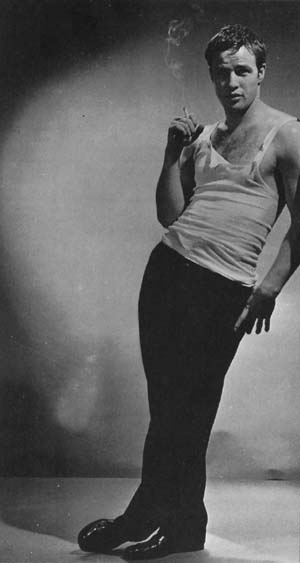
Why hello Marlon Brando, the original metrosexual! I once showed this photo to Mark Simpson and commented that you can't tell whether he's just committed rape or been raped. He seems to have enjoyed it, in any case. You want to tell me if this sex object is “passive” or “active”? Gore Vidal, in his essay on his friendship with Williams, suggests that Brando's Kowalski was the first time that women were put in the cultural position of being allowed to exhibit their lust for men as sex objects – which, of course, they were permitted to do thanks to Williams's expression of his gay male lust. And so the gay male gaze paved the way for the female gaze.

Objectification and Identification in Narrative Art

It's not gaze theory that I want to directly challenge here, though, but rather the notion of “objectification.” As a female writer who has written male characters as often as she's written female characters, it's occurred to me to wonder: can you actually separate objectification from identification in the process of writing? In that same essay Vidal recounts Williams's claim that he couldn't write a short story (I'm sure it applied to plays as well) unless he was sexually attracted to at least one of the characters. I know what he meant, and though I've written plays where this was not, or less, the case, it was a lot tougher to get motivated. For some writers, at least (maybe those in the decadent mode, as per Paglia's theory of decadence), the line between fantasy and art is fine indeed. And maybe that's never more true of the female writer than at the acute point of (uninitiated) adolescent libido. Anyway, I've often thought that the psychology behind my award-winning play Live With It, about 60s gay playwright Joe Orton, was comparable to the Bronte sisters' in their Byron fanfic. In fact I was so aware of it that I had to make a conscious effort to “make” that play art by forcing myself to be less attracted to my male protagonist (who, in an additional psychological twist, was just a narcissistic fantasy of my insufferably female teenage self as a gay male “bad boy” anyway).

But if for some male and some female writers, sex plays an important role in literary composition (and one can obviously include filmmakers too), the question is whether this results in something called “objectification.” Because my identification with Orton was murderously (so to speak) intense; though no more intense (and actually perhaps less) than my identification with the Halliwell character, to whom I was not attracted.

But the greater portion of my evidence comes from my experience as a reader and viewer, that is, as a critical theorist (since I cannot perform these roles without analysis, whether simultaneous or retrospective). In Love and Death in the America Novel, Leslie Fiedler argued that the puritan strain in British culture led to an obsessive focus on rape in the British novel, most spectacularly in the first great “realist” novel, Samuel Richardson's Clarissa. One result of this puritan tendency to take imperilled virtue as its subject was the temporary phenomenon of male writers creating female protagonists, which culminated in the psychologically sex-crossing Henry James, and has never become popular again. Well, at least until Steig Larrson performed his immensely popular modern spin, with virtue and rape still as much at stake as ever (and still as much of a mask for prurience), as Tim Parks's New York Review of Books article, “The Moralist,” makes clear. The male author in this strain both identifies with and objectifies his heroine, views her as subject and object. The “rape line” reemerges in cinema with Hitchcock and continues with Polanski and Lynch. There's a grim culmination in Rosemary's Baby, in which a director has rarely more closely identified with a heroine (or forced an audience into closer identification), and yet still subjects her to his rape fantasy. (I wonder if I've already mentioned on this blog the irony that Roman Polanski may understand women better than any other film director. And I'm not the only woman I know who thinks this.)

I suppose what I am trying to say is that a heterosexual (or whatever Henry James was) artist's relationship to his or her opposite-sex main character is, or can be, immensely complex, comprising both identification and attraction, and, in result, sadism and masochism; not to mention the psychological implications of sex-crossing identification. And in the reader's response, too, identification and objectification also often co-exist.

I'll give the unlikely example of a couple of songs by the punk band Mindless Self Indulgence, “Shut Me Up” and “Faggot.” In them, the male singer assumes the persona of an apparent masochist, begging for someone of indeterminate gender – it would be equally perverse whether it was a woman or a man – to, well, shut him up, or call him (make him?) a faggot. The assumption of masochism by a hardcore performer gives these songs a real frisson for me, but I couldn't tell you whether it's sadistic or masochistic in nature: if I'm enjoying the abjection of the male persona or identifying with it. (The male listener's choices are even more limited: he can identify and be queer, or enjoy and be queer. The hardcore phenomenon of MSI and its relationship to queerness is something far beyond my understanding! The only “hardcore” I understand is the Pulp album.)

(Actually, come to think of it, the assumption of masochism and invocation of a shadowy abstract figure to perform sadistic acts on one just reminded me of John Donne's Holy Sonnet XIV. Backing away fast.)

From this (very) brief discussion of narrative art, it should be clear that “objectification” is not simply a visual, but a mental act: not just a way of looking at someone, but a way of seeing them.

Objectification in Visual Art and the Metrosexual Subversion

The question becomes different when we move from narrative or narrative-visual to visual art. The feminist concern, as I understand it (in its most reasonable form, that is), is that cinema and mass media, including advertising, inherited the tradition of the female nude in fine art (a permanently discredited meme within fine art since Picasso's Demoisells d'Avignon) and pervaded the culture with sexualized images of women to such a degree that young men were being insidiously “educated” to believe that all women were “objects” with no human agency or subjectivity. In its less reasonable form, this feminist concern becomes the concept of “rape culture,” in which this objectification of women (including pornography as well) creates an environment in which rape is more likely to occur. (Never mind that rape is as old as, well, sex. Or crime. Or may most often happen to minors, in situations having nothing to do with media portrayal of women. Or in situations of social and political upheaval, such as war, along with other terrible crimes against men, women, and children; again, with zero relation to the media.)

Obviously, I'm not too interested in the “rape culture” argument, but I am interested in what gives it whatever emotional credence it has. For many men and women have now become so pervaded with the feminist meme, without even studying feminist theory (and without any necessary feminist interest or allegiance), that it's often now taken for granted that a) to be photographed in a sexualized manner is to be “objectified” and b) that this inevitably makes one passive.

Certainly, this sort of thinking is behind the subversiveness of Mark Simpson's theory of “metrosexuality” and the yummy Sporno evidence he's produced in support of it. I can't remember if Mark has ever said in so many words that men are now more often the objects of the gaze in advertising than women are, but I do believe that that's Quiet Riot Girl's interpretation of metrosexuality. (If I'm wrong she can correct me for the record in the comments!) Yet this consequence of metrosexuality has been met with disbelief, scorn, and defensiveness by the media because, for one reason, of the implications that feminist gaze theory has bequeathed us: with disbelief based on the idea that men can't be objectified because masculinity is inherently “active” (and Mark's concentration on sports is crucial here); with defensiveness based on the idea that being the object of the gaze is to be made passive (and why would men want that?).

In her post on Mark Simpson's analysis of Rafael Nadal's Armani ad, "Why Can't A Woman Be More Like A Man?," Quiet Riot Girl quotes from Mark's dwelling on the flirtiness and tartiness of the delectable image, and wonders why it has more of a “charge” for her than a similar ad run simultaneously by the company, featuring a female model. Well, I would suggest that it's because the image of Nadal subverts our expectations of masculinity by deliberately exhibiting passivity and flirty invitation, which is all the more piquant because he possesses a traditionally masculine, hunky physique, as well as his athletic rep.  In much the way Paglia has described the perversity of some of Michelangelo's sculpture that erotically renders hunky males passive, languid, or masochistic. (Sorry, I gave away my most recent copy of Sexual Personae when I was drunk, otherwise I'd give the exact quote here, because it's good. And by good I mean hot.)

The other reason metrosexuality has caused a scandal is that to make yourself the object of the gaze means potentially (or really, at least in the public imagination, inevitably) making yourself the object of the male gaze. For men to be comfortable being the object of the gaze means getting over their homosexual panic, not only "abstractly," by choosing to be "passive," but directly, by desiring the desire of men. Which is what “metrosexuality” is all about. What Mark, if I recall correctly, hasn't emphasized as much is that it also means that other kind of homosexual panic, being comfortable as the (“passive”) object of the female gaze.

...Men Sick of Looking at Naked Women?

Unfortunately for feminist theory (and those of us who've unconsciously imbibed it, for our own female or male self-interested purposes), the active/passive binary just doesn't hold up. Of course women aren't uniformly “passive” or men uniformly “active” (whatever that could possibly mean), and of course every sexy photograph does not make the subject of the photograph “passive” (whatever that could possibly mean). However, these ideas of “activeness” and “passivity,” attached to ideas of “masculinity” and “femininity,” are there to be played with in the sophisticated sexual theatre of image-creation.

I've had the opportunity to occasionally peruse softcore gay male magazine porn (academic/aesthetic interest only, you perverts; it's not what I “use”), and, in my opinion anyway, it's exponentially more effective as a turn-on for my female purposes than any comparable porn I've seen created by straight women for straight women. And if I analyze it, it's because the models in those magazines, despite having rather blandly handsome faces and chiseled bodies that aren't my usual type, are engaged in flagrant displays of “feminine” passivity (sensual offerings of the body, especially buttocks) that are far beyond what I'm used to seeing from my academic perusal of straight male softcore magazine porn. In other words, these men are working hard at being passive. Which I find interesting, because you'd think with the reputation of gay men for being horny, all they'd need – as straight men claim to – is a naked body, no seduction or semiotic foreplay required.

Metrosexuality isn't the whole story of the Noughties. Even if metrosexuality was on the rise in advertising, the “objectification” of women in the media didn't go away, as feminists and conservatives (the same unlikely bedfellows as ever) clamoured about the “pornification” of culture. Since I always like a bit of Great Woman history, I'm going to go ahead and follow Simpson in putting the blame for this squarely on Madonna. In the early 90s, Paglia claimed that her favourite pop star crush had single-handedly “corrected” second-wave feminism by showing that female sexual glamour meant power, not passivity or victimization. With the Paglian insights (of the essay collections Sex, Art, and American Culture and Vamps and Tramps) intertwining with other aspects of media feminism, the result was a generation or so of young women, including young women pop stars, who seemed to think that the road to “empowerment” (that awful catch-all empty Feminism Lite meme) was paved with self-exploitation. If sex was power, and women could dress however they wanted to on feminist principle, ergo, women ought to flaunt whatever they've got (or acquired through surgery); and as long as they were doing it on their own prerogative, or at least for self-interested purposes (like getting fame and money, the bottom-line capitalist justification), they stayed firmly on top even if they were crawling on their knees and licking the dirty floor.

If you think I'm going to draw some awkwardly backtracking feminist-lite sentimental conclusion from this, like how maybe the concept of modesty had its merits, you've obviously never read me or spoken to me before. I prefer Mark's conclusion, in his Out take on the Paglia v. Gaga showdown (Two Great Women determine The Future of Sex!), that pornification via the post-feminist self-objectified female body has simply led to a cultural dead end: “[Gaga]'s post-the now boringly compulsorily 'sexy' world that Madonna helped usher in, bullwhip in hand, which is now as burned-out as that 'Bad Romance' skeleton.” Or in a word (his word), she's “postsexual,” as are we all now.

In confirmation, I recently saw a YouTube video (one of my favourite sources of sociological hard evidence) of Janelle Monae's Letterman performance of “Tightrope” in which a presumably male commenter celebrated the novelty of a female pop singer with “clothes and talent.” (Here's the vid, but I can't find the comment now. If you want proof, or proof that I'm on crack, you can look through them all if you want!) And it's true that it seems like the choices for the female in pop, thanks, ultimately, to Madonna, are now between Gaga's postsexual exposed labia and Monae's buttoned-up androgyny.

Morrissey's on board with my Great Woman History here too (and with great minds like Paglia, Simpson, Morrissey, and me on the case, how can one go astray?). I recall reading an interview in which he commented at the time that Madonna had erased the already historically academic line between pop music and prostitution. Of course, he was one to talk.

The Western tradition of homoerotic iconography reaches new heights of subtle suggestiveness in pop music's most sustained coy tease.


Who's Calling the Shots? (Fun with Guns)

As I suggested above, passivity and activity in relation to masculinity and femininity are not fixed, essential qualities, but roles to be played, and played with (whether you want to come at that from a Butlerian or Paglian perspective). Nor is the “sex object” of a photographic image fixedly passive, or, in Paglia's reversal of the binary, active or “powerful” either. Any image that aspires to be iconic, at least, is a collision site of both previous iconic images and our inherited cultural understanding of what and how images mean. And this is true whether the primary auteur of the image is the photographer or the photographic subject, in a given case (or it may be a collaboration).

In order to talk about objectification and passivity in sexual imagery meaningfully, we have to carefully, and without an agenda, examine individual images. Academic feminism is tops at careful examination but tends to fall down on the “lack of agenda” front.

It might also help to know the background of how the image was created. So I'll tell a little story. When I was an 18-year-old playwriting prodigy facing the opportunity of my first front page Arts section newspaper photograph, I wanted to make an impact. (And it's a good thing I made the most of it, because it would also be my last such photograph.) This is because I held in my mind a gallery of iconic writer photographs that had determined what it meant to be “a writer” for me, from Oscar Wilde's scandalous long-haired dandy series, to Colette's sensational Claudine “schoolgirl” series, to Capote's seductive pixie-boy dust-jacket photo for his debut novel, to Orton's Christine Keeler take-off. In other words, I thought it was my pleasurable duty to make people upset, with sex the easiest way to accomplish this. But as pop tarts from Britney to Ke$ha have demonstrated with their bland “compulsory” sexiness, it's not quite as easy as it looks. It does require a bit of thought.


When the adult male photographer and assistant showed up for the shoot on the set of the small indie theatre where Live With It was first performed, my greeting to them was, “You can do whatever you want with me.” (Passivity? Not always so passive.) In fact, however, I was the one who suggested that we use a pair of handcuffs, a prop from the play (not S&M at all, perverts; those were mofo existential handcuffs), which I put on and posed curled up on a bed, another prop (the scene of Orton's gory murder). I can't remember who suggested the bed, but I would have been game due to the reclining Capote precedent.

See, I wanted a sexy image of myself because, who doesn't, but I also wanted a sensational image, and since this was the early 90s, and we'd already been through Madonna, there already wasn't much left to do with a sexy image of a woman that would be sensational. I had read Paglia by the time of this photo, and I took her point that Madonna had demonstrated that for a woman to be sexy was to be powerful. So what was the only taboo left surrounding representations of women in the still-p.c. early 90s feminist environment? (You cannot imagine now the media flack that Paglia got. Maybe Quiet Riot Girl can. And yet fellow liberals still tell me that the conservative perspective is dominant in the media.) Obviously: female masochism.

Honestly, I came up with all this in 3.5 seconds; that image was the coalescence of all of my thoughts about women, feminism, sex, and the role of the writer (which like many of my generation, I had started to confuse with the role of the pop star: the writer and pop star as “poor man's” versions of each other) up to that point. Female masochism – to make the cheeky suggestion that women were not so powerful after all – was the most confrontational, aggressive, active thing I could do in what would otherwise be a blandly passive sexual representation of myself.

...although I may have fallen a little short of my iconic/iconoclastic intentions, considering the only response I ever got to that photo was that it made me look fat. (Trufacts.)

I don't have the original of that photo (I do of another, earlier Free Press photo, in which I presented myself as an underage smoker in a purple suede miniskirt... the cigarette did inspire reader complaints), or a scanner to reproduce it, or the faded and tattered newspaper reproduction, if I still have an intact copy of it anywhere. But, since I take the least photographic opportunity (I only wish I had more) to perform a minute twist on the “active” and “passive,” here's a Halloween snap from about ten years later (I'm supposed to be Emma Peel):


It would be just too obvious for me to assume that “powerful” dominatrix female role (notoriously a male fetish, anyway) by pointing the gun at you. (Yeah, that's a toy gun at my jaw there. It's not a professional image, sue me.) I thought that the flippant suicidal suggestion was much more subversive, and much more aggressive. (A line of thought that would culminate in a ten-minute one-woman performance I gave at the National Theatre School about three years later, in which I took inspiration from Jarvis Cocker's – on record! – troubled pornography “obsession” at the time of This is Hardcore. ) I mean, if a woman's death-wish is a turn-on for you (and you are otherwise normal), that is not going to be a comfortable feeling. (And so Charlotte Corbeil-Coleman and I discussed when coming up with our improv-based performance, Where Are You Going?, which we privately subtitled “A Clown Piece About Rape.” We agreed that we wanted to be sexy – who doesn't – but in the most uncomfortable way for the audience possible.)

On the other hand – as a man – James Maker makes the dominatrix iconography (phallic symbol fetish gun and heels) of the photo below really work for him. I can't know Mr. Maker's intentions here, if he recalls them himself – and I prefer not to ask, because I'd rather imagine that, like me in my Free Press photos, his primary motivation was simply to rile up anyone who cares to get riled. But there's definitely something more psychologically complicated going on in this photo than the typical metrosexual melting submission or good-natured gaze-courting. To me it reads as a literalization of the look/don't look nature of the female relationship (with the aggressive component underlined) to the male gaze (or male sexuality generally) of which men have been heard to complain. Or maybe I'm just thinking of the back cover photo on the original Blizzard edition of Live With It, in which (still 18) I tried my hardest to look like Garbo (in tribute to Bowie's Hunky Dory cover) and posed with cigarette in languid hand... with a stop sign propped up behind me (the legend "STOP" clearly legible). (It made my publisher giggle. Once again, I aimed at the sublime and achieved the ridiculous.) 

Regardless, you want to get shot through the heart by this pretty face, don't you?


I also feel like there's some channeling of Diana Rigg's aforementioned 60s pop feminist twist on the dominatrix, Mrs. Peel:


Put her in trad-dominatrix costume in order to make her a typical sex object, however, and her cool disdain at this farcical charade (I believe it was my friend Donna who told me to look at the way she's looking at that snake) is evident. 

Woman v. snake!!! The primal conflict. Now that's a look.  


Temporary Conclusions: Another Look

To summarize in the terms of some of the questions raised in Quiet Riot Girl's fascinating series of posts on metrosexuality and the gaze:

Are women the primary objects of the gaze anymore? No.

Are “metrosexual” men enjoying the gaze that the puritan strain of feminism told women was tantamount to rape? It would appear to be so.

Is there a female gaze? If you mean are women looking at men as sex objects, yes, obviously. If you believe Vidal, Williams and Brando started it all in the 50s; the male rock star continued it (as Paglia has pointed out); and in the 90s and Noughties, most women (certainly the ordinary, mainstream pop-listening, masculine men-dating young women I knew) were looking not at Armani ads, but at shirtless six-pack-flaunting rappers – who, for some reason, no one has ever claimed for metrosexuality. (Is this because black men have always been – whether in fact or in white perception – more comfortable with displays of their sexuality than the pre-metro buttoned-up white male? Or because no white critic dared to question the machismo of what Kevin Barnes called, in song, "a black male domination spasm"?) (It's a little more complicated than that, since Barnes is talking about, or in the person of, his alter ego, a Tiresian MTFTM, if I've got that right, black transsexual. But you know what they mean.)

But the most interesting question to me, as the foregoing should have made clear, is whether to be what we call a “sex object” inevitably involves passivity. What I attempted to demonstrate above is that although the concept of passivity plays an important role in the theatre of sex and sexuality, passivity itself isn't always passive. Take a good look at what you're looking at. There may be much more going on than you think. Oh, and remember to enjoy it while you're at it, too.

If you can. The boyfriend who took this picture told me it freaked the hell out of him.


Of course, you don't have to date me.