Showing posts with label Janelle Monae. Show all posts

Wednesday, September 18, 2013

American Eccentrics, Hollywood Transcendentalism, and Progressive Politics

Academic feminist film criticism has brought some attention to the woman's film as a genre, but most widely-known woman's films gained their cultural prominence through the attention of men – gay men, who made a cult of Garbo and Dietrich, Hepburn and Stanwyck, and especially Crawford and Davis. It's an oddity of the history of Hollywood film reception that straight men hero-worship the male directors they've nominated as “auteurs” while gay men diva-worship the female stars. Moreover, to judge from the type of directors likely to be embraced as important auteurs by either the French New Wave critics or their American followers you might assume that the great American cinematic subject is “men being violent” (although sometimes this subject is under scrutiny, as in the films of Nicholas Ray and Paul Thomas Anderson). Perhaps the only prominent male critic to write about the woman's picture is Stanley Cavell in the 90s, and I have never seen this work cited by other critics, whereas I see his work on screwball comedy cited all the time. Douglas Sirk (taken seriously since the championing of Fassbinder in the 70s) is the single fashionable auteur who directed woman's pictures.

The “machismo” of the American film canon is all the odder when you consider that the gynocentric side of the war between Fieldingites and Richardsonians in academic criticism of the English novel triumphed over the androcentric side long before the advent of academic feminism, with F. R. Leavis's The Great Tradition (1948) a pivotal salvo in the battle. Harold Bloom has often spoken of the “lines” of Richardson and Fielding and their separate supporters; Leavis wasn't fond of either, but his favouring of Austen, Lawrence, and honourary English novelist helped to put heroines at the centre of the English lit canon. But this is the English novel. American Romanticism and the odd “novel” that it produced is, as Leslie Fiedler pointed out, often conspicuously and purposefully devoid of women, although one must also contend with Hawthorne and that cultural misfit, his admirer, James.

I am not so much pleading for criticism of American films to adopt a more gynocentric approach as I am pointing out the arbitrary elements of canon formation, which in this case reflected the way that both American and French male critics (and Pauline Kael) thought about what it means to be “American.” Likewise, the gynocentric slant of criticism of the English novel reflects what critics came to think the novel should be about, namely interiority; although with Modernism an even more highly developed interiority is instead attached to the autobiographical protagonist, who will now be male when the author is male (as he usually is).

Given the present state of the American film canon, however, a corrective may be in order. With the field divided between a macho auteurism that favours movies in which women, if present at all to a significance degree, are relegated to the sidelines and traditional roles (however feisty they may be in them, as in the Ford and Hawks Westerns), and the seemingly endless fascination with film noir, a genre in which women are represented by the femme fatale, it can't hurt to bring more attention to the woman's picture and to the many interesting directors (such as Frank Borzage, William Dieterle, and frequent woman's picture director King Vidor) who have never become fashionable auteurs perhaps in part because they were not especially interested in masculinity as a subject.

A film critic friend of mine once told me that noir was the only genre of which it can be said that every member was interesting, and while I agree with him about the inherent interest of noir, I think the same can be said for the woman's picture if it can be considered a genre. Does a Hollywood movie become a woman's picture just because it stars a woman – meaning that women will watch movies starring men but not vice versa? It can sometimes seem so, although women can also be the stars of horror films (or, today, action films*) and the co-stars of romantic comedies and dramas. In the woman's picture, however, men are usually love interests or secondary characters. A woman's picture can star a man, however, like Sirk's There's Always Tomorrow, which puts Fred MacMurray in the same trapped middle-class position as Jane Wyman in All That Heaven Allows; just as a woman can be the protagonist of a noir (e.g. Ophuls's The Reckless Moment), although noirs with female protagonists are usually considered noir/woman's picture hybrids, which by rights should be the most interesting genre of all – and it's true. There is also a sub-genre of woman's picture, or woman's picture/noir, in which the male protagonist falls in love with a woman he's never seen in the flesh, who does not appear for the first stretch of the film (e.g. Preminger's 1944 Laura and Dieterle's 1945 Love Letters), which shows the influence of the Gothic on both genres and serves as a bridge between Wilkie Collins's 1859 The Woman in White and Alfred Hitchcock's 1958 Vertigo.

I was prompted to reflect on these things after seeing a couple of interesting forgotten classical Hollywood, Nicholas Ray's A Woman's Secret (1949), with a screenplay by Herman (of Citizen Kane authorship controversy) Mankiewicz, and People Will Talk (1951), written for the screen and directed by the other Mankiewicz brother, Joseph. Joseph Mankiewicz is not a fashionable auteur even though as a writer-director and sometimes writer-director-producer he is an auteur a la lettre. Is this because he was so often associated with woman's pictures, such as his most famous movie, All About Eve? People Will Talk, released the year after All About Eve (and with its same producer, Darryl F. Zanuck), is a remarkable comedy-drama in which Cary Grant's eccentric, progressive, cultured, and magically benevolent Dr. Praetorius (that's correct) becomes romantically involved with a woman who's become pregnant out of wedlock (that's correct), for which she is neither shamed nor punished. It's evident that attacks on 50s conformism started early in the movies – a lot earlier than Sirk's 1956 All That Heaven Allows (a movie kindred in spirit), maybe as early as the great Mildred Pierce (1945). The tension between conformism and individualism in American culture is American culture, of course, and People Will Talk sometimes reminded me of a Mr. Deeds Goes to Town if the latter were populated by atheist intellectuals instead of small-town innocents.

Jeanne Craine is not as much of a feminist in this film as she first appears... but Cary Grant is.

As for A Woman's Secret, it seems to have slipped through the cracks of the canon because it made no impact at the time and does not fit in with the auteurist-friendly subject of many of Ray's later films, starting with the success of Rebel Without a Cause on: aforementioned masculinity. It's easy to see why A Woman's Secret did not set the world on fire at the time of release, and it's for the same reasons that it's so delightfully charming now. It is absolutely a screenwriter's picture, and Mankiewicz has no interest in any of the genres that it dabbles in, from woman's picture to murder mystery. The murder plot in fact makes no sense psychologically, and the two women it involves (played by Maureen O'Hara and Gloria Grahame) are shoved into the background and flashbacks while Melvyn Douglas takes centre stage as a world-weary author avatar.

Drat... I just had that rug cleaned!

The Svengali melodrama in which O'Hara and Grahame are embroiled could be a lot of fun, as it is in the Cukor-directed Gothic melodrama A Woman's Face (1945), starring Douglas, Joan Crawford, and Conrad Veidt. Mankiewicz, however, gives it perfunctory treatment, instead developing the comedic characters of the long-suffering elderly police inspector and his exceedingly eccentric, mystery novel-reading, amateur-detective wife, who finally, semi-inadvertently, provides the key (literally) to the mystery. The sharp-edged interaction between these characters, played by Mary Philips and Jay C. Flippen, is delightful; while Philips's character is a patented “batty woman,” it's evident that she chafes at her husband's mild/gruff, but withal complacent, patriarchal authority, and Philips gives her line readings just the right note of off-kilter menace to be laugh-out-loud funny, especially when she seizes an opportunity to declare, “I could have you committed, you know,” soon after missing his coffee cup and dumping a spoonful of sugar into his lap.

As an ill-educated but strong-willed floozy, Gloria Grahame also delivers line readings that tease out the absurdism in Mankiewicz's literate and whimsical dialogue. Douglas is the flippant playboy from Ninotchka, but even more dissipated ten years on, with a touch of Oscar Levant about his piano-playing wisecracker – if Levant could ever be imagined as conducting an affair with a woman or as giving up his bachelor ways in the final moments. The Douglas-O'Hara extra-wedlock affair is another one slipped past the censors, suggested by a reference to her jealousy of Grahame and confirmed by his louche body language with her in a later scene. Blink and you'll spend most of the movie thinking he's her gay best friend.

Speaking of American non-conformists, it struck me on a recent viewing of the 1934 Anne of Green Gables that one of the greatest of them in literature isn't a citizen of the United States at all. In Canada, beginning with my generation it's been a rite of passage to grow up with the mid-80s made-for-TV movie starring Megan Follows, and it seems evident that the later adaptation's casting of Marilla and Matthew and especially Anne herself owe a lot to the 30s film. The latter, however, adds a romantic plot to the episodic novel, focusing in fan fiction style on Anne's relationship with Gilbert Blyth. The movie's Gilbert Blyth himself departs from the studious young man of the book with whom Anne intellectually competes to become a sort of teenage proto-John Garfield type; especially hilarious if one was a fan of the 80s movie's daringly effeminate Gilbert.

Jonathan Crombie's "daringly effeminate" Gilbert Blythe... Candrogyny strikes again?

But although the 30s movie doesn't stick to Montgomery's vision of the clash between Anne's imaginative and impulsive ways and the town's demand for decorum and propriety (brokered by Marilla, who appreciates both Anne's ways and the town's), there's an early scene in which Anne elaborates on her preferred way of praying, as opposed to the way she's been taught, that's shocking in its frank portrayal of the young adolescent's “pagan” animism and antidoctrinalism. Exalted by her Romantic imagination (Elinor Dashwood would never approve), Anne is in some ways more of a Transcendentalist even than Jo March, in a line of Protestant heroines that descends from Jane Austen and ends up in two superb woman's pictures that explicitly grapple with philosophical subjects in a Transcendentalist context, the great Bette Davis vehicle Now, Voyager and Douglas Sirks's All That Heaven Allows.

The Anglo-American noncomformist spirit has often been represented by heroines presumably because women have traditionally had to do so little to not conform to their social role**; because being female is already to not conform to the male-determined “norm” (hence the emphasis in the initial chapters of Anne of Green Gables on the mistake of ordering her instead of a boy); because women are encouraged to develop their imaginations and middle-class women traditionally had the (double-edged, as the non-Anglo-American example of Madame Bovary emphasizes) leisure in which to do so; because women are not encouraged to challenge their circumstances or environment, which makes it all the more dramatic when they do. See also the heroines of Theodor Dreyer, an auteur very much concerned with both spirituality and nonconformism. Another good example from cinematic history is Powell and Pressburger's Gone to Earth (1950), in which Jennifer Jones plays a peasant woman who identifies with her dead mother's paganism, who cannot find happiness with either the Baptist minister who thinks she's an innocent child of nature or the swaggering squire who satisfies her body but threatens her soul, and who scandalizes her community in her attempt to achieve fulfilment (compare Dreyer's Day of Wrath).


Since seeing Paul Thomas Anderson's The Master I've wanted to compare it to Now, Voyager: both are “therapy” movies that use sea voyages as metaphors for spiritual journeys, and in both cases the protagonist must work out their relationship to male authority, represented by a guru/mentor. Since Now, Voyager, with its overt reference to Whitman, is about the process of becoming an individual (and shows how Transcendentalism might have special application for women, who historically have not been encouraged to think their own thoughts and lead their own lives), Davis resolves her relationship with male authority with relative ease (her mommy issues are another matter); in contrast, in The Master, Joaquin Phoenix seems to be offered charismatic authority as a solution to his “male” anger and alienation, and a finally unacceptable one. (His mommy issues, too, are another story, and one that, along with the central performances by brothers who ape James Dean's persona in remarkably different ways, makes The Master a fascinating companion to Gus Van Sant's My Own Private Idaho, which, come to think about it, is also about the search for/escape from a problematic male guru as much as about longing for the mother.) 


*I can't comment on “chick flicks,” the contemporary equivalent to the studio-era “woman's picture,” since I have seen very few of them. They do often appear to indulge in gender essentialism, but whether that's also true of studio-era woman's pictures and I simply overlook it because of their cultural context, or whether the few hundred woman's pictures that have any reputation are exceptions that challenged that context, is something I haven't studied. I know that some feminist film critics have embraced blockbusters with female appeal like James Cameron's Titanic, but that's further than I'm capable of going even though I'm willing to admit that theoretically Cameron's dopey, historically dodgy, and impeccably pop-feminist blockbuster could be the true heir to Gone With the Wind.


**Nowadays, on the other hand, it's probably easier for a boy or man to fail to conform to his gender role than it is for a girl or woman. This kind of nonconformism, however, has not yet been absorbed into our narrative consciousness. At the same time, it's hardly the case that women have total freedom to ignore conventional gender self-presentation. It's interesting to see self-declared feminist Janelle Monae – sporting Bette Davis's pompadour from Now, Voyager – bring female androgyny to a pop arena in which female bodily display and conventional attractiveness remain mandatory (hence the abuse Amy Winehouse took). Even in indie, where conventional sexiness is met with disapproval (hence the abuse that Lana Del Rey gets), there's a weird emphasis on long, flowing Pre-Raphaelite hair (Kate Bush, Neko Case, Florence Welch... heck, even Courtney Love in recent years... that's totally enough for a thing). Camille Paglia may have been right that Madonna was the most important feminist of the 1980s because she proved that sexiness and power were not mutual contradictory, but once the lesson of Madonna was absorbed by a new generation of women in pop that message became muddled: no one doubts that Beyonce, for example, is powerful (i.e. she's famous, wealthy, and in charge of her career), but unlike Madonna, she does not project an image of power (not even when she specifically manufactures one in the form of Sasha Fierce). Should she? What were the goals of feminism again? For women to be self-determining and financially successful or for women to be a threat to the status quo, a.k.a. scare the bejesus out of heterosexual men? And what do we make of the fact that despite the continued insistence on women's sexual self-display in pop music, most of Madonna and Beyonce's male fans are gay? It's a crazy world out there, kids....


"Mother... I'm not afraid!"


Friday, August 5, 2011

That Old Black Magic: The Female Artist as Witch

This post is going to finally give you what you've been waiting for: a glimpse into how my mind actually works when it comes to art and gender. Ready?

Way back in the day, Paglia's sexual personae taught me how to leap across centuries and cultural contexts in a single bound, as in her comparison of the bust of Nefertiti and Bowie in his “android phase.” What I liked about this tendency to yoke together the disparate with violence was that it enabled me to perceive, or assert, affinities between my two areas of interest (in common with many thoughtful teens of my generation and since): high culture and pop culture. Which can otherwise be rather difficult to compare. How could I measure which had the “greater” impact on me as a teenager – Hamlet, or Hatful of Hollow? Pride and Prejudice, or Ziggy Stardust and the Spiders from Mars?

In any case, Paglia instilled in me a lifelong tendency to think of artists in groups of “personae,” although my personae weren't as sexy as hers. I've got one main cluster, which I can separate out into male and female examples; today, I'll be giving some of the female examples. I think of this main grouping as “fey” artists, male or female, with some peripheral overlap with Paglia's “Mercurius androgyne.” These artists are also usually “minor,” or at least for niche tastes; they may also be miniaturists, like Robert Walser.

Maya Deren and Jane Bowles: Entangled Twins

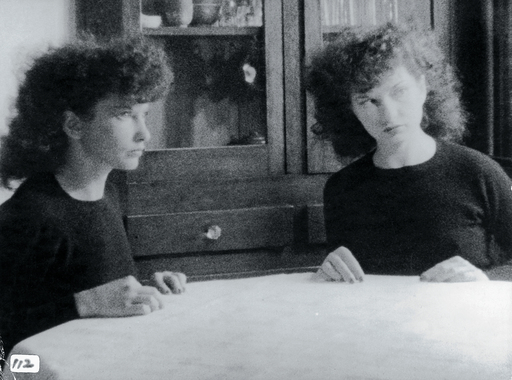
Although I'm not sure how well my first example today, early American experimental filmmaker Maya Deren, fits this category. She's certainly obscure/niche, and a miniaturist in the sense that she only made short films. But as a persona, Deren was too richly sensual to be “fey”; a sensual intellectual. Her first and best-known film, Meshes of the Afternoon, reveals her deep entanglement in what even now, in our “metrosexual era,” can only be called a specifically female narcissism: not mere physical vanity but dreamy psychological self-absorption.

Deren eerily reproduces herself in this film in a way that distinctly reminds me of one of my favourite paintings, Memories, by the Symbolist Khnopff. 


A heavy, humid, hauntingly “maternal” atmosphere hangs over Khnopff's painting, as it does over Deren's film. Deren herself, with that abundant curly hair, seems physically as well as psychologically in the same Pre-Raphaelite mode as Khnopff's model (his sister, if I recall from Sexual Personae) and the most famous example, Rossetti's late Muse, Jane Morris.


I'm hardly the only blogger to think in terms of “sexual personae,” and others have noted Deren's similarity to another British icon, both physically and as an artist: Kate Bush.


Certainly, Bush has that same sensual/intellectual combination, and her lyrics frequently obliquely explore a certain freaky, convoluted female sexual psychology in which narcissism plays a large role, as in the rather terrifying “Get Out of My House,” in which male sexuality is figured as a kind of invasive poltergeist (and, oh yeah, an abject donkey). Bush, whose lyrics often align sexuality with occult powers (think of the Cathy-ghost in “Wuthering Heights,” where it's male sexuality that's shunning and cold), also likes to take on the role of “witch,” perhaps as a metaphor for demonized femininity; another point in common with Deren, who became fascinated with Haitian Vodoun, to which she was introduced by dancer, choreographer, and dance anthropologist Katherine Dunham.

Deren, however, was not British, but an American of Jewish Eastern European origins (born in the Ukraine). On the evening I finally familiarized myself with Deren (after hearing about her for ages in connection with Lynch and especially Mulholland Dr.), I did a little dreamy, persona-based googling. (In the early 90s, Paglia recommended browsing library shelves to spark unexpected associations, which I'd already been doing as a teenager anyway; the internet facilitates this creative methodology to an exceptional degree.) Based on nothing more than their hair, their Jewishness, their limited output, and their cult status, I made a connection between Deren and American writer Jane Bowles, and was surprised (“spooked” might be a better word) when I googled their Wikipedia entries to learn that they were born in the same year, just a couple of months apart: Deren on April 29, 1917; Bowles on February 22, 1917.


Deren and Bowles had much more in common, too. They were both denizens of New York in their main period of artistic activity, the 1940s (did they ever meet?): in fact, just now I learned, on a closer look at the entries, that Bowles's only novel, Two Serious Ladies, was published in 1943, the same year that Deren made her first completed film (co-directed with her husband, Alexander Hammid), Meshes of the Afternoon. They were both drawn to the “exotic,” Deren travelling to Haiti, Bowles travelling with her husband to Mexico and Central America before settling with him in Tangier. Deren became infatuated with Voudon; Bowles with the Berber woman Cherifa.

It seems to be a “thing” for female cult artists to develop strange myths surrounding their lives and deaths. Anyway, it certainly happened to Deren and Bowles. The documentary In the Mirror of Maya Deren gives an account, mainly from a seemingly 60s-addled commentator, of the rumours that Deren's early death (at 44) was related to her dabbling in Voudon. Commentators who knew her towards the end also suggest that it was due to her vast, volatile creative energy, responsible for many stormy rages, which had turned poisonous due to her frustration at not getting enough funding to continue making the films she wanted to. (Among the official reasons given was malnutrition.)

Bowles also died young, at 58, in a sanitorium in Spain. She may have outlived Deren, but only to suffer, since in 1957 (four years before Deren's death), she had a stroke (official reason: alcohol) that severely incapacitated her to the end of her life. In the hotbed of expatriate gossip and rumour in Tangier, however, the story spread that her declining health was due to Cherifa's native witchcraft – also supposedly responsible for Bowles's obsession with the woman. Throughout her life, many who knew her (and her fans in her lifetime included John Ashbery, Truman Capote, Tennessee Williams, and Christopher Isherwood, who supposedly based Sally Bowles on her in part) believed that her to some charismatic, to others (notably an unimpressed Gore Vidal) insufferably neurotic personality was the result of her thwarted creativity, a life of extended, tormented writer's block.

That Voodoo That You Do So Well

Deren's Eastern European and Greenwich Village connections (and the hair, again!) wafted me along to my next association: the heroines of producer Val Lewton's 1940s B-horror/noirs, especially Simone Simon in Cat People (1942, directed by Jacques Tourneur) and the iconic Jean Brooks (of the Pulp Fiction hair) in The Seventh Victim (1943, directed by Mark Robson).


Lewton, also of Jewish Ukrainian origins, was a pulp fiction writer who found his metier making classy horror films on a low budget for RKO. In Cat People, French Simon plays Irena Dubrovna, from Serbia. (In a Hollywood film, the French are “exotic” enough for anything, and one Eastern European country as good as another.) Irena is trying to Americanize (by pathologically attaching herself to bland all-American boy Oliver Reed, played by Kent Smith, every bit as wooden as he sounds), and get away from a past that includes idol-worship, witchcraft... and the ability to turn into a panther. The “horror” of the film is female sexuality: Irena appears frigid (returning us to the terrain of “Get Out of My House”), but her “panther self” seems a metaphor for the voracious female sexual appetite, which she's afraid to unleash. There's a distinct thematic connection to Dreyer's great melodrama about witchcraft, Day of Wrath (1943 again!), in which female sexuality turns out to have the power to telepathically kill.

(Yet Dreyer, like Lewton, stays on its side.)

The Seventh Victim, set in Greenwich Village, deals openly with the topic of suicide: the heroine, Jacqueline, is a decadent sensation-seeker who can't decide if she wants death as the final sensation or if she's just world-weary; but she's as terrified of it as she is drawn to it. She gets mixed up with a Satanic cult who want to force her to die, and tries to get away from it. (Doh! Just realized that this was the main source for a one-woman theatre piece I wrote and performed in which I played two women who might be one woman with a split personality: one is convinced that a sinister cult wants to put her in a snuff film; the other is trying to persuade her filmmaker-boyfriend to make one in which she stars. My favourite line from it, towards the end, was: “I want them to say, 'She only did it for the attention.'”) In the end, however, she goes back to her Village apartment and hangs herself. The whole thing eerily anticipates the Manson murders and their connection (through director Polanski, husband of victim Sharon Tate) with Rosemary's Baby.

Lewton also produced an RKO film... about Voudon. I Walked With a Zombie (1943) is set on the Caribbean Island of Saint Sebastian (probably because Lewton, or someone involved, liked the decadent reference to the homoerotic imagery of the suffering saint; here, however, put in service of representing the legacy of African slavery). The film also draws on the actual Voudon origins of North America's favourite millennial monster, and features a “gone native” female doctor who believes she can be possessed by a Voudon god and deliver curses, as Deren apparently did.

Recent shout-outs to Deren in a variety of media include the video for Janelle Monae's “Tightrope” (2010), set in an imaginary asylum for artists in which, a bit of text informs us at the start, “Dancing has long been forbidden for its subversive effects on the residents and its tendency to lead to illegal magical practices,” and Bruce LaBruce's queer zombie movie, Otto; or, Up with Dead People (2008), where the filmmaker-within-the-film Medea Yarn is obviously loosely modelled on Deren.

Fragments of Bowles and Deren

Janelle Monae also has some of that Bride of Frankensteinesque Bowlesian hair (and androgyny) going on:


The cover of her debut album, The ArchAndroid, however, seems to draw specifically on the cover of Sexual Personae, which no doubt Monae has read, since it includes Paglia's android-Bowie/Nefertiti comparison. For Paglia, the head-heavy Nefertiti represents a new, nature-rejecting image of woman as aspiring, soaring intellect; for Monae, claiming this right for women seems to mean embracing an android persona that (although, ironically, object-like) repels attempts to turn her into a sex object.


During a long period (between 15, when I read Millicent Dillon's biography, and 23 or so) when I was rather obsessed with Jane Bowles, I found still other correspondences, such as Katharine Hepburn in Bringing Up Baby (obviously an alien, especially in the bar scene where she's wearing that extraordinary metallic dress with the bits of ribbon floating around her face like translucent antennae) and Jennifer Jones in Love Letters


Jones has no association with witchcraft that I know of, but the two films in which she starred that were directed by William Dieterle, Letters and Portrait of Jennie, have an eerie, Gothic/Expressionist feel suited to Jones's fey, earthy/ethereal, high-strung, almost somnambulistically narcissistic persona as nothing ever would be again. In Portrait of Jennie, she plays a ghost who ages in quantum leaps, and gives the most convincing portrayal by an adult actress of a child I've ever seen. In Love Letters (with a screenplay by... wait for it... AYN RAND), she's, basically, a Platonic Idea, who can't psychologically negotiate the reality of her own or male sexuality, despite being as avidly, felinely sensual as ever. I suspect that Hitchcock took notes for Vertigo watching Portrait of Jennie and for Marnie watching Love Letters. The critic David Thomson, who's usually grievously wrong about everything, was almost right when he said that Jones would have been suited to play James's Isabel Archer; if he'd said Milly Theale, I would have forgiven him everything.


More Tragi-Farcical Courtship Rituals

The last play I ever had produced was called Non Sequitur, about the marriage of Jane and Paul Bowles, which I subtitled “A Screwball Comedy with Consequences” because I couldn't figure out how to focus it until I made the Bringing Up Baby connection. (I also had in mind Paglia on As You Like It in Sexual Personae.) The first act was produced at the 1999 Toronto Fringe Festival, and NOW magazine made it a top pick; it was self-contained enough that no one noticed the second act missing. The play focused, scene by scene, on various more or less malicious games the couple played to negotiate their complex relationship, and my own favourite, which recurred as a motif, was the one in which Paul pretended to be a parrot that Jane would have to send to his cage when, due to her coaxing, he got out of control (or in others words, got his queer on and “freaked out” – an idea brilliantly, bravely realized by straight actor Ross McMillan in the workshop production; Ross also played a note-perfect Orton in the original production of Live With It). The wonderful poster (sadly, no longer up on the internet) for the Toronto production seized on this image, portraying a tiny Paul brooding (Cary Grant Thinker style) in a bird cage, on which Jane leans languidly – sort of like I Dream of Jeannie with a gender role reversal. I thought it was a great image, but for many years I was in deep denial that I had really portrayed such an overpowering woman, when I thought I was portraying my idea of an equal marriage (except for the part where Paul is forced to put Jane in her cage – the asylum – at the end).

Nevertheless when the actress who played Jane in the Toronto production, Sarah Neville, repeated to me with worry a critic's opinion that she was “too relentless” as Jane, I reassured her, “It's Jane Bowles. That's not possible.”

Shirley MacLaine, Preying Ingenue

A sort of postscript: the freakiest, feyest performance I've ever seen a woman give is the young Shirley MacLaine in Tashlin's Dean Martin and Jerry Lewis vehicle, Artists and Models, which may still be the queerest movie ever made, harnessing all of the gender-bending potential of the Martin and Lewis partnership in the service of a bisexual utopic subtext. In all other Martin and Lewis films (generally regarded as vastly inferior), Lewis is the queerest object on display, a homely Boylita who, for 50s (straight) America, was secretly the ultimate twink to an even greater degree than Justin Bieber is now, to judge from the surprising fact that he, not Martin, is the sex object of the films. But here the genuine ingenue MacLaine beats eternal ingenue Lewis at his own game by being, as I recall Mark Simpson and I observed together in a discussion of this, a better boy than he is, providing a rare example of the androgynous (though voluptuous) girl being more charismatic than the androgynous boy. And when she serenades him on a staircase by bellowing “My Innamorta” at him as he tries frantically to get away, she's like some kind of contortionist stick-insect, and textually, he's an adolescent boy scared of the faster-maturing adolescent girl, while, subtextually, he's a queer man fleeing the female preying mantis who's trying to devour him because he's asking for it by being such a tasty little morsel. (If there's any difference. Lewis would, of course, perfect this persona and scenario in his masterpiece, The Ladies Man. But more on that in a later post.) But they're reverse mirror images of each other, and their bizarre courtship ritual is, of course, symbolic of heterosexual relations even into adulthood, according to some analyses. Which is what makes male homosexuality a continuity with male heterosexuality. 


MacLaine isn't exactly a witch, but her freaky-kooky persona at this early stage of her career lets you see where the later, New Age advocate MacLaine came from, and almost makes up for it.