Showing posts with label Katharine Hepburn. Show all posts

Wednesday, February 5, 2014

Thirteen Ways of Looking at the Vogue-Jezebel Lena Dunham Dust Up

So we all know by now that the popular feminist site Jezebel offered $10, 000 for the unretouched photos from Lena Dunham's shoot for this month's issue of Vogue. If you cared about that, you will also have learned that Jezebel's readership did not take kindly to what they interpreted as mean-girling, concern-trolling, anti-woman click bait. It may have been a sad day for pop feminism when Jezebel posted that article, but it became a happy day when the readership decided they wouldn't put up with it. And surely it's the least we can ask from feminism that it not do anything that can be interpreted as bullying and shaming a woman who's in the public eye. Or at any rate, isn't it kind of sweet that we develop these protective feelings towards female celebrities when we think they've taken too much shit – from men and women, critics and internet trolls? It almost seems like there's a wave of girl-bashing every few months, followed by the backlash. And I've jumped to the defense of them all over the years: Courtney, Britney, Amy, Lana, Miley. I even watched The Simple Life, and thought it was pretty funny.

There's always an “it” girl, someone we can't stop talking about, that we're obsessed with as a culture. We ogle, we nitpick, attack her appearance, laugh at her if she's supposed to be dumb, dismiss her as a “hipster” if she's smart. She's not the girl that everyone can agree to like, who's often presented as her opposite, like Lorde and Miley Cyrus, as if all women come in contrasting pairs, a Good Example and a Bad Example. The “it” girl phenomenon is perhaps partly the result of pop culture being pretty much wall-to-wall men (with eye candy hanging on the walls*), so that we can only think about one woman at a time, and partly the result of the general public (or mostly women?) projecting soap opera narratives onto the private lives and psyches of female celebrities in a way we just don't for men. The backlash is the result of men and women needing to decide on what represents acceptable femininity. If I say “I like this girl” or “I don't like this girl,” it is momentous, because I'm deciding on the kind of woman I want to be; and whatever side I choose, you can be sure I think I'm righteous, because of how, you know, civilization itself is at stake.

This is sort of a companion piece to my post on the David Gilmour PR fiasco. Anyway, I've pulled out the numbered list again. 

I'm Thinking of a Woman Called Jezebel, Who Did Evil in the Sight of God...”

1. Lena Dunham is an ordinary-looking woman, say some. Or, is she a hideous beast? According to others. Or is she in fact a better-than-average-looking woman? Which, I'd contend (like Bette Davis before her – or is Judy Garland the better comparison?), in some ways she is. She has celebrity charisma and an appealing clown face, excellent (as well as her slumped clown body) for comedy, that reminds me above all of Giulietta Masina.


2. Jezebel was trying to humiliate her by scrutinizing the appearance flaws in her unretouched photos. Or – Jezebel didn't think they're flaws. They thought that Vogue thought they were flaws. Jezebel thinks she looks fine without retouching! Only none of the commenters believe that. But does that mean that they think Dunham is a hideous beast, or that they think that Jezebel thinks that, whereas they think that Dunham looks fine? Is it possible for anybody to come out of this without admitting that they don't think Dunham looks fine?

3. Is it different to compare before-and-after photos of models or sex symbols and to do it with Dunham? Is is ever valiant to educate the public by showing the unrealistic standards to which the media holds women's appearance? Relatedly, in the episode of Girls where Hannah finds out her e-book editor died, I got the fullest view of Dunham's body in a while, standing up in nothing but panties, with nothing obscuring it, and I was surprised to see that she's bigger than I remembered, or thought she was from viewing her clothed figure. BUT. Take a look at Catherine Deneueve in Belle de Jour (1967), when she was considered one of the most beautiful women in the world. By today's toned, retouched, and implanted standards, she's chunky and small-breasted. THEN AGAIN. Check out Cary Grant in his shirtless scene in North by Northwest (1959). Half a century ago, that was fan service for the ladies, but by today's cruel standards, he looks skinny, saggy-breasted, and undefined. (He's also got a real Dunhamesque case of slope-shoulders.)


Not good enough!

4. Also, please note, people, that even the greatest beauties in history have facial flaws that were removed from sight so that their beauty could enter the realm of art and fantasy, where it rightfully belonged. Did you want to see Vivien Leigh play Scarlett O'Hara with a moustache? Even if it would make you feel better about your own femmestache? (Saw the before and afters in a book on Gone With the Wind. Also removed: eyebags. That was a long and stressful shoot.)

5. Why this idea by both Jezebel and some of Dunham's defenders in the comments that the unretouched photos show what she “really” looks like? There's no “really looks like” to a photo. A photo can be flattering or unflattering, depending on lighting and angles. On top of which some people are photogenic and some are not despite being attractive in person. I sure hope my worst “somebody tagged you” Facebook photos aren't what I “really look like.” On the other hand, there is such a thing as retouching beyond recognition, or to the point of inhuman flawlessness.

6. It's not exactly that male celebrities are allowed to be more flawed. Things like wrinkles aren't considered flaws on men; they lend gravitas, which is considered attractive in men, whereas women are supposed to always look like they did at peak baby-making time. I'm sure that nevertheless magazines retouch the hell out of pictures of male celebrities, they just get to leave certain things in. And we're used to seeing a greater variety in men's appearance in the media, from exceptionally handsome to average to sloppy, because the role of women in the media is still largely to be eye candy for men, and if they are also actors, or singer-songwriters, or comedians, they are still expected to be eye candy on top of that.

7. Is Dunham a hypocrite? Is she's all for body positivity, why appear in evil Vogue, which conspires to hold women to an impossible ideal? Well, I hope it's because Lena Dunham loves Vogue. I certainly did as a teenager and in my early 20s, back when I emulated current high fashion on a budget by shopping in thrift stores. After I stopped expressing my creativity through my clothing, I also stopped buying fashion magazines; the Dunham cover is the first time I've picked one up in maybe a decade. I was more interested in the clothes than in the models, although I loved Kate Moss like everyone else. But there's nothing wrong with beauty. And while it would be great to see Vogue expand its notion of beauty a little (beyond “anorexic 19-year-old”), photo retouching has not become oppressive for women because of the fashion magazines, but because everywhere in the media women are held to that standard.

8. Speaking of Kate Moss, unleashed photo retouching has allowed supermodels to have careers that go on forever and ever. This is good for the models, but not so good for women in general, since the effect is that, more than ever, we're not allowed to age.

9. The effect of all of this is that we have actually forgotten what real women look like. And I don't mean some ideal “real woman,” who is somehow more “essentially womanly” because she's heavier-set, say. I mean “real woman” as opposed to a made-up media ideal. And a lot of the Dunham hate coming from men on the internet is because men, too, have been brainwashed into thinking that women ought to look like women on TV, in movies, in magazines, and in ads... oh and porn. And yes, that has to stop, and on her show, Dunham is trying to help put a stop to it. We, men and women, have to be able to look at a physically imperfect woman in the media without freaking out and thinking she's a monster.

10. Carol Burnett was a funny-looking comedian. Did she take this much crap, or was there a time when women didn't have to be hawt to be on TV? What about Mayim Bialik over on The Big Bang Theory? My impression is that she's a very popular character, and while the show sometimes calls attention to the fact that she's less hawt than the two other main female characters, it never makes her the butt of jokes based on her looks, and she is definitely presented as sexually viable (albeit also frustrated because she's dating the asexual Sheldon). Why does she get away with playing a female nerd, and Dunham doesn't? Conversely, why don't we hear about everything that Bialik is doing for female body image?


Rocking the cardie for comedy

11. I understand that by confronting us with her naked body a lot on Girls, Dunham is desensitizing us to what a real woman's body looks like, and that's a good thing. That said, I don't necessarily want to see imperfect naked male bodies on TV, either. For example, I have a big crush on Jason Schwartzman which I'm pretty sure would only be negatively impacted by constantly seeing him undressed on a TV show. Yes, we're used to seeing a lot of average-looking men on TV, but then again, George Costanza kept his clothes on**. Well, mostly.


Ilu, and because ilu, I will try to forget I saw this

Naked for comedy. I can never forget I saw this

12. This idea we have, by the way, that you can't say or imply that a woman is less than lovely without causing irreparable psychological damage and being a brute – where does that come from? It seems to have been behind the irate reaction of Dunham's producers to a reporter who questioned her about her nudity on Girls, another Dunham story that was all over the internet recently. Dunham goes out of her way to look awful on Girls, while cleaning up nicely in her (public) private life and making an effort to look pretty, because, some women (obviously not Hannah Horvath) like to do that sometimes. It's a sad day for a comedian when your fans and even your producers feel that they have to jump in and reassure you that you're beautiful all of the time. Pretty sure Jason Alexander does not inspire, or require, this reaction, or Woody Allen. And all it does is reinforce the idea that appearance and desirability are a woman's most important attributes.

13. Likewise, every time someone reacts to criticism of Dunham's appearance by objecting, “But Lena Dunham isn't ugly – she's cute!” or “But Lena Dunham isn't fat – she's average!”, my immediate thought is, “Well then, what about the women who are ugly and are fat. Do they not deserve to be represented in the media? And would they deserve the hateful attacks that you are saying Dunham does not because she's not?” The media is always going to be a place where pretty people thrive, but when a female entertainer isn't permitted to look any other way, even if the departure is as minor as it is in the case of “Hollywood Homely” Dunham, that's a problem.

Internalization and Defiance

Incessant criticism of one's appearance can be psychologically damaging to a female celebrity, however. Look at Judy Garland. Look at Courtney Love, although her examination of cultural expectations of female beauty was so intense and personal that her plastic surgery just seems like an extension of it. Look at Amy Winehouse. Bette Davis weathered it out and took advantage of the acting opportunities it gave her, and the opportunity to be taken seriously as an actor, but she so frequently made herself appear grotesque that you know she took it to heart. Katharine Hepburn, however, an actress criticized by the Hollywood moguls for her “sexlessness” and the general public for her privilege and the confidence and eccentricity that went with it, came equipped with enough narcissism that she seemed impervious to the first kind of criticism, at least. I strongly advise any Hepburn fans to check out the fascinating, prickly Dick Cavett interview, where, early on, the elderly Hepburn repeatedly insists that he check out a picture of her taken for a play as a half-naked teenage hottie, a picture so smouldering that, she claims, it launched her in Hollywood.

I assume it's this one.


However, Hepburn did seem to internalize the public's criticism of her personality, to the extent that she commissioned a play from Philip Barry that would humble her persona and therefore, she hoped, finally make her a popular actress. The self-abasement worked, but this aspect of The Philadelphia Story still makes fans of the original, uncompromised Hepburn cringe. To judge by the new season of Girls, Dunham seems to be internalizing the criticism directed at her in a different way: instead of trying to appease her critics, she defiantly keeps making Hannah Horvath more and more unlikable. Which I find a bit of a shame, because I never understood why Hannah was supposed to be unlikable in the first place. In her cadences, her irony, her articulate, paragraph-long observations and reports on her inner life, Hannah reminded me of girls I knew in university, fellow English students – the kind of girl I'd want to be friends with the moment I heard her and took in her wonderful, awful fashion sense. The kind of girl I was. 

I'm so predisposed to empathize with this character type that Hannah's flashes of unmistakable sociopathy still feel OOC to me, and when the other characters gang up on her, as in "Dead Inside," and try to browbeat her into conforming to social norms, I side with her the way I used to side with Oscar the Grouch against the sanctimonious adults on Sesame Street when I was three. "Adults" on this show are often the regular male characters, Adam and Ray (who is in fact significantly older than the girls); they, in any case, see themselves as adults, and talk like adults, although Ray can't pull his own life together and Adam is capable of egregious interpersonal misjudgments, to say the least. In that respect they serve a killjoy role a little bit like the Skyler one (a very little bit) on Breaking Bad, scolding the girls for their bad behaviour; as men, however, they also represent the norm that the girls are passively-aggressively rebelling against. 

"Very Little to Distress or Vex Her"

Dunham's not just any other “it” girl, or controversial, Courtney-like hate-magnet. Her genealogy traces back through Hepburn to Jane Austen's Emma Woodhouse, the seminal privileged white girl of Anglo-American fiction, who irritates readers because of the confidence and narcissism that her sheltered life has given her. That confidence, however, is the reason that, to use Lionel Trilling's sexist phrasing, she is one of the rare heroines of fiction who “has a moral life like a man”; which is to say that she sees herself as the protagonist of her life, and she has enough power that her morally incorrect decisions have consequences for others. Dunham, however, isn't pretty enough to be an Emma – but she'd make a great Elizabeth Bennet, who's not supposed to have much going for her in the looks department except “a fine pair of eyes.” Maybe Patrick Wilson would like to play Darcy?

Bizarrely, some of the hatred directed at Girls by some media commentators seems to derive from the archaic idea that privileged white girls are the most useless human beings on the planet, parasites (because this idea was born in a world where women could do nothing with their lives except marry) who nevertheless think of themselves as the height of human perfection because they've been raised to believe that the world revolves around them. It can't possibly be that the girls of Girls are self-absorbed, petty sitcom characters like any other self- absorbed, petty sitcom characters – like the Seinfeld characters, say, or the central characters on any number of British sitcoms, like Peep Show, or for that matter, Absolutely Fabulous. (Joanna Lumley's Patsy is surely what Jessa is going to grow up to be.) 


No, because they're young girls from privileged upbringings, they must be “princesses,” towards whom we must direct a special hatred to compensate for all of the undeserved love we think they must have been given. Including all of that undeserved love from critics, since depending who you ask, Girls is either the most hated or the most overrated show on television.

Besides, if shows that ask the viewer to sympathize with the trials of privileged white people are the problem, go complain about Downton Abbey. Seriously.


* The argument can also be made that the relative lack of celebration of male beauty and the male body in our male-gaze-assuming, heteronormative culture is bad for men in all kinds of ways, while "metrosexuality" is in some ways a gain for men. Of course it can, and if you want to see how it can, check out the fascinating writings of my friend Mark Simpson

**On the other hand, if you want to know what male privilege was like in the bad old days, when it was assumed without question that the only value a woman had was her desirability to men, a while back on the Facebook Film Forum, someone posted a link to some "off the record" interviews with Orson Welles from which the press had pulled his remark about Bette Davis that he couldn't watch her movies because he couldn't stand to look at her. To which I replied, "I wonder how she felt about looking at Orson Welles."

Friday, August 5, 2011

That Old Black Magic: The Female Artist as Witch

This post is going to finally give you what you've been waiting for: a glimpse into how my mind actually works when it comes to art and gender. Ready?

Way back in the day, Paglia's sexual personae taught me how to leap across centuries and cultural contexts in a single bound, as in her comparison of the bust of Nefertiti and Bowie in his “android phase.” What I liked about this tendency to yoke together the disparate with violence was that it enabled me to perceive, or assert, affinities between my two areas of interest (in common with many thoughtful teens of my generation and since): high culture and pop culture. Which can otherwise be rather difficult to compare. How could I measure which had the “greater” impact on me as a teenager – Hamlet, or Hatful of Hollow? Pride and Prejudice, or Ziggy Stardust and the Spiders from Mars?

In any case, Paglia instilled in me a lifelong tendency to think of artists in groups of “personae,” although my personae weren't as sexy as hers. I've got one main cluster, which I can separate out into male and female examples; today, I'll be giving some of the female examples. I think of this main grouping as “fey” artists, male or female, with some peripheral overlap with Paglia's “Mercurius androgyne.” These artists are also usually “minor,” or at least for niche tastes; they may also be miniaturists, like Robert Walser.

Maya Deren and Jane Bowles: Entangled Twins

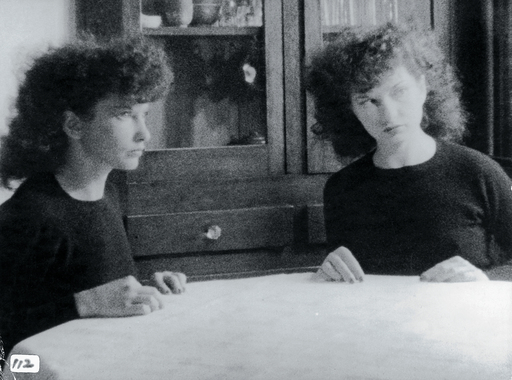
Although I'm not sure how well my first example today, early American experimental filmmaker Maya Deren, fits this category. She's certainly obscure/niche, and a miniaturist in the sense that she only made short films. But as a persona, Deren was too richly sensual to be “fey”; a sensual intellectual. Her first and best-known film, Meshes of the Afternoon, reveals her deep entanglement in what even now, in our “metrosexual era,” can only be called a specifically female narcissism: not mere physical vanity but dreamy psychological self-absorption.

Deren eerily reproduces herself in this film in a way that distinctly reminds me of one of my favourite paintings, Memories, by the Symbolist Khnopff. 


A heavy, humid, hauntingly “maternal” atmosphere hangs over Khnopff's painting, as it does over Deren's film. Deren herself, with that abundant curly hair, seems physically as well as psychologically in the same Pre-Raphaelite mode as Khnopff's model (his sister, if I recall from Sexual Personae) and the most famous example, Rossetti's late Muse, Jane Morris.


I'm hardly the only blogger to think in terms of “sexual personae,” and others have noted Deren's similarity to another British icon, both physically and as an artist: Kate Bush.


Certainly, Bush has that same sensual/intellectual combination, and her lyrics frequently obliquely explore a certain freaky, convoluted female sexual psychology in which narcissism plays a large role, as in the rather terrifying “Get Out of My House,” in which male sexuality is figured as a kind of invasive poltergeist (and, oh yeah, an abject donkey). Bush, whose lyrics often align sexuality with occult powers (think of the Cathy-ghost in “Wuthering Heights,” where it's male sexuality that's shunning and cold), also likes to take on the role of “witch,” perhaps as a metaphor for demonized femininity; another point in common with Deren, who became fascinated with Haitian Vodoun, to which she was introduced by dancer, choreographer, and dance anthropologist Katherine Dunham.

Deren, however, was not British, but an American of Jewish Eastern European origins (born in the Ukraine). On the evening I finally familiarized myself with Deren (after hearing about her for ages in connection with Lynch and especially Mulholland Dr.), I did a little dreamy, persona-based googling. (In the early 90s, Paglia recommended browsing library shelves to spark unexpected associations, which I'd already been doing as a teenager anyway; the internet facilitates this creative methodology to an exceptional degree.) Based on nothing more than their hair, their Jewishness, their limited output, and their cult status, I made a connection between Deren and American writer Jane Bowles, and was surprised (“spooked” might be a better word) when I googled their Wikipedia entries to learn that they were born in the same year, just a couple of months apart: Deren on April 29, 1917; Bowles on February 22, 1917.


Deren and Bowles had much more in common, too. They were both denizens of New York in their main period of artistic activity, the 1940s (did they ever meet?): in fact, just now I learned, on a closer look at the entries, that Bowles's only novel, Two Serious Ladies, was published in 1943, the same year that Deren made her first completed film (co-directed with her husband, Alexander Hammid), Meshes of the Afternoon. They were both drawn to the “exotic,” Deren travelling to Haiti, Bowles travelling with her husband to Mexico and Central America before settling with him in Tangier. Deren became infatuated with Voudon; Bowles with the Berber woman Cherifa.

It seems to be a “thing” for female cult artists to develop strange myths surrounding their lives and deaths. Anyway, it certainly happened to Deren and Bowles. The documentary In the Mirror of Maya Deren gives an account, mainly from a seemingly 60s-addled commentator, of the rumours that Deren's early death (at 44) was related to her dabbling in Voudon. Commentators who knew her towards the end also suggest that it was due to her vast, volatile creative energy, responsible for many stormy rages, which had turned poisonous due to her frustration at not getting enough funding to continue making the films she wanted to. (Among the official reasons given was malnutrition.)

Bowles also died young, at 58, in a sanitorium in Spain. She may have outlived Deren, but only to suffer, since in 1957 (four years before Deren's death), she had a stroke (official reason: alcohol) that severely incapacitated her to the end of her life. In the hotbed of expatriate gossip and rumour in Tangier, however, the story spread that her declining health was due to Cherifa's native witchcraft – also supposedly responsible for Bowles's obsession with the woman. Throughout her life, many who knew her (and her fans in her lifetime included John Ashbery, Truman Capote, Tennessee Williams, and Christopher Isherwood, who supposedly based Sally Bowles on her in part) believed that her to some charismatic, to others (notably an unimpressed Gore Vidal) insufferably neurotic personality was the result of her thwarted creativity, a life of extended, tormented writer's block.

That Voodoo That You Do So Well

Deren's Eastern European and Greenwich Village connections (and the hair, again!) wafted me along to my next association: the heroines of producer Val Lewton's 1940s B-horror/noirs, especially Simone Simon in Cat People (1942, directed by Jacques Tourneur) and the iconic Jean Brooks (of the Pulp Fiction hair) in The Seventh Victim (1943, directed by Mark Robson).


Lewton, also of Jewish Ukrainian origins, was a pulp fiction writer who found his metier making classy horror films on a low budget for RKO. In Cat People, French Simon plays Irena Dubrovna, from Serbia. (In a Hollywood film, the French are “exotic” enough for anything, and one Eastern European country as good as another.) Irena is trying to Americanize (by pathologically attaching herself to bland all-American boy Oliver Reed, played by Kent Smith, every bit as wooden as he sounds), and get away from a past that includes idol-worship, witchcraft... and the ability to turn into a panther. The “horror” of the film is female sexuality: Irena appears frigid (returning us to the terrain of “Get Out of My House”), but her “panther self” seems a metaphor for the voracious female sexual appetite, which she's afraid to unleash. There's a distinct thematic connection to Dreyer's great melodrama about witchcraft, Day of Wrath (1943 again!), in which female sexuality turns out to have the power to telepathically kill.

(Yet Dreyer, like Lewton, stays on its side.)

The Seventh Victim, set in Greenwich Village, deals openly with the topic of suicide: the heroine, Jacqueline, is a decadent sensation-seeker who can't decide if she wants death as the final sensation or if she's just world-weary; but she's as terrified of it as she is drawn to it. She gets mixed up with a Satanic cult who want to force her to die, and tries to get away from it. (Doh! Just realized that this was the main source for a one-woman theatre piece I wrote and performed in which I played two women who might be one woman with a split personality: one is convinced that a sinister cult wants to put her in a snuff film; the other is trying to persuade her filmmaker-boyfriend to make one in which she stars. My favourite line from it, towards the end, was: “I want them to say, 'She only did it for the attention.'”) In the end, however, she goes back to her Village apartment and hangs herself. The whole thing eerily anticipates the Manson murders and their connection (through director Polanski, husband of victim Sharon Tate) with Rosemary's Baby.

Lewton also produced an RKO film... about Voudon. I Walked With a Zombie (1943) is set on the Caribbean Island of Saint Sebastian (probably because Lewton, or someone involved, liked the decadent reference to the homoerotic imagery of the suffering saint; here, however, put in service of representing the legacy of African slavery). The film also draws on the actual Voudon origins of North America's favourite millennial monster, and features a “gone native” female doctor who believes she can be possessed by a Voudon god and deliver curses, as Deren apparently did.

Recent shout-outs to Deren in a variety of media include the video for Janelle Monae's “Tightrope” (2010), set in an imaginary asylum for artists in which, a bit of text informs us at the start, “Dancing has long been forbidden for its subversive effects on the residents and its tendency to lead to illegal magical practices,” and Bruce LaBruce's queer zombie movie, Otto; or, Up with Dead People (2008), where the filmmaker-within-the-film Medea Yarn is obviously loosely modelled on Deren.

Fragments of Bowles and Deren

Janelle Monae also has some of that Bride of Frankensteinesque Bowlesian hair (and androgyny) going on:


The cover of her debut album, The ArchAndroid, however, seems to draw specifically on the cover of Sexual Personae, which no doubt Monae has read, since it includes Paglia's android-Bowie/Nefertiti comparison. For Paglia, the head-heavy Nefertiti represents a new, nature-rejecting image of woman as aspiring, soaring intellect; for Monae, claiming this right for women seems to mean embracing an android persona that (although, ironically, object-like) repels attempts to turn her into a sex object.


During a long period (between 15, when I read Millicent Dillon's biography, and 23 or so) when I was rather obsessed with Jane Bowles, I found still other correspondences, such as Katharine Hepburn in Bringing Up Baby (obviously an alien, especially in the bar scene where she's wearing that extraordinary metallic dress with the bits of ribbon floating around her face like translucent antennae) and Jennifer Jones in Love Letters


Jones has no association with witchcraft that I know of, but the two films in which she starred that were directed by William Dieterle, Letters and Portrait of Jennie, have an eerie, Gothic/Expressionist feel suited to Jones's fey, earthy/ethereal, high-strung, almost somnambulistically narcissistic persona as nothing ever would be again. In Portrait of Jennie, she plays a ghost who ages in quantum leaps, and gives the most convincing portrayal by an adult actress of a child I've ever seen. In Love Letters (with a screenplay by... wait for it... AYN RAND), she's, basically, a Platonic Idea, who can't psychologically negotiate the reality of her own or male sexuality, despite being as avidly, felinely sensual as ever. I suspect that Hitchcock took notes for Vertigo watching Portrait of Jennie and for Marnie watching Love Letters. The critic David Thomson, who's usually grievously wrong about everything, was almost right when he said that Jones would have been suited to play James's Isabel Archer; if he'd said Milly Theale, I would have forgiven him everything.


More Tragi-Farcical Courtship Rituals

The last play I ever had produced was called Non Sequitur, about the marriage of Jane and Paul Bowles, which I subtitled “A Screwball Comedy with Consequences” because I couldn't figure out how to focus it until I made the Bringing Up Baby connection. (I also had in mind Paglia on As You Like It in Sexual Personae.) The first act was produced at the 1999 Toronto Fringe Festival, and NOW magazine made it a top pick; it was self-contained enough that no one noticed the second act missing. The play focused, scene by scene, on various more or less malicious games the couple played to negotiate their complex relationship, and my own favourite, which recurred as a motif, was the one in which Paul pretended to be a parrot that Jane would have to send to his cage when, due to her coaxing, he got out of control (or in others words, got his queer on and “freaked out” – an idea brilliantly, bravely realized by straight actor Ross McMillan in the workshop production; Ross also played a note-perfect Orton in the original production of Live With It). The wonderful poster (sadly, no longer up on the internet) for the Toronto production seized on this image, portraying a tiny Paul brooding (Cary Grant Thinker style) in a bird cage, on which Jane leans languidly – sort of like I Dream of Jeannie with a gender role reversal. I thought it was a great image, but for many years I was in deep denial that I had really portrayed such an overpowering woman, when I thought I was portraying my idea of an equal marriage (except for the part where Paul is forced to put Jane in her cage – the asylum – at the end).

Nevertheless when the actress who played Jane in the Toronto production, Sarah Neville, repeated to me with worry a critic's opinion that she was “too relentless” as Jane, I reassured her, “It's Jane Bowles. That's not possible.”

Shirley MacLaine, Preying Ingenue

A sort of postscript: the freakiest, feyest performance I've ever seen a woman give is the young Shirley MacLaine in Tashlin's Dean Martin and Jerry Lewis vehicle, Artists and Models, which may still be the queerest movie ever made, harnessing all of the gender-bending potential of the Martin and Lewis partnership in the service of a bisexual utopic subtext. In all other Martin and Lewis films (generally regarded as vastly inferior), Lewis is the queerest object on display, a homely Boylita who, for 50s (straight) America, was secretly the ultimate twink to an even greater degree than Justin Bieber is now, to judge from the surprising fact that he, not Martin, is the sex object of the films. But here the genuine ingenue MacLaine beats eternal ingenue Lewis at his own game by being, as I recall Mark Simpson and I observed together in a discussion of this, a better boy than he is, providing a rare example of the androgynous (though voluptuous) girl being more charismatic than the androgynous boy. And when she serenades him on a staircase by bellowing “My Innamorta” at him as he tries frantically to get away, she's like some kind of contortionist stick-insect, and textually, he's an adolescent boy scared of the faster-maturing adolescent girl, while, subtextually, he's a queer man fleeing the female preying mantis who's trying to devour him because he's asking for it by being such a tasty little morsel. (If there's any difference. Lewis would, of course, perfect this persona and scenario in his masterpiece, The Ladies Man. But more on that in a later post.) But they're reverse mirror images of each other, and their bizarre courtship ritual is, of course, symbolic of heterosexual relations even into adulthood, according to some analyses. Which is what makes male homosexuality a continuity with male heterosexuality. 


MacLaine isn't exactly a witch, but her freaky-kooky persona at this early stage of her career lets you see where the later, New Age advocate MacLaine came from, and almost makes up for it.