Showing posts with label women. Show all posts

Saturday, July 18, 2015

Feminist, All Too Feminist

On a recent Best of the Left podcast episode, “What are women complaining about?,” I found out about action being taken to address Hollywood's gender bias, which has received a lot of media attention in the past year. What really caught my ear was the stat that the percentage of speaking roles for women in Hollywood movies has only increased by 5% since the 1940s and 50s. And what interested me about that stat was that, as a fan of classical Hollywood movies, I was under the impression that there were now far fewer major roles for women – not a few more. Fans of classical Hollywood movies just think that there were more and better roles for women then because so many of the movies from that era that film buffs still care about have terrific roles for women: canons are not necessarily representative of the norm.

So far, so awesome for women that the ACLU has taken political action to have the industry investigated for gender inequity. In fact I think that every industry where there's perceived discrimination should be subjected to thorough governmental investigation, especially if that industry is as powerful as Hollywood (or Silicon Valley). How else is the public going to know, and how is discrimination by the powerful going to combated except by transparency, public pressure, and public accountability?

However, the segment lost me when an indie director who was asked why it matters that there are so few women in the industry gave a standard leftist response: that we won't see more “authentic portrayals of women" in movies in television until we have more female directors. In the first place, surely what matters about women not being able to make careers in an industry is... women not being able to make careers in an industry.

Second, as a writer and English major I'm disturbed by the implication that only female creators can produce good female characters. Because there are so many more canonical male authors than female ones, almost all of the female characters who mean the most to me were authored by men. The exceptions are the heroines of Jane Austen and George Eliot, but they don't mean more to me than the heroines of Chaucer, Shakespeare, Flaubert, Thomas Hardy, Henry James, Ibsen, or Tennessee Williams. Nor are they noticeably more “authentic”: they are all distinctly literary characters, and as such resemble (and are, no doubt, influenced by) each other more than actual people.

The question of authorship is more complicated in the case of film directors, but assuming the fiction that the director is the “auteur,” all of my favourite female film characters were authored by men. I don't tend to think of it that way, though, because many classical Hollywood actresses have more-or-less-unofficially attained the status of auteurs in their own right, so that I think of a Bette Davis or Barbara Stanwyck or Jennifer Jones character as being authored by her; or, if she's paired with a remarkable director (or, occasionally, producer) in a remarkable film, co-authored. Sometimes directors and actresses develop ongoing creative relationships in which the collaborative aspect is emphasized: Sternberg and Dietrich, Fellini and Masina, Godard and Karina, Cassavetes and Rowlands, Lynch and Dern. The other part of this is that I've hardly seen any movies by female directors, a fault I hope to remedy some year soon (I have a lot of faults, though, so I can't promise when it will happen), and it so happens that my favourite movie by a female director, Elaine May's Mikey and Nicky, contains a couple of my favourite male characters.

Which leads to my objection as a writer to this use of “authenticity”: of course both male and female authors have to be free to create characters of both genders. I don't want to be told what I can write about, and I don't want any other writer to be told that, either – although if they create a representation that's offensive in some way, they should be criticized. If you want to hear me criticize sexist representations, please enjoy my podcast about time travel movies, co-hosted by David Fiore. (Criticizing sexism isn't the purpose of the podcast, but we do spend a lot of time doing it in each episode, especially me, really loudly, with swearing.)

Moreover, if you tell men that they can't write female protagonists, you reinforce the notion that women are utterly alien, which isn't exactly conducive to the feminist project. At its best, imaginative literature and filmmaking about women by men has been about the fluid movement between desire and cross-gender identification; about the affirmation of heteronormativity through desire and its undermining through identification; about sympathy and sadism. To remove cross-gender identification from literature and film would be to remove at least 50% of what interests me about them.

So, based on my responses to this segment, what do you think: am I a feminist, or not a feminist? Please answer in 3-5 paragraphs, giving the reasoning for your position.

I think the answer is that I'm all too feminist, but it will take more than five paragraphs to flesh it out.

Penultimate Post

Although I first promised this post on feminism a long time ago, I've gone back and forth about whether to write it. As I finally sit down to compose it as the penultimate post of this blog, I wonder if I can finally do it without getting too angry or sarcastic – the reason I've abandoned my many previous attempts.

A couple of things have happened to make me less angry. First, my political perspective has vastly broadened this year, which has had the effect of taking my focus off of feminism. When I'm not focused on it, I'm less upset about it. I also realized, quite a long time ago, that a tone of anger is never going to persuade anyone to listen to your criticisms. It didn't work when Camille Paglia did it in the 90s, and it doesn't work when Cathy Young does it now.

In fact, my first criticism of feminism is its resistance to criticism. And that's the final reason my anger about feminism has subsided a little. When I was listening to the Best of the Left episode yesterday, hoping to get myself riled up to write this post, because now the problem was that I was too calm about feminism to write it, I noticed that one of the clips, a collage of reasons to be a feminist, featured a couple of MRA talking points, I realized that feminism has, in fact, been absorbing criticisms from all corners, and not just from other communities that feminists recognize as oppressed, such as Women of Color and the trans community. Does that make me any more hopeful about feminism? We'll see.

Definitions 

First, let's get the context out of the way. What is feminism, and am I a feminist? If feminism is the belief in the equality of women and men, then why yes, I am. I think the majority of people in most countries nowadays would define themselves that way, in fact. (If you want stats, don't look to this post, because I'm not going to provide them for every point. Many critics of feminism have written many stats-laden articles that can be easily found on the internet. I decided it's not worth my time to produce one of those articles, because I'm not getting paid for this and because mountains of stats alone won't persuade anyone of anything. If you find yourself concerned or intrigued by anything in this post, I'd suggest that you do your own internet research, like I did, and, like I did, draw your own conclusions.)

The very fact that this is a popular sentiment – few would define themselves as racist, either – means I have to further define what I mean by “feminist.” So let me be clear that not only do I think men and women are equal, but I also reject traditional gender roles. I have never wanted children and my life is centred around my artistic and intellectual pursuits.

On the other hand, if being a feminist means adopting certain political stances (e.g., on reproductive rights) and/or adhering to at least a few of the theories propagated by the feminist movement (e.g. those theories evoked by terms like “patriarchy,” “objectification,” “rape culture,” and “consent”), you're starting to lose me. If it means feeling righteous anger about street harassment or male “spreading” on public transit, among other popular talking points and memes, you've lost me. If it means believing that women as a global group today are oppressed, I'm not going to agree without heavy qualifications. I'm not even sure that “oppression” is the best lens through which to look at the traditional position of women (it's a lens, and an informative one), and increasingly I think that each instance of oppression, or disenfranchisement, needs to be looked at in its own particular cultural, historical, and political context.

Finally, if being a feminist means thinking that there's a place for a women's movement even in supposedly modern, democratic countries today – then again, yes, I do. But I have given up thinking that feminism will ever be “reformed”: that is, that it will ever purge the elements that I find objectionable and become a collection of ideas and set of priorities that I largely agree with and find positive. Nevertheless, there are of course many people, from lawyers working to improve the legal process for rape victims and ensure access to safe abortions for economically deprived women, to members of civil rights watchdog groups committed to social justice, who do good feminist work with real, important consequences every day.

In summary, then, as soon as you move outside of a definition of “feminist” that means “person who believes in the equality of women and men and rejects traditional gender roles,” feminism, for me, is just another set of ideas to be considered independently and objectively. Some of them are interesting and useful, many of them (even the same ones) are misguided and infuriating; all of them have been carefully considered by me, and none of them are accepted by me without many qualifications. Sometimes, as in the case of reproductive rights, I agree with the feminist position, but not for the reasons most often given by feminists: I don't think that being able to control one's reproductive capacity is in itself essential to equality, because I don't think that opposition to abortion is solely a conspiracy by the patriarchy to keep “control of women's bodies” in their hands. That, like so much feminist poststructuralism, is a melodramatic cartoon that obfuscates more than it illuminates. I do, however, think (in keeping with older trends in feminism) that control of one's reproductive capacity is necessary for economic independence, which is necessary for equality.

I'm not here today to talk about the hard (in the sense of both “difficult” and “concrete”) issues, though. I'm here to talk about the stuff that a person of my demographic (highly educated, raised middle class) is going to most often encounter on the internet: the theory, on the one hand, and the memes, on the other. In fact, it's unavoidable. Along with geeks, feminists may be the highest-profile colonizers of the internet – no doubt because they're pouring out of college and university campuses.

Keeping this in mind, here are my Top 5 Criticisms of Feminism:

Imperviousness to Criticism

If you start to criticize a trend in feminism to or in front of a feminist – say, for example, the way that feminism treats the topic of rape – the first thing you will hear is some variant of “feminism is not a monolith.” The response neatly serves to shut down the conversation because it's irrefutable but fails to address the point. It doesn't matter to me, or my criticism, if some feminist in a cave somewhere agrees with me. What matters is the general tenor of the conversation, and that is the source of my frustration.

Many critics of feminism have pondered why such criticism engenders such defensiveness. Believe it or not, I can also be the feminist responding defensively to attacks on it – all it takes to trigger that response is for the attacks to be made to me. The best explanation I can give is that, whether or not the mainstream media is “liberal” (that's an argument for another day), people of leftist sympathies have picked up the liberal message from the media that “feminism=equality for women=good for women=good” and identified with it to such a degree that any criticism of feminism is equated with being anti-woman and, as such, next door to evil. So that when, as a teenager, I heard about Camille Paglia the “anti-feminist,” I genuinely believed that she must be some kind of Antichrist. Until I saw her on a talk show, risked listening to her, and found what she had to say fascinating and challenging, even when I disagreed with her.

To me it seems like a no-brainer that no political movement can be at its strongest unless it's open to having its most fundamental philosophical positions questioned. I don't mean negated: if we take as the basis of feminism the assumption that women and men are equal, feminism doesn't have to entertain the idea that they are not equal. But any positions formed on the basis of the assumption of equality should be open to criticism, with the idea that proponents and critics have the same goal of advancing the idea and reality of equality. So if your ideas suck, or if they may in fact be harmful to the cause of equality, you ought to know about that, think hard about it, and abandon or refine them.

Since, however, the left is no better than the right at having open, objective, rational discussion about its pet ideas, but instead wants to find reasons to cast out traitors, the bullshit of feminism goes unchecked, and reform is impossible. Because if “feminism is not a monolith” or its variants doesn't succeed in shutting down the conversation, the next move is to discredit your critic by branding her an “anti-feminist.”

Now, there are people who are actually anti-feminists, and not always from a conservative perspective. There are many reasons for a person to be an anti-feminist: you can actually think that women and men are not equal, or you can think that men and women are equal but different and traditional gender roles honour that difference, or you can think that feminism is opposed to “family values,” or you can think that feminism promotes political divisiveness and does not actually serve the cause of gender egalitarianism. In my experience, people who are anti-feminists are quite happy to identify themselves as such. For my part, I think I still identify as a feminist despite a hugely fraught relationship with feminism from my teen years on because I don't want to be confused with traditionalists. As much explaining as I have to do in order to identify as a feminist, I feel like I'd have to do even more explaining in order to not identify as a feminist, and my time is limited.

One day maybe we'll get to the point where we can all call ourselves “humanists” or “egalitarians” and it won't seem like a complacent move, but we're not there yet. In the meantime, what I've learned to do is to continue to identify as a feminist but to broaden my egalitarian focus. What you are actually thinking, saying, and doing is probably more important than how you label yourself.

Failure to Model Enfranchisement

My second criticism of feminism is its failure to provide a model of what an enfranchised woman would look like. There were two roads feminism could have gone down: the road of emphasizing victimization, and the road of emphasizing enfranchisement. Guess which one it took. I was never happier as a feminist than when, as a teenager and in my early 20s, I was reading Molly Haskell on the types of independent womanhood represented by the great stars of classical Hollywood (Garbo and Dietrich, Davis and Crawford, Hepburn and Stanwyck), or Camille Paglia celebrating feminist role models (mostly those same women plus heroines of Spenser and Shakespeare); or marveling at forceful famous women of arts and letters from Colette to Courtney Love – or for that matter, Paglia herself.

Part of the reason for feminism's emphasis on victimization is, presumably, that the idea of “personal responsibility” was so tainted by conservative rhetoric that the left surrendered it to the other side long ago. (Which is exactly why Paglia's use of it was so electric.) The left seems to consider the rhetoric of liberation and independence to be in conflict with the recognition of systemic victimization. The result is that feminism can look awfully fucking depressing, and attracts on the basis of feelings of anger and victimization rather than feelings of possibility and aspiration. 

Not that the idea of agency has been entirely banished from feminism. Here, feminism is definitely not a monolith, but rather a mishmash. Recently, for example, Charlize Theron's action hero character in Mad Max: Fury Road was widely celebrated as a victory for pop culture representations of female agency. This is something that seems to happen periodically in the era of the action blockbuster – I can remember the excitement and controversy over Linda Hamilton in Terminator 2: Judgement Day when I was a kid. Women are, obviously, never going to get equal representation in the action genre, so that every time, at long intervals, a movie of this kind with a good, ass-kicking role for a woman does come out, it will feel like something revolutionary and “feminist” all over again.

Personally, I'm not that inspired by depictions of women kicking ass. (Linda Hamilton in T2 is more interesting to me because she's a complex character who's a bit of a psycho, not an idealized mother, and not at all a sex object – while still being very badass.) But a feminism that envisions its end goal as a woman who is free from male oppression and victimization is going to look very different from a feminism that envisions its end goal as a woman who is intellectually, emotionally, and economically independent – which is not, notice, necessarily the same thing as a woman who is unequivocally triumphing in a late capitalist society. The first has its emphasis on (a negative view of) men, and what they do; the second on (a positive vision of) women, and what they can be.

Linda Hamilton in T2: a bit of a psycho, but check out those buff arms
And lest you think that the personal responsibility “piece” (to use late capitalist businesspeak out of a business context, like a real asshole) is just about celebrating female capability and strength, the other side of it is the recognition, which some iterations of feminism consider essential to considering women as full human beings, that women can be just as deeply shitty as men can. That is, I think, what Lionel Trilling meant when he said that Jane Austen's Emma Woodhouse is one of the few female characters in literature who have “a moral life” just like a man. People who are just victims, who have no agency, can be pitied, but they can't make true decisions and choices, and therefore can't be held responsible for their actions.

Perpetuation of Gender War

It's bizarre how some feminist arguments seem to be stuck in a time warp: they keep appearing, decade after decade, as though no progress, or attempt at progress, has been made. For example: the catcalling issue, which emerged again when that woman posted that video on YouTube. What did the video add to the discussion, other than bringing the argument to a new medium? Have we made any progress toward stopping catcalling? Or have we made any progress toward understanding and addressing the cultural and economic reasons why it happens? Or are we still chanting the mantras “patriarchy” and “misogyny”?

A whole lot of feminism, especially the kind that occurs on the internet, is just the perpetuation of gender war. One of the feminist memes I've heard endlessly repeated is that people who say that feminism is about male-bashing “just don't understand” what feminism is. Obviously, the ideological basis of feminism is not hating men, nor does it logically entail hating men, but not everyone who thinks that feminism has a man problem is simply confusing the idea of being equal with men with the idea of hating men.

Men and women have been accusing each other of terrible things throughout history. That is, apparently, what human beings who are necessarily (for the propagation of the race and transmission of property) intimate with each other, and who are on more-or-less of an equal social footing (compared to, say, property-owning men and slaves) with each other, do. Since men, for most of this time, by and large wrote the books, this argument has survived as anti-feminist literature and its refutation, the latter of which could be put in the mouths of female characters (Chaucer's Wife of Bath, for example, or Cervantes's Marcela), and which could involve criticisms of men as well as defenses of women. Now that women not only write more books but also have access to Twitter, they can write their own attacks on men, which can go viral, because there's nothing that either men or women like better than a bitter stereotype characterizing the “opposite sex.” Since feminism is predicated on the idea that “men oppress women through patriarchy,” a notion that's broad enough to include every complaint any woman might think to make about men, feminism legitimates this demonization of men, which in fact often proudly announces itself as feminism.

If you try to point this out, you will be told that “reverse sexism” isn't a thing because “reverse racism” isn't a thing. Feminists don't, can't, hate men; they can only react against misogyny. The fact that the racism analogy is always brought out to avoid addressing criticisms only goes to show that, unconsciously, feminists know that people consider race a more serious problem than gender, and in fact share that bias. It's true that men don't suffer from systemic sexism, which is not to say that the traditional male gender role doesn't involve plenty of hardships and disadvantages. (Feminism has got this covered under “patriarchy is bad for everyone,” although that phrase, too, is often used to deflect rather than to engage with criticism.) However, the fact that demonizing men doesn't contribute to systemic sexism doesn't make it more pleasant. All it does is add fuel to the neverending gender war.

Sexual Parochialism

I could write a book about the sexual parochialism of (most) feminism. Camille Paglia did write one, and it's called Sexual Personae. Credit where it's due, a lot of feminists did come around after the 90s debates: BDSM feminists emerged; it seems to be largely acceptable among feminists for women to direct pornographic films as an expression of their sexuality; and feminists seem to be recognizing sex worker's rights as a legitimate women's issue.

But alongside sex-positive feminism there arose rape culture feminism, which as far as I can tell is an excuse for the left to police any language or behavior that it doesn't like by associating it with rape; and campus rape hysteria, which appears to be a volatile mixture of sheltered middle-class women at their hormonal peak who are being fed a steady diet of victimization feminism, men at their hormonal peak who are being fed a steady diet of misogynous sports culture, controlling parents paying exorbitant tuition fees and expecting that their children will be protected from dangerous reality in return, and a culture of binge-drinking. Sounds like the makings of an American tragedy to me.

Meanwhile, feminist hostility toward the concept of personal responsibility has become a self-caricature wherein, by tortuous logic, no one – women included – is allowed to discuss strategies for rape prevention other than “telling men to stop raping,” or they risk being accused of “victim blaming” or even being a “rape apologist.”

Rape is to the left as terrorism is the right. Rape is, no doubt, a bigger actual threat to American women than terrorism is to Americans, though the numbers that float around and have even reached the White House are bizarrely inflated: more soberly, in a 2014 Bureau of Justice Statistics survey about 6 per 1000 female college students age 18-24 reported being raped or sexually assaulted. Both left and right trade in fear-mongering, as the dwindling middle class invents bogeymen in its entitled pursuit of a vacuum-sealed reality of perfect safety.

Back in the 90s, when I first became aware of problems with feminism, I was willing to entertain the possibility that feminist studies were inflating rape statistics. But I could not buy Paglia's claim that date rape “hysteria” consisted of sheltered young women, unprepared for the fact that adult life and sexual freedom can sometimes be physically and emotionally unpleasant, having “bad sex” and then retroactively – perhaps due to the intervention of feminists – interpreting it as rape. Until, two decades later, I read Lena Dunham's account in her memoir, Not That Kind of Girl, of what she labelled on the book tour, though not in the book, as her “sexual assault,” which is an absolute textbook case of the process I've just described. There are sometimes good reasons to expand the legal definition of rape, as feminism has been doing and attempting to do for some time now, and there are also good reasons to be concerned about its expansion. All we've got to go on are our intuitions, which are themselves culturally determined, but all I know is that there's not an intuition in my body that can account for why Dunham (who I think is a fine comedic writer and performer) thinks that she was sexually assaulted, unless she thinks that a traumatic sexual experience is, ipso facto, a sexual assault. There's one occurrence early on that one could make a case for as a sexual assault, but Dunham specifically doesn't describe it in a way that would make it unambiguous.

If Dunham had refrained from labeling the incident in life as on the page, the account could have stood as an example of some of the shit young women experience in their sex lives, although even as such it casts a sort of Gothic shadow over female sexuality, as if, here as elsewhere in the book Dunham is conveying the message that the sexual freedom for women that one version of feminism fought for is a cul-de-sac that ends in male violence and callousness. If I say that my own experience, although sometimes weird and awkward, hasn't been that bad at all, I know I'll get the response that offering a different example is insensitive to people who aren't as fortunate. But the very fact that these dark experiences are apparently widespread makes me think that Paglia called it when she said that middle-class feminism was producing generations of depressive young women who were not equipped to philosophically or emotionally handle the turbulent reality of their sexual imaginations and experiences.

Hence – the ongoing problem of the sexual parochialism of feminism.

Failure of Cultural Perspective

Feminism's difficulty with philosophically dealing with sex is part of its broader failure to look at the issues it raises in a wider cultural perspective. To use the example of rape culture: the tortuous logic of rape culture theory is that our culture, rather than condemning sexual violence against women, actually condones it. Of course, there's a certain striking, paradoxical truth to this. You can make the same argument about violence in general: on the one hand, we strongly condemn it; on the other hand, we glamourize it; make it the constant focus of movies, TV, the news, even popular music; celebrate it in sports; institutionalize it in the police, military, prisons; make it the cornerstone of masculinity.

Given this similarity, I don't see why we're not making the leap that the problem we should be doing something about is not violence against women, but violence. MRAs, whatever their problems, have made the points that although women are at far greater risk of being murdered by an intimate partner than men are, men are at far greater risk of being murdered in general, and also at far greater risk of death by suicide. Why should we so focused on rape? Because we're invested in female virtue? Not as feminists we're not. Because feminists are only interested in problems that affect women? Because that would be a problem. It was one thing when we thought that violence disproportionately affected women; as we apply the arguments of feminism to men, we become increasingly aware that that is not the case.

Likewise, one of the more interesting feminist articles I've stumbled upon on the internet have to do with looking at the problem of the wage gap from the perspective of worker's rights and women's unpaid labour as mothers. In other words, for me, as soon as you look at the problems that affect women alongside problems affecting other groups, they become a lot more interesting, but maybe that's because we're no longer simply repeating the words “patriarchy” and “misogyny,” or, more recently, “privilege” and “entitlement,” and thinking we're done.

Trust me, I've been an angry young woman in my lifetime, and at the age of 40 (as of the end of next month), I still get pissed off at sexism as often as I get pissed off at feminism. Female anger, as a symbolic, lightning-in-a-bottle substitute for female agency in a world that stifles the latter, is a glorious thing (as long as you're not dealing with it in person), and it's still a delight to see it disrupt expectations of soothing, submissive feminine niceness. But I've never been especially interested in being angry at men. Insofar as men do terrible things to women and other men, is it because they're inherently evil, or because that's how masculinity is constructed? If it's the latter, why are we wasting our energy ranting about “toxic male entitlement,” as happened in the wake of the Isla Vista Killings? Couldn't we, instead, be talking about toxic gender roles and their relation to violence?

It seems to me that the majority of feminism happening on university campuses and the internet is a lot more invested in staying angry at men than in doing something about the issues it has raised. That's a shame for many reasons, and not least because once upon a time some people thought that one of the great boons of feminism would be the transformation of heterosexual love into a relationship based on equality; that changing the meaning and improving the nature of love would be feminism's contribution to a new and better world. 

Failing that, nevertheless, at this point in history, I don't think there's any point to trying to adjust the current social and economic system to make it better accommodate women, with their same old biological disadvantages (slightly curtailed by birth control) – not that the white men at the top of the global power structure are interested in sharing their power anyway. We should all be focused, women and men, on creating a better, more egalitarian, social and economic system. All of the ideas of feminism are valuable to think about; the best ones, by their own logic, ought to be extended beyond feminism and take feminism beyond identity politics; the worst ones should be unequivocally rejected.

Wednesday, July 24, 2013

Troublesome Feminist Classics: The Second Sex and Courtney Love

Simone de Beauvoir's The Second Sex (1949), the seminal work of modern feminism, is fat enough that reading it used up all of my library renewals; consequently, I have no copy to refer to in reviewing it. I can say that I tore through The Second Sex, fascinated even as I violently agreed or disagreed with every sentence (or tried to decide which): it has the scope and generalization of a work of philosophy with the detail and psychological insight of an epic novel. It's easily one of the most interesting and thought-provoking books I've ever read, fiction or non-. In fact I don't think I've been so thought-provoked since I read its obvious progeny, Paglia's Sexual Personae, as a teenager.

Ironically, it's as feminism that The Second Sex may be found wanting today. In de Beauvoir's use of existentialism, as wearisomely repeated throughout the work (which is nothing if not doctrinaire in its philosophical framework), the subject must realize him/herself by transcending him/herself through action in the world. Otherwise we “sink” into “mere immanence,” which to de Beauvoir is pure “emptiness.” This is how de Beauvoir explains the position of women at present: men have stifled their potential for action in the world; consequently, women are useless creatures of immanence.

Here are just a few problems with this conception of feminism:
  1. For de Beauvoir, the traditional male subject position is the human subject position. Because every subject sets him or herself up as sovereign and essential through positioning others as the “inessential Other” and trying to dominate the latter (more of de Beauvoir's existentialism), and because women were originally at a slight disadvantage vis-a-vis men because of the burdens of pregnancy, childbirth, and child care, men stopped women from achieving this full human status. Consequently, for de Beauvoir equality will be achieved when women are allowed to act exactly like men.

    For contemporary feminists or anyone who's opposed to gender essentialism or all that's meant by the catch-all “patriarchy,” this analysis doesn't go nearly far enough. De Beauvoir could not have foreseen that the democratic impulse would one day, not very far in the future (about half a century), lead to the deconstruction of what we mean when we say “masculinity.” The Second Sex opens with de Beauvoir mocking the essentialists of her time and their question, “Where are all the women?”; now they ask, “Where are the men?”
  1. De Beauvoir's insistence that action in the public sphere is the only vehicle for human fulfillment leads to some strange and uncomfortable conclusions. She glorifies playground violence in the process of lamenting the way that girls are prevented from natural self-expression through physical action, from climbing trees to smacking your companion. Women, she asserts, have no opportunity to test themselves against others, whether through the exertion of their strength or, later, at work, and so they have no true sense of their own abilities and come to falsely value their selves instead (i.e., they become narcissists). But there is no analysis here of the way that boys are coerced from their playground days into violence that may frighten and repel the majority of them.

    While overvaluing violence, de Beauvoir severely undervalues maternity – and must do so through the logic of her argument. While she seems to be offering a corrective to the view that marriage and maternity are the fulfillment of the female “destiny,” in fact motherhood for de Beauvoir must always take second place to the true fulfillment of the human destiny, work, even as it interferes with that destiny. The de Beauvoirian feminist could only ever be childless by choice, which unfortunately makes de Beauvoirian feminism completely non-viable, not only because the world has to be populated but because the vast majority of women want to experience motherhood. For de Beauvoir such women are victims of social programming (or “advertising,” as she wittily calls it at one point) who have “accepted their feminine destiny” as the easy road to achieving regard instead of the “authentic” way. But even if you are childless by choice, as I am, it's a grim version of feminism that defines motherhood as a species necessity that prevents women who indulge it from ever completely realizing the fully human destiny.
  1. Abstractly, the idea that the human destiny is to realize oneself by transcending oneself through action in the public sphere in the form of work sounds good, but de Beauvoir herself realizes that work in its present form is far from living up to the glorious role she gives it. Consequently she also must periodically admit that the vast majority of men are no more fulfilling their human destiny than women are. At one point she even admits that the only place where we see the difference is in the case of a tiny minority of male creative geniuses. It's unclear whether her brand of existentialism implies socioeconomic reform for all so that both men and women can achieve fulfillment or whether she is elitist and wants the path cleared for exceptional women to join the pantheon of exceptional men.
Here, on the other hand, are a couple of key feminist arguments that I'd formerly agreed with unthinkingly, but which I was persuaded of by de Beauvoir:
  1. There can be no equality for women without access to birth control and abortion. If women are at the mercy of their biology they will not be able to participate in the social world created by men and will remain, to a substantial degree, chattel. For the same reasons I was finally fully convinced, as well, that maternity leave, parental leave, and access to affordable or free daycare services are essential components of an egalitarian, civilized society.
  1. There can be no equality for women without economic independence. No one can be a free person who is in a state of economic dependency on another person. This, again, makes motherhood problematic – and I should note here that everything in The Second Sex implies that problematic status: according to the argument presented (and it is a compelling perspective), the equality of women does not become a social problem until we have reached a very advanced stage of individualism, and individualism makes the natural in the human, as vividly symbolized by maternity, extremely problematic. In cases where the division of labour in a child-raising partnership is such that one person earns while the other raises the children, child-raising must be legally recognized as work in case of divorce and consequent loss of one's means of support. What de Beauvoir could not have foreseen is that men might decide to be the ones to stay home – if the inclinations of the couple are aligned that way, or if the woman happens to have the better job.
Courtney Love and the Failure of Feminism

The moment when I first became really cognizant of Courtney Love was a feminist epiphany, though of a peculiar sort. It was when I saw the video for “Violet” for the first time, when I must have been 19, in 1994. What struck me about the video was the way that Love mingled traditional feminine imagery with a depiction of herself as massively messed-up. At 19 I had read Camille Paglia; I thought I knew how I felt about feminism; I thought that (as de Beauvoir prefaces The Second Sex, published in 1949) most of the significant battles had been won, or close enough; I did not feel hampered by my gender in my writing career or my ambition to be an academic; I thought that Western women were free of the old stereotypes and could choose to adopt “femininity” or discard it at will, always viewing it ironically. From my late teens through my mid-20s, the period of my life when I was most interested in style, sometimes I cut my hair short and dressed to resemble Falconetti in The Passion of Joan of Arc or David Bowie in The Man Who Fell to Earth; sometimes I grew it longer and dressed to resemble Grace Kelly, complete with a string of pearls.

The message that the “Violet” video sent me was simple: feminism had failed. Young women were not okay. We were not “over” the stereotypes and expectations. If anything, feminism had contributed to our confusion and frustration, because we found that we couldn't live up to either traditional or feminist expectations. We did not feel powerful. The woman in the “Violet” video wasn't just angry; she was raw, vulnerable, masochistic. She was no feminist ideal except in the sense that she was everything the culture did not want to see: the culture didn't want to know about women's rage and pain and conflict. You were supposed to be pretty on the inside, too; and if you couldn't be, then you at least had to hide it and keep it pretty on the outside.

I had previously been aware of Love from an interview in the NME that I started reading because Love, on the cover, was juxtaposing feminine imagery and punk style in a way that I'd started doing at 17; reading it, I was impressed that she had read Paglia's Sexual Personae. I didn't know anyone else at all who'd read the book that had changed my life, and it certainly wasn't the kind of thing you expected a celebrity to talk about. Oddly, all of the things we had in common didn't make me check out her music. A rabid Smiths fan, I was following the early developments of Britpop in the form of Suede and Elastica; I liked glam, not grunge.

Soon after that, I got married and thought that I had to give up my teenage obsession with pop music, which, I felt, would have consumed my life and made it impossible to live in the real world. As it happened my husband was a Hole fan and recommended Live Through This to me when I mentioned my reaction to the “Violet” video. But the cover of the album, with its distorted image of a demented beauty queen, in combination with the band name, frankly scared me. Love was getting at deeply uncomfortable things about women's relationship to their femininity, and I wasn't ready for it. It had to wait until my mid-20s, when I was a divorced frustrated playwright, for me to be angry enough to appreciate Live Through This, which I played constantly in my tiny dorm room, alternating it with The Marshall Mathers LP.

Googling Courtney

That was the year 2000, the same year I became an internet user in a serious way, after getting access to it as a research assistant. During my lunch break or after I'd finished my work for the day I'd sit in my office doing things like googling Courtney Love. Googling Courtney is in many ways an ill-advised thing for a fan to do: between her many moments of seeming madness, all the drugs, and the (sometimes paranoid) online vitriol directed at her, a bout of Courtney googling lasts me for years. I must have had one or two more little ones in between 2000 and the last few days, the latest prompted by seeing her live for the first time, on her I'm Still Alive tour, at the Danforth Music Hall in Toronto. A good thing about only googling a celeb at long intervals is that when you go back there's a wealth of new material.

Courtney Love's relationship to feminism is as controversial as everything else about her. I'm sure there are better feminist role models in rock: women who were only ever interested in music, not fame; who have quietly released one good album after another; who are famous only for what they have done, not for whom they married; whose wealth is entirely their own. Kat Bjelland has been at pains to clarify that when Courtney came to her in the late 80s with the idea of creating an all-girl band, Courtney could not play an instrument or, therefore, write songs. This, however, put her in no different a position than Morrissey's when he met Johnny Marr. Like Morrissey, she had only a talent for writing lyrics, a willingness to sing, delusional-seeming ego and ambition, and a misfit's desire to get revenge on the world by becoming famous. While Morrissey has never changed his strange ways, Love, as a woman, had more to prove, and consequently eventually became a proficient guitarist and learned how to craft classic pop songs. In early interviews (such as one with Cobain in Sassy) she complains that women in music are known as lyricists rather than songwriters and declares her ambition to join the ranks of the latter. 

Feminism is a theme for Love from the beginning, and she's never stopped talking about it. And the young Love, I discovered this time (through the excellent VH1 Behind the Music documentary), has some serious feminist bona fides: she “demanded” that Faith No More make her their lead singer, crashing the all-male rock party directly, until, naturally, they booted her out, preferring to go in the direction of “a male energy”; whereupon she resolved “to have an all-female band that took over the entire world.” At that point she hooked up with Bjelland, but Love's drug use got in the way; she went to L.A., started an abortive movie career, eventually formed Hole with Eric Erlandson and pursued first Billy Corgan and then Kurt Cobain.
Internet defenders of Love have it that Hole was outselling Nirvana two to one when Love and Cobain first met; I see no reason to doubt this, and in that case Love's "groupie tendencies" indicated only that her desire to be a rock star had a fascination with rock stars as the other side of a single coin.

It's not original to note that the unequal “feminist” supercouple of Cobain and Love was rock's answer to the Clintons in the same decade. Two decades later we seem no closer to a female president of the United States (and Canada is doing no better in that regard), but we are getting better at entertainment supercouples, such as Jay-Z and Beyonce – a marriage between multimillionaires of equal fame. But while there's always been room for both men and women in mainstream pop, there has not been room for women in rock. There is no competition between Jay-Z and Beyonce because there is no idea that Beyonce might want to be Jay-Z. Why would she? In rock, however, there can only be one great star per generation, and Courtney Love wanted to be it. Instead, her husband was it, and hated it so much that he committed suicide, which only made him more it. In a further irony, the explosion of Nirvana and Cobain's suicide were practically the last moment that rock mattered. American alt-rock got a commercial boost from Nirvana's success that lasted through the 90s, while England celebrated guitar pop in the same decade, but by the turn of the millennium the commercial scene was dominated by hip-hop and dance-pop and the alternative scene by various kinds of post-rock (from twee through electronic), aside from the blip of The Strokes/Libertines/White Stripes. The mantle Love was after, that was going to redeem her existence – to be a rock star like the male rock stars, not a girl rock star in a girl rock ghetto, a rock star like Jim Morrison or Mick Jagger or Eddie Vedder, but also unlike them because a woman doing the same things can't mean the same thing – has dematerialized.

The Cultural Significance of “Bad Feminism”

Courtney's “bad feminism” is one of the things that makes her more culturally significant than the good feminists of rock. In her we see a woman of limitless ambition, great talent, and an insatiable need to rebel in constant conflict with cultural expectations. Love has always wanted to conform as powerfully as she wanted to rebel. An outsider by virtue of her appearance and attitude, she wanted to become an “insider” in the world of celebrity, of the wealthy and powerful and famous; her literally compulsive name-dropping is Proustian snobbery transposed to the “democratic” era of celebrity. At the same time, she has never been able to conform for long; the tragic part is that her form of rebellion is so self-destructive.

Love's relationship with physical beauty is as conflicted as her relationship with the beautiful people, as though each were a metaphor for the other. 80s photos reveal that before the plastic surgery started, Love was definitely no one's idea of pretty, although she was cute and stylish in a street urchin way; sometimes she looks like a young Pete Doherty. After she dyed her hair blonde and the facial adjustments began, that briefly turned into a cross between Marie Antoinette (suitably pictured, with her head chopped off, on the cover of Nobody's Daughter), Bernadette Peters, and early Madonna. From her earliest interviews Love maintained that sexual attractiveness was a more interesting choice than being sexless or plain, and the way Love played with the blonde baby doll/beauty queen archetype from Pretty on the Inside through Live Through This was as much a part of her significance as her music and her rage. She was certainly fascinated by the sexual charisma of male rock musicians, but that could not be reproduced by a woman because the mass male audience does not find aggression sexy or sexiness aggressive. She knew that she would have to be a new, unknown archetype – but she wasn't going to ignore sex.

One reason Courtney wanted to become an insider, or at least be accepted by the insiders, is summarized by her statement in an early 90s interview: “I want to affect culture in a very large way.” She had no interest in being eternally viewed, despised, and dismissed as a punk; she wanted to be taken seriously and to reach a mass audience. This has, of course, always been indie's dilemma: how to be anti-mainstream outsiders without limiting one's ambition; and on the other hand, how to reach the mass audience without selling out/conforming. Courtney has acted out that dilemma, just as she's acted out the conflicted relationship of women to beauty and sexual “power” (from a woman whose background includes a stint in foster homes where molestation was a constant threat, from which she escaped partly by stripping for cash). No good feminist is supposed to admit that she wants to be beautiful, maybe more than anything in the world, as no good punk is supposed to admit that she wants to be famous. Conflicts like these are part of what makes Courtney Love reflect, and in doing so affect, culture.

Ground in the Very Mill of the Conventional

At the moment Courtney is being a good girl again. She wants to promote her new album, whose release has been pushed back to coincide with the Xmas season appearance of her memoir. There's a good chance that the memoir will sell, so maybe it'll help the album – who knows? To increase its chances she's doing the rounds of genteel publicity in order to endear herself, as she put it in one interview, to the people in Texas who think she's still on crack. She showed up on The View, well-groomed, and let Barbara Walters grill her; she appeared looking like Grace Kelly via the ghost of Madeleine Elster in Vanity Fair, which, as kind to her as usual, skewered her for her truly distressing paranoid obsession with the Nirvana finances (although given that the intermittently incapacitated Love seems like anything except a businesswoman, it's entirely possible that her complaints have some foundation in truth).

She has also accepted an offer to be a reality TV show judge. “I never wanted to be comic relief,” goes the one line that she altered for herself on the one song she didn't co-write on Nobody's Daughter, Linda Perry's “Letter to God.” But in today's celebrity circus, it's hard to know what other role Love could fill. Kurt Cobain's recent transformation into a Muppet (no, not like when it happened to Angel) confirms that he and Love have become 90s nostalgia kitsch detritus. Assuming she can stay off non-prescription drugs, will it be Courtney Love's fate to replace Sharon Osbourne as the reigning rock wife bitch of reality TV? Well, it's true that her first bid for celebrity was when she auditioned for The Mickey Mouse Club... by reading a Sylvia Plath poem. 

But here's the thing: Courtney Love still puts on a great show. I'm as surprised as anyone, between all the drug abuse, the self-indulgence, and the fact that she seems a little bit nuts in recent interviews. To be sure she's always seemed a little bit nuts, but a little bit nuts is charming in a brilliant, ambitious young person or a rock goddess at the height of her fame and glory; less so in a stupendously wealthy middle-aged 90s star with a plastic surgery addiction who's developed an obsession with the idea that people are stealing money from her.

Love, however, is sane and together where it counts for fans, which is on the stage. When I got my ticket I didn't even know what the tour was for, I just wanted to see Courtney. With the low price tag of $51.50 for the mosh pit, I was not only expecting but looking forward to an evening of brand-new material, instead of which we got about half each of Live Through This and Celebrity Skin, plus a couple of covers and a couple of songs from Nobody's Daughter. In interviews I read afterwards Love states that this small-venue tour is for “super-fans” who, she believes, know all the words to her songs. I didn't know there was such a thing as a Courtney Love super-fan because I didn't know there was such a thing as a casual Courtney Love fan, but in any case I was caught out when she directed her microphone at the crowd, handing over every other line of songs like “Miss World” and “Doll Parts” to us. Love is a great lyricist of her generation, but not in a Morrissey way: her lyrics are more like poetry than like prose; they evoke moods and images rather than telling coherent stories, and I've never felt the need to know or understand everything she's saying.

However, to my surprise a good portion of the crowd did seem to know all the words – especially to the Live Through This songs, especially the young women who looked to be in their early 20s. Rather adorably, these same girls imitated Courtney's hand movements during some of the songs like you might expect at a Taylor Swift concert, and exactly one tall young flannel-wearing dude raised his lighter during "Northern Star." (I guess no one carries lighters anymore.) Other young men and women engaged in enthusiastic headbanging, which was also adorable. The almost all-white audience was about 50/50 in terms of gender, with, I think, some trans representation as well; as for ages, to me it looked like about 50/50 20s and 30s. 

Courtney seemed buoyantly happy, e-cigarette dangling from her mouth, throwing roses to the crowd throughout – I caught one when its head became detached from its stem and bounced over audience heads right into my hands. She's in top voice and full of energy, and although she made us scream for an encore (as well she should), when she returned she played four more songs and then lingered on the stage as, handing out the remaining roses to fans in the front row and then examining the “lingerie” (bras and panties), as she called it, that someone had draped over the mic stands while she was offstage,and grinning at us like she was having such a good time she didn't want to leave.


I went with David Fiore, who agreed that it was like when our parents went to see The Rolling Stones in our youth. Of course the difference was that we were 90s indie kids and our rock heroes were never famous on that scale, with the exception of the weird blip of Nirvana, a freak of the zeitgeist; hence the strangeness, though suitable for punk, of seeing a legend in almost a club setting. And regardless of the fact that her career has been overshadowed by her husband's fame and her own drug problems, CL is a legend: as a persona, a performer, and a songwriter. She may not have convinced the world that she's the rock star of her generation, but for a small group of us, seeing Courtney Love in 2013 means exactly what it would have to see The Stones in the early 90s. 

Friday, August 5, 2011

That Old Black Magic: The Female Artist as Witch

This post is going to finally give you what you've been waiting for: a glimpse into how my mind actually works when it comes to art and gender. Ready?

Way back in the day, Paglia's sexual personae taught me how to leap across centuries and cultural contexts in a single bound, as in her comparison of the bust of Nefertiti and Bowie in his “android phase.” What I liked about this tendency to yoke together the disparate with violence was that it enabled me to perceive, or assert, affinities between my two areas of interest (in common with many thoughtful teens of my generation and since): high culture and pop culture. Which can otherwise be rather difficult to compare. How could I measure which had the “greater” impact on me as a teenager – Hamlet, or Hatful of Hollow? Pride and Prejudice, or Ziggy Stardust and the Spiders from Mars?

In any case, Paglia instilled in me a lifelong tendency to think of artists in groups of “personae,” although my personae weren't as sexy as hers. I've got one main cluster, which I can separate out into male and female examples; today, I'll be giving some of the female examples. I think of this main grouping as “fey” artists, male or female, with some peripheral overlap with Paglia's “Mercurius androgyne.” These artists are also usually “minor,” or at least for niche tastes; they may also be miniaturists, like Robert Walser.

Maya Deren and Jane Bowles: Entangled Twins

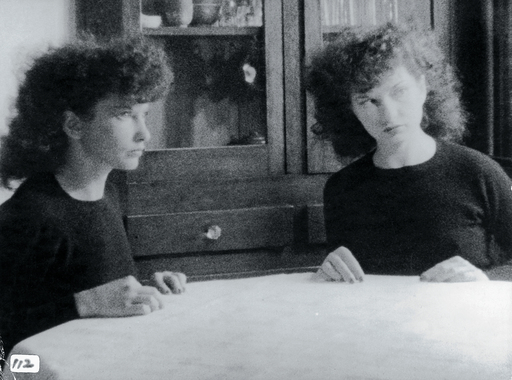
Although I'm not sure how well my first example today, early American experimental filmmaker Maya Deren, fits this category. She's certainly obscure/niche, and a miniaturist in the sense that she only made short films. But as a persona, Deren was too richly sensual to be “fey”; a sensual intellectual. Her first and best-known film, Meshes of the Afternoon, reveals her deep entanglement in what even now, in our “metrosexual era,” can only be called a specifically female narcissism: not mere physical vanity but dreamy psychological self-absorption.

Deren eerily reproduces herself in this film in a way that distinctly reminds me of one of my favourite paintings, Memories, by the Symbolist Khnopff. 


A heavy, humid, hauntingly “maternal” atmosphere hangs over Khnopff's painting, as it does over Deren's film. Deren herself, with that abundant curly hair, seems physically as well as psychologically in the same Pre-Raphaelite mode as Khnopff's model (his sister, if I recall from Sexual Personae) and the most famous example, Rossetti's late Muse, Jane Morris.


I'm hardly the only blogger to think in terms of “sexual personae,” and others have noted Deren's similarity to another British icon, both physically and as an artist: Kate Bush.


Certainly, Bush has that same sensual/intellectual combination, and her lyrics frequently obliquely explore a certain freaky, convoluted female sexual psychology in which narcissism plays a large role, as in the rather terrifying “Get Out of My House,” in which male sexuality is figured as a kind of invasive poltergeist (and, oh yeah, an abject donkey). Bush, whose lyrics often align sexuality with occult powers (think of the Cathy-ghost in “Wuthering Heights,” where it's male sexuality that's shunning and cold), also likes to take on the role of “witch,” perhaps as a metaphor for demonized femininity; another point in common with Deren, who became fascinated with Haitian Vodoun, to which she was introduced by dancer, choreographer, and dance anthropologist Katherine Dunham.

Deren, however, was not British, but an American of Jewish Eastern European origins (born in the Ukraine). On the evening I finally familiarized myself with Deren (after hearing about her for ages in connection with Lynch and especially Mulholland Dr.), I did a little dreamy, persona-based googling. (In the early 90s, Paglia recommended browsing library shelves to spark unexpected associations, which I'd already been doing as a teenager anyway; the internet facilitates this creative methodology to an exceptional degree.) Based on nothing more than their hair, their Jewishness, their limited output, and their cult status, I made a connection between Deren and American writer Jane Bowles, and was surprised (“spooked” might be a better word) when I googled their Wikipedia entries to learn that they were born in the same year, just a couple of months apart: Deren on April 29, 1917; Bowles on February 22, 1917.


Deren and Bowles had much more in common, too. They were both denizens of New York in their main period of artistic activity, the 1940s (did they ever meet?): in fact, just now I learned, on a closer look at the entries, that Bowles's only novel, Two Serious Ladies, was published in 1943, the same year that Deren made her first completed film (co-directed with her husband, Alexander Hammid), Meshes of the Afternoon. They were both drawn to the “exotic,” Deren travelling to Haiti, Bowles travelling with her husband to Mexico and Central America before settling with him in Tangier. Deren became infatuated with Voudon; Bowles with the Berber woman Cherifa.

It seems to be a “thing” for female cult artists to develop strange myths surrounding their lives and deaths. Anyway, it certainly happened to Deren and Bowles. The documentary In the Mirror of Maya Deren gives an account, mainly from a seemingly 60s-addled commentator, of the rumours that Deren's early death (at 44) was related to her dabbling in Voudon. Commentators who knew her towards the end also suggest that it was due to her vast, volatile creative energy, responsible for many stormy rages, which had turned poisonous due to her frustration at not getting enough funding to continue making the films she wanted to. (Among the official reasons given was malnutrition.)

Bowles also died young, at 58, in a sanitorium in Spain. She may have outlived Deren, but only to suffer, since in 1957 (four years before Deren's death), she had a stroke (official reason: alcohol) that severely incapacitated her to the end of her life. In the hotbed of expatriate gossip and rumour in Tangier, however, the story spread that her declining health was due to Cherifa's native witchcraft – also supposedly responsible for Bowles's obsession with the woman. Throughout her life, many who knew her (and her fans in her lifetime included John Ashbery, Truman Capote, Tennessee Williams, and Christopher Isherwood, who supposedly based Sally Bowles on her in part) believed that her to some charismatic, to others (notably an unimpressed Gore Vidal) insufferably neurotic personality was the result of her thwarted creativity, a life of extended, tormented writer's block.

That Voodoo That You Do So Well

Deren's Eastern European and Greenwich Village connections (and the hair, again!) wafted me along to my next association: the heroines of producer Val Lewton's 1940s B-horror/noirs, especially Simone Simon in Cat People (1942, directed by Jacques Tourneur) and the iconic Jean Brooks (of the Pulp Fiction hair) in The Seventh Victim (1943, directed by Mark Robson).


Lewton, also of Jewish Ukrainian origins, was a pulp fiction writer who found his metier making classy horror films on a low budget for RKO. In Cat People, French Simon plays Irena Dubrovna, from Serbia. (In a Hollywood film, the French are “exotic” enough for anything, and one Eastern European country as good as another.) Irena is trying to Americanize (by pathologically attaching herself to bland all-American boy Oliver Reed, played by Kent Smith, every bit as wooden as he sounds), and get away from a past that includes idol-worship, witchcraft... and the ability to turn into a panther. The “horror” of the film is female sexuality: Irena appears frigid (returning us to the terrain of “Get Out of My House”), but her “panther self” seems a metaphor for the voracious female sexual appetite, which she's afraid to unleash. There's a distinct thematic connection to Dreyer's great melodrama about witchcraft, Day of Wrath (1943 again!), in which female sexuality turns out to have the power to telepathically kill.

(Yet Dreyer, like Lewton, stays on its side.)

The Seventh Victim, set in Greenwich Village, deals openly with the topic of suicide: the heroine, Jacqueline, is a decadent sensation-seeker who can't decide if she wants death as the final sensation or if she's just world-weary; but she's as terrified of it as she is drawn to it. She gets mixed up with a Satanic cult who want to force her to die, and tries to get away from it. (Doh! Just realized that this was the main source for a one-woman theatre piece I wrote and performed in which I played two women who might be one woman with a split personality: one is convinced that a sinister cult wants to put her in a snuff film; the other is trying to persuade her filmmaker-boyfriend to make one in which she stars. My favourite line from it, towards the end, was: “I want them to say, 'She only did it for the attention.'”) In the end, however, she goes back to her Village apartment and hangs herself. The whole thing eerily anticipates the Manson murders and their connection (through director Polanski, husband of victim Sharon Tate) with Rosemary's Baby.

Lewton also produced an RKO film... about Voudon. I Walked With a Zombie (1943) is set on the Caribbean Island of Saint Sebastian (probably because Lewton, or someone involved, liked the decadent reference to the homoerotic imagery of the suffering saint; here, however, put in service of representing the legacy of African slavery). The film also draws on the actual Voudon origins of North America's favourite millennial monster, and features a “gone native” female doctor who believes she can be possessed by a Voudon god and deliver curses, as Deren apparently did.

Recent shout-outs to Deren in a variety of media include the video for Janelle Monae's “Tightrope” (2010), set in an imaginary asylum for artists in which, a bit of text informs us at the start, “Dancing has long been forbidden for its subversive effects on the residents and its tendency to lead to illegal magical practices,” and Bruce LaBruce's queer zombie movie, Otto; or, Up with Dead People (2008), where the filmmaker-within-the-film Medea Yarn is obviously loosely modelled on Deren.

Fragments of Bowles and Deren

Janelle Monae also has some of that Bride of Frankensteinesque Bowlesian hair (and androgyny) going on:


The cover of her debut album, The ArchAndroid, however, seems to draw specifically on the cover of Sexual Personae, which no doubt Monae has read, since it includes Paglia's android-Bowie/Nefertiti comparison. For Paglia, the head-heavy Nefertiti represents a new, nature-rejecting image of woman as aspiring, soaring intellect; for Monae, claiming this right for women seems to mean embracing an android persona that (although, ironically, object-like) repels attempts to turn her into a sex object.


During a long period (between 15, when I read Millicent Dillon's biography, and 23 or so) when I was rather obsessed with Jane Bowles, I found still other correspondences, such as Katharine Hepburn in Bringing Up Baby (obviously an alien, especially in the bar scene where she's wearing that extraordinary metallic dress with the bits of ribbon floating around her face like translucent antennae) and Jennifer Jones in Love Letters


Jones has no association with witchcraft that I know of, but the two films in which she starred that were directed by William Dieterle, Letters and Portrait of Jennie, have an eerie, Gothic/Expressionist feel suited to Jones's fey, earthy/ethereal, high-strung, almost somnambulistically narcissistic persona as nothing ever would be again. In Portrait of Jennie, she plays a ghost who ages in quantum leaps, and gives the most convincing portrayal by an adult actress of a child I've ever seen. In Love Letters (with a screenplay by... wait for it... AYN RAND), she's, basically, a Platonic Idea, who can't psychologically negotiate the reality of her own or male sexuality, despite being as avidly, felinely sensual as ever. I suspect that Hitchcock took notes for Vertigo watching Portrait of Jennie and for Marnie watching Love Letters. The critic David Thomson, who's usually grievously wrong about everything, was almost right when he said that Jones would have been suited to play James's Isabel Archer; if he'd said Milly Theale, I would have forgiven him everything.


More Tragi-Farcical Courtship Rituals

The last play I ever had produced was called Non Sequitur, about the marriage of Jane and Paul Bowles, which I subtitled “A Screwball Comedy with Consequences” because I couldn't figure out how to focus it until I made the Bringing Up Baby connection. (I also had in mind Paglia on As You Like It in Sexual Personae.) The first act was produced at the 1999 Toronto Fringe Festival, and NOW magazine made it a top pick; it was self-contained enough that no one noticed the second act missing. The play focused, scene by scene, on various more or less malicious games the couple played to negotiate their complex relationship, and my own favourite, which recurred as a motif, was the one in which Paul pretended to be a parrot that Jane would have to send to his cage when, due to her coaxing, he got out of control (or in others words, got his queer on and “freaked out” – an idea brilliantly, bravely realized by straight actor Ross McMillan in the workshop production; Ross also played a note-perfect Orton in the original production of Live With It). The wonderful poster (sadly, no longer up on the internet) for the Toronto production seized on this image, portraying a tiny Paul brooding (Cary Grant Thinker style) in a bird cage, on which Jane leans languidly – sort of like I Dream of Jeannie with a gender role reversal. I thought it was a great image, but for many years I was in deep denial that I had really portrayed such an overpowering woman, when I thought I was portraying my idea of an equal marriage (except for the part where Paul is forced to put Jane in her cage – the asylum – at the end).

Nevertheless when the actress who played Jane in the Toronto production, Sarah Neville, repeated to me with worry a critic's opinion that she was “too relentless” as Jane, I reassured her, “It's Jane Bowles. That's not possible.”

Shirley MacLaine, Preying Ingenue

A sort of postscript: the freakiest, feyest performance I've ever seen a woman give is the young Shirley MacLaine in Tashlin's Dean Martin and Jerry Lewis vehicle, Artists and Models, which may still be the queerest movie ever made, harnessing all of the gender-bending potential of the Martin and Lewis partnership in the service of a bisexual utopic subtext. In all other Martin and Lewis films (generally regarded as vastly inferior), Lewis is the queerest object on display, a homely Boylita who, for 50s (straight) America, was secretly the ultimate twink to an even greater degree than Justin Bieber is now, to judge from the surprising fact that he, not Martin, is the sex object of the films. But here the genuine ingenue MacLaine beats eternal ingenue Lewis at his own game by being, as I recall Mark Simpson and I observed together in a discussion of this, a better boy than he is, providing a rare example of the androgynous (though voluptuous) girl being more charismatic than the androgynous boy. And when she serenades him on a staircase by bellowing “My Innamorta” at him as he tries frantically to get away, she's like some kind of contortionist stick-insect, and textually, he's an adolescent boy scared of the faster-maturing adolescent girl, while, subtextually, he's a queer man fleeing the female preying mantis who's trying to devour him because he's asking for it by being such a tasty little morsel. (If there's any difference. Lewis would, of course, perfect this persona and scenario in his masterpiece, The Ladies Man. But more on that in a later post.) But they're reverse mirror images of each other, and their bizarre courtship ritual is, of course, symbolic of heterosexual relations even into adulthood, according to some analyses. Which is what makes male homosexuality a continuity with male heterosexuality. 


MacLaine isn't exactly a witch, but her freaky-kooky persona at this early stage of her career lets you see where the later, New Age advocate MacLaine came from, and almost makes up for it.